
Remember how Jerry Maguire typed out a ‘Mission Statement’ in the middle of the night just because he couldn’t sleep because of bad pizza or an epiphany. He makes a case against commercialisation of sport, loses his job and has nothing to hold on to but just his ideals.
Cameron Crowe was lucky to embark upon a rather simple issue there. Replace Sports with Education. Add the extremely flammable issue of reservation. Then, caste politics, players and parties affected. This is India. Throw a stone in the air here and it will hit and hurt at least one person. How do you make a film that is treading into a territory rigged with land mines?
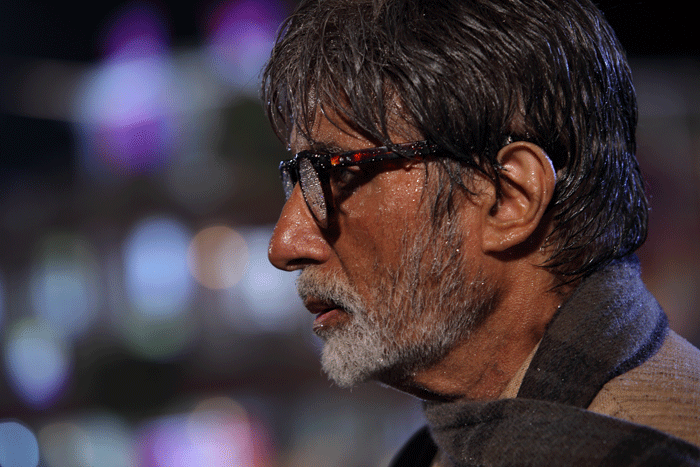
Writers Prakash Jha and Anjum Rajabali set up the debate through the key players in a private university called Shakuntala Thakral Mahavishvavidyalaya (STM). It’s managed by an idealistic disciplinarian Anand Prabhakar (Amitabh Bachchan may just win every Best Actor award for this role next year) unwilling to compromise on his principles, no matter how much pressure there is from the rich trustees of the college. He teaches underprivileged students irrespective of their caste free of cost at home and considers deserving cases for admission on the basis of economic background than caste.
It’s a nice touch that the poor University clerk’s son is not a Dalit but a Pandit and it is a Dalit (Saif Ali Khan is convincing as Deepak Kumar) who happens to be the University topper. Anand’s daughter Poorbi (Deepika Padukone, surprisingly effective) represents the love and friendship between the hardworking Deepak and the carefree rich upper caste kid Sushanth (Prateik Babbar in a career worst).
The ‘Us versus Them’ divide surfaces with the Supreme Court’s judgement on reservation as opportunists (led by the Vice Principal Mithilesh played by Manoj Bajpai) turn friends into enemies. The film then becomes a platform of heated debate between Deepak and Sushanth.
For Deepak, his identity is a sensitive issue. As he says, it’s a story that dates back thousands of years and reminded to him every single day. He has reached the top through sheer hard work fighting the odds. He is pro-reservation.
When Sushanth realises that he will not get admission in a government college to do the mass communication course he wanted to do because of the quota system, he’s bitter. He is anti-reservation.
“Earn it through hard work,” is Sushanth’s first argument. Deepak reminds him of the hard work and service his people have done over centuries.
“You people are too scared to compete,” Sushanth responds. Deepak tells him there have been no avenues open to them to compete.
“Why don’t you earn it through merit,” asks Sushanth. Deepak tells him they would love to but… “In a race, the starting line should be the same. If started from the same place we did, it would have been a fair race.”
When the Principal pulls them up both for indulging in politics inside the campus, Deepak wants him to make his stand clear. “You are either with us or against us,” he says. Deepak suspects that the Principal is helping the underprivileged as charity. He does not want charity.
The Principal represents the conscientious Indian teacher. To him, all students are equal. He would leave politics out of it and stick to teaching. Yet, he is forced to take a stand by every other character in the film, including his own wife. Even then, there’s a fine sense of balance. While the father (head of system) says personally he does not see anything wrong about the Supreme Court judgement, the mother of the home (Tanvi Azmi) says that any law that plays with the future of children is bad.
That comment straight from the heart, coming without even a wee bit of political intent, becomes what the Mission Statement was to Jerry Maguire. Sticking to his ideals, Anand prefers to quit than continue as a party to the dirty politics only to find that there is no escaping it. Now, here’s where Jerry Maguire becomes a Rajnikanth film (Annamalai, Baasha, Padayappa or Sivaji) in Aarakshan as the protagonist goes from zero to hero, fills the film with unbelievably fairytale idealism, manufactures instant change of hearts and mobilizes thousands, only not as fast as it happens in a Rajnikant film.
This is the portion of the film that is grossly misread by many critics. Political cinema or any mass communication of political nature needs to be studied keeping in mind historical context, representation, technology and social relations. Yes, I remember my political communication lectures.
1. Historical context demands you get to the root of the issue and study solutions employed in the past and modern day application. How did Gandhi address the divide? He worked with them, practiced pluralism and inclusion, leading by example. Anand Prabhakar does exactly the same, and Prakash Jha, unlike a more mainstream director like Hirani, doesn’t see the reason to brand it ‘Gandhigiri’ or have Gandhi talk down to the masses. He creates a modern day Gandhi (he says he does not believe in non violence and he responds to all insults by focusing on what needs to be done, choosing to respond in action and deed than preachy diatribe like Munnabhai would). These very critics who want subtlety here had no such problems with Munnabhai because it was entertaining.
2. Representation is not about looking at whether a character has bad hair dye or a big nose or if they are drinking red wine, these are cosmetic issues (which are certainly relevant if the film needs to be rated for technical flair alone). Sometimes men play women in street theatre. Sometimes they don’t even have the props they need to tell the story and it is possible that they are not always the best of actors. A bourgeois art critic may just be amused by this depiction and dismiss it as amateur without considering the purpose and the relevance of it to their lives. What needs to be checked in representation, the key issue in political cinema, is the basics of balance. Are all parties represented, if yes… How? So are all the rich upper caste folk drinking wine like villains? The three villains are representatives of Commerce (the Vice Principal Mithilesh who expressly says that education is a business), Politics (the Minister played by Saurabh Shukla and later, we learn the leader of Dalits is a petty politician himself – exactly the reason the film didn’t go down well with Punia, who objected to the release of the film) and power hungry Educationists (one of the Trustees of the college). Are all educationists bad? Not really, among the upper caste are also the protagonist himself (who does not hesitate to write a cheque or stand guarantee to help the poor) and the other Trustee played by Darshan Jariwala who offers his house for teaching.
Just because a film goes away from discussing reservation, it does not mean that the film has forgotten the issue. The ideology is very clear. The first step towards addressing the complex issue of reservation is to convince those affected that the head of the system is all for inclusion, he sees every student as the same and recognises that some students need more attention than the others and that every student who cannot afford education needs to be helped out. This is exactly how you get to the root of the issue. The issue thrives on discrimination. The film gets right to that and makes sure that the protagonist never discriminates and yet addresses the issues and forces that brought reservation and quota into play – the lack of avenues for education, lack of supplementary/remedial education for the downtrodden. How is talking about inclusion going away from discussing reservation? It is going deeper into the subject. The points of the debate were made in the first half of the film. Now, in the second half, the film was working at solutions, yet failing where Hirani succeeded – in appealing to the urban bourgeois because of its tacky execution, a shame given the scale and the budget of the film, something street theatre never has access to.
3. That brings us to the issue of technology itself. Cinema as a technology used for this communication has become bloody expensive and is governed by forces of its own. The plague of star system, the hyper-sensitive political groups, social climate and the economics of marketing a film when there are more films made and few channels of distribution open to reach a mass. Technology determines the content and it cannot be ignored while studying political communication.
4. Social Relations. The issue still evokes polarized reactions in society, caste system still prevalent, even among the educated urban elite whose sensibilities may have changed but biases continue. With globalization, they may have embraced high art and developed condescension towards anything downmarket unless it is to appear cool enough to be seen loving the Singhams and the Dabanngs or Robots. There is a hidden condescension in that too but that’s a different story. Which part of the social equation does the film address? Education.
Due credit must be given to the makers for reminding us that, reservation or no reservation, it is the duty of every teacher to empower the underprivileged, irrespective of caste, whether it’s inside a classroom or a cow shed. Forget caste, think economic strata. Education is a great leveller. When you provide quality education, the rich will have no choice but to sit with the poor.
The point is made when a rich father asks if the teacher can conduct private tuitions separately for the rich. “You know, they don’t bathe. They stink,” he says, rather stupidly only to be sternly told by the protagonist, the biggest superstar of the nation, “It’s your thought that stinks.”
Despite the sloppy second half that is long-winded and idealistic, Aarakshan deserves to be watched for it advocates inclusion as a solution to the issue of reservation. It’s a complex truth that needs to be examined by the easily provoked who need to be shown that not every leader representing the minority is actually looking out for them. Case in point, the objections raised to this film by Punia who selectively quoted some of the anti-Dalit dialogues without acknowledging the powerful responses given by the protagonist of the film. Some times, bad leaders make all activism look silly.
As the villain of this film ironically sums activism: “Azaadi hai. Jo chahe nautanki kar le.” (There’s freedom. Anyone can do any drama.)
Like Anurag Kashyap told Punia during a recent debate on TV, if I want to address the issue/reality that Dalits are not allowed to enter a temple in Orissa, the first person to object would be the head of SC/ST board. Why would then anyone be brave enough to tread into that territory.
By objecting to Aarakshan and raking up a controversy where it was not needed, Punia has turned this film completely meta. The film has become the stand and the answer to the question raised by the likes of Punia – If you are not with us, you are against us.
It needs to be seen so that people know that system is not anti-Dalit. In fact, the truth is that an upper caste filmmaker made a film whose heart beats for the Dalit as much as it does for every poor student who cannot afford education.
Before I have more art critics pouncing on me approximating Aarakshan to Madhur Bhandarkar (whose films have no depth or balance from the socio-political perspective. Yes, Jha who is described as ‘Madhur Bhandarkar with a JNU background’ with his understanding of political communication is any day better than a multiplex-audience seeking sensation who exploits stereotypes. Jha employs archetypes to make his point and advocate solutions through mass media. Jha’s caricatures reveal more about reality than Bhandarkar’s pseudo-realistic portrayals) or B-grade films depicting rape (exploitation films dishing out sex and violence) because of the inherent cheese and tackiness quotient in Aarakshan, let me clarify two points.
1. Not all cinema is high art or even good art. Social films by design need to simple not to because people are stupid but because our politicians/ people representing groups are capable of twisting the most innocuous representations for political gain – do look at the number of victims of caste instigated violence and self-immolations that are related to the issue.
2. Debate/Social commentary is not always good cinema, some of them are obnoxious enough to keep running their public service messages on a loop. Yet, we need our cinema to address social issues in a way that they reach the mass simply because cinema’s role as mass media as a tool for change has been grossly underutilized. How many set out to make a Mother India today? The economics and business of cinema has changed phenomenally from the days of Mother India. With the amount of marketing spends needed to reach out to a mass, stars are a necessary evil.
Aarakshan is not great or even good cinema, but there’s no denying that it is a balanced social debate in mass media, not bad at all given all that it achieves through representation. Also, with Bachchan at the centre delivering one of the best roles of his career, Aarakshan despite all its other failings merits a watch. Not because it’s the best in the genre. Because not many make films in this genre. Films close to the real heartland of India. Our cynical urban upbringing has taken us far away from the charms of street theatre and social films. Sadly, this curious hybrid spawned by a big budget is all we get these days.
Genre: Drama
Directed by: Prakash Jha
Cast: Amitabh Bachchan, Saif Ali Khan, Manoj Bajpayee, Deepika Padukone, Prateik Babbar
Storyline: A principled Principal gets sucked into a political debate he does not want to entertain & gets his focus back
Bottomline: A brilliant socio-political debate halfway becomes a Rajnikant film without Rajnikant
 MADRAS INK.