• SUDA MING’S CHANNEL
  • TALKING FILMS
  • Good Night | Good Morning
  • My Talk Show
  • PROFILE

MADRAS INK.

Menu

  • Archives
  • Columns
  • Diary
  • Interviews
  • My Films
  • Reviews
  • Good Night | Good Morning

  • Word thru the bird

    Tweets by SudhishKamath
  • Connect with GNGM

    Connect with GNGM
  • About GNGM

    Reviews

    “A cerebral joyride”
    Karan Johar, filmmaker on REDIFF

    “Among the most charming and creative Indian independent films”
    J Hurtado, TWITCH

    ★★★★✩
    “You don’t really need a big star cast… you don’t even need a big budget to get the techniques of filmmaking bang on…”
    Allen O Brien, TIMES OF INDIA

    ★★★★✩
    “An outstanding experience that doesn’t come by too often out of Indian cinema!”
    Shakti Salgaokar, DNA

    ★★★
    “This film can reach out the young, urban, upwardly mobile, but lonely, disconnected souls living anywhere in the world, not just India.”
    Namrata Joshi, OUTLOOK

    “I was blown away!”
    Aseem Chhabra, MUMBAI MIRROR

    “Good Night Good Morning is brilliant!”
    Rohit Vats, IBN-LIVE

    ★★★✩✩
    “Watch it because it’s a smart film.”
    Shubha Shetty Saha, MIDDAY

    ★★★✩✩
    “A small gem of a movie.”
    Sonia Chopra, SIFY

    ★★★✩✩
    “A charming flirtation to watch.”
    Shalini Langer, INDIAN EXPRESS

    “Interesting, intelligent & innovative”
    Pragya Tiwari, TEHELKA

    “Beyond good. Original, engrossing and entertaining”
    Roshni Mulchandani, BOLLYSPICE

    * * * * *
    Synopsis

    ‘Good Night Good Morning’ is a black and white, split-screen, conversation film about two strangers sharing an all-night phone call on New Year's night.

    Writer-Director Sudhish Kamath attempts to discover good old-fashioned romance in a technology-driven mobile world as the boy Turiya, driving from New York to Philadelphia with buddies, calls the enigmatic girl staying alone in her hotel room, after a brief encounter at the bar earlier in the night.

    The boy has his baggage of an eight-year-old failed relationship and the girl has her own demons to fight. Scarred by unpleasant memories, she prefers to travel on New Year's Eve.

    Anonymity could be comforting and such a situation could lead to an almost romance as two strangers go through the eight stages of a relationship – The Icebreaker, The Honeymoon, The Reality Check, The Break-up, The Patch-up, The Confiding, The Great Friendship, The Killing Confusion - all over one phone conversation.

    As they get closer to each other over the phone, they find themselves miles apart geographically when the film ends and it is time for her to board her flight. Will they just let it be a night they would cherish for the rest of their lives or do they want more?

    Good Night | Good Morning, starring Manu Narayan (Bombay Dreams, The Love Guru, Quarter Life Crisis) and Seema Rahmani (Loins of Punjab, Sins and Missed Call) also features New York based theatre actor Vasanth Santosham (Bhopal: A Prayer for Rain), screenwriter and film critic Raja Sen and adman Abhishek D Shah.

    Shot in black and white as a tribute to the era of talkies of the fifties, the film set to a jazzy score by musicians from UK (Jazz composer Ray Guntrip and singer Tina May collaborated for the song ‘Out of the Blue), the US (Manu Narayan and his creative partner Radovan scored two songs for the film – All That’s Beautiful Must Die and Fire while Gregory Generet provided his versions of two popular jazz standards – Once You’ve Been In Love and Moon Dance) and India (Sudeep and Jerry came up with a new live version of Strangers in the Night) was met with rave reviews from leading film critics.

    The film was released under the PVR Director’s Rare banner on January 20, 2012.

    Festivals & Screenings

    Mumbai Film Festival (MAMI), Mumbai 2010 World Premiere
    South Asian Intl Film Festival, New York, 2010 Intl Premiere
    Goa Film Alliance-IFFI, Goa, 2010 Spl Screening
    Chennai Intl Film Festival, Chennai, 2010 Official Selection
    Habitat Film Festival, New Delhi, 2011 Official Selection
    Transilvania Intl Film Festival, Cluj, 2011 Official Selection, 3.97/5 Audience Barometer
    International Film Festival, Delhi, 2011 Official Selection
    Noordelijk Film Festival, Netherlands, 2011 Official Selection, 7.11/10 Audience Barometer
    Mumbai Film Mart, Mumbai 2011, Market Screening
    Film Bazaar, IFFI-Goa, 2011, Market Screening
    Saarang Film Festival, IIT-Madras, 2012, Official Selection, 7.7/10 Audience Barometer

    Theatrical Release, January 20, 2012 through PVR

    Mumbai
    Delhi
    Gurgaon
    Ahmedabad
    Bangalore
    Chennai
    Hyderabad (January 27)

    * * * * *

    More information: IMDB | Facebook | Youtube | Wikipedia | Website

  • Browse: Categories

  • November 2012
    M T W T F S S
     1234
    567891011
    12131415161718
    19202122232425
    2627282930  
    « Sep   Dec »
  • Recent Posts

    • Simmba: A departure from the formula
    • Zero: The hero who wasn’t
    • Protected: AndhaDhun: What did that end mean?
    • Love and other cliches
    • October: Where is Dan?

Archive For November, 2012

Guest Post: Yash Chopra – On the fringes of art

November 16, 2012 · by sudhishkamath

– Rakesh Katarey     

What art is and how a work qualifies its creator to be an artist, have long been central to any discourse on art. Any serious retrospective on the body of work left behind by Yash Chopra will have to consider this sublime puzzle.
It is expected of artists – intrepid and avant garde as they are – to use the canvas to represent and reflect ideologically on life and experience and confront our inconvenient truths. Was Yash Chopra an artist enough whose works did so? Was he able to achieve through his modern idiom half of what the peerless K. Asif achieved in his historicals?
It is not easy to conclude if Yash Chopra will ever make the list of India’s best filmmakers, given the parameters being laid out here. But progressive he was, and yet, breathed his last on the fringes of art, hesitant as he always was to tar his canvas in black. Something his brother B.R.Chopra did with far greater conviction and honesty.
While younger directors like Imtiaz Ali and Zoya Akhtar have brought to bear their convictions upon their films in dealing with the complexities of relationships in a matter-of-fact manner, Yash Chopra spent years sorting triangles, battling the one conflict that seems to dog almost his entire body of work.
Filmmakers play out the dialectics of mind and experience, the contrasts of the utopias and the dystopias to draw cinema out of life. They subvert the status quo through their events and characters. But Yash Chopra could only watch convention destroy the lives of his characters in being a passive spectator as if his job were to only point out how unfair it all was, but do nothing about it. Perhaps he was too gentle to become an artist confronting ugly truths. His advice to Mahesh Bhatt to refrain from projecting harsher aspects of life and spare his films the dosage is therefore instructive.
He possibly modelled his characters on the lives of his near and dear ones and, of course, on his own. But in trying to be fair to his characters and therefore to himself, he curbed and compromised their natural propensities. Since he had chosen one of its roles to play himself – or many – he failed to be objective and built excuses to explain the helplessness of his characters in dealing with the inconvenient truths of their relationships. He defended their vacillations in the name of fate and chance. And life in all his films would invariably degenerate in the second half into a sum of divine accidents, not a result of interconnected ideological conflicts beginning in the first half.
In Kabhi Kabhie, an ageing Amitabh smoulders on the virtues of silence and sacrifice to please their elders than assert his love, a regressive sentiment celebrated for decades thereafter. In fact, Yash Chopra spawned an entire generation of film makers who felt life was ‘all about loving your parents’(KKKG) or taking their permission and suffer their irrationalities than elope (DDLJ). It allowed parent pleasers to don the masks of sacrifice – as inTrishul -to hide their betrayal of their true love and gutless surrender to tradition.
In that sense, his characters – although rebellious enough to fall in love – are fettered by him and have had to suffer rather than stand and fight. They’ll have to settle for happiness only when allowed to.
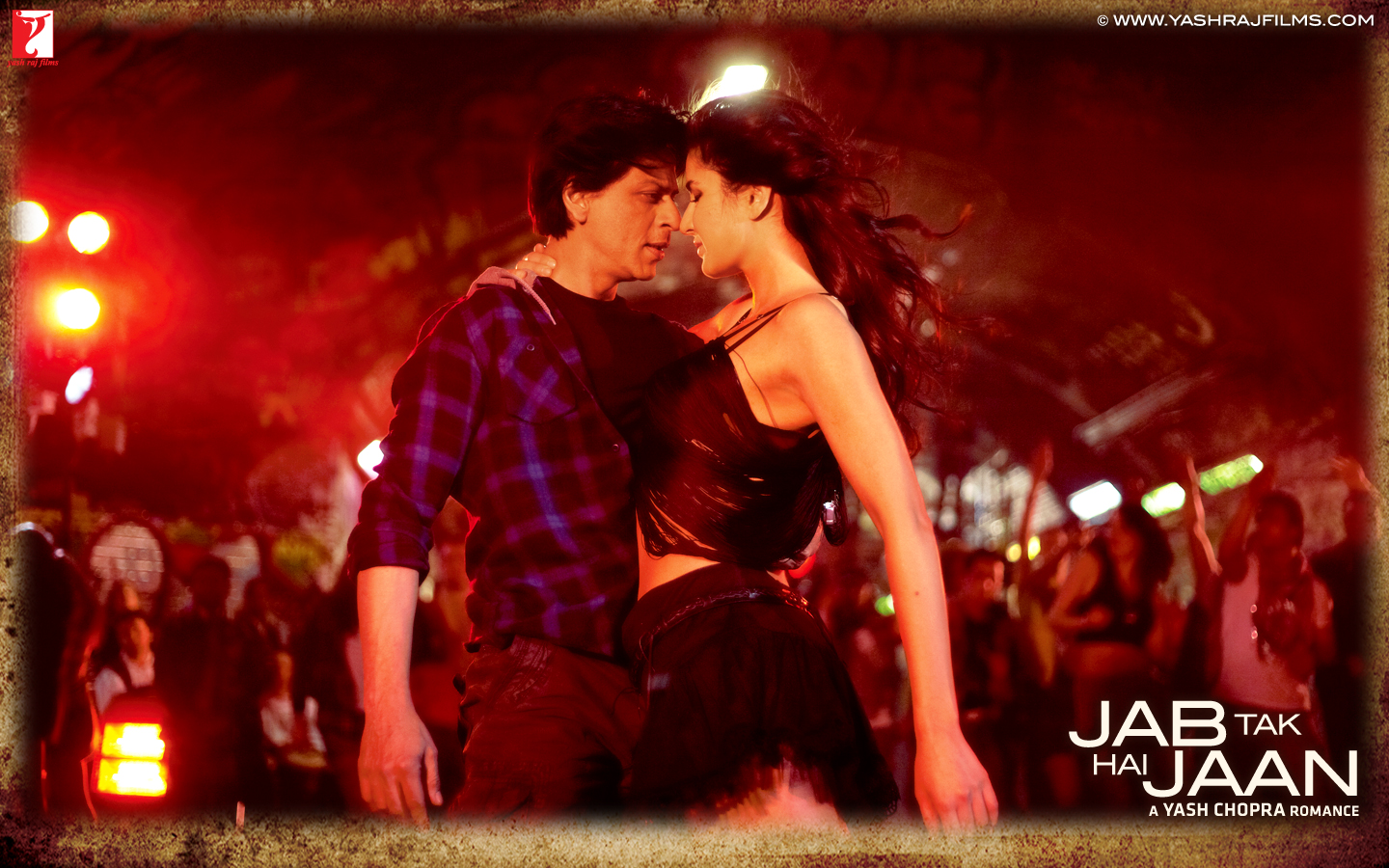
In JTHJ, the director has done worse. He has fiddled out a story that has no conflict! Only his inconsequential triangles stay. The first half is a breeze as Katrina transforms from a dainty of the castles into a galli ki goondi. As they set the screen on fire together, Shah Rukh is the agent of change holding a mirror to Katrina’s inner self and tutoring her on the virtues of modernism over her deal-making devotion.  For a while, she seems truly transformed. Yet when the push comes to the shove she regresses into the morals of faith and kills the only possible seed of conflict. And the director doesn’t seem to mind! He seems more interested in setting up events that can somehow bring the two together! The promise of a grand rebellion over nothing is soon exposed and the film goes into an eternal yawn after the intermission. So of what consequence was her transformation to the narrative? As usual, the thespian’s characters are quite simply out of depth with the times. All he takes are Ray Ban’s, Guccis and a few sundry accidents to get the film to cross the tape.
From Kabhi Kabhi to Trishul to JTHJ, Yash Chopra seem to only drawn the scars of lakshman rekhas rather than become the saboteur of convention he is made out to be. Yes, his cinema was progressive enough to have crossed the borderlines of lies we live out. But his celluloid shrinks at the very sight of standing by the truths that subvert the status quo.  And that diminishes his claims over being an artist.
(Rakesh Katarey heads NITTE Institute of Communication, Mangalore)
  • Create a free website or blog at WordPress.com.
Privacy & Cookies: This site uses cookies. By continuing to use this website, you agree to their use.
To find out more, including how to control cookies, see here: Cookie Policy
  • Subscribe Subscribed
    • MADRAS INK.
    • Join 483 other subscribers
    • Already have a WordPress.com account? Log in now.
    • MADRAS INK.
    • Subscribe Subscribed
    • Sign up
    • Log in
    • Report this content
    • View site in Reader
    • Manage subscriptions
    • Collapse this bar
 

Loading Comments...