
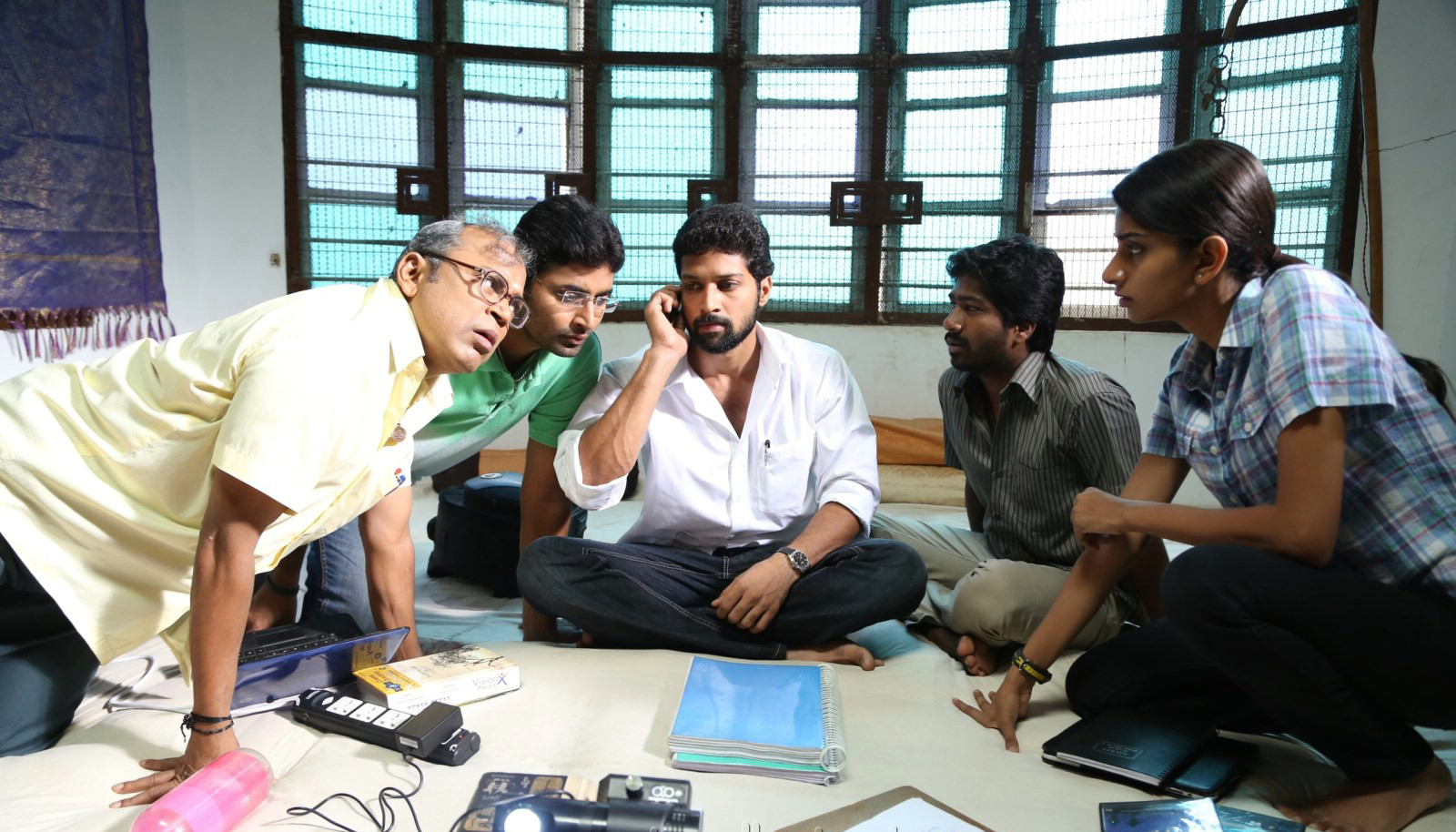
As much as I want to appreciate the “different” approach, I was a little let down. Maybe because of all the generous praise from the younger bunch of filmmakers. Maybe they felt the need to return the compliments this film gives them.
I have multiple issues with R.Parthiepan’s film though I didn’t mind it at all and was quite entertained for half its running time. It also had quite a few endearing moments and I was tickled by the wordplay and wit too. Since many have already dwelt on these positive aspects, I think I should talk a little more about the critical aspects of this film that’s both good and bad (50:50 to use the director’s yardstick.)
One, while I have full respect for the senior writer-director’s ambitions of doing something truly different, he is probably attributing way too much importance for being different, as if a different story or making a film with no story is a great idea that deserves applause.
It’s a nice gimmick no doubt but the premise of a bunch of people trying to make a movie is not all that uncommon. Most student films, in pretty much every film school or class anywhere in the world, are about the angst of trying to make a film. It’s a thought that almost every filmmaker has either crossed out or pursued deeper right at the beginning of their career. It’s how deeper you go into this premise that gives the film depth, meaning and perspective. While this gave me an insight into the thinking process of the average Tamil filmmaker, I was quite surprised by the randomness in the script discussion sessions. No method, no structure, no progression from thought to idea to plot to story to script to film. Just random brainstorming that makes screenwriting seem like the bit of improvisation we used to do back at school culturals in the 20 minutes of prep time we got before Ad Zap. Yes, while I am aware that maybe 80-90 per cent of films are still written this way, I certainly do not expect a film about the script to be so grossly unaware of the basics.
The filmmaker assumes or wants us to believe it has no story or script. Because he wants us to think that people making a film is not a story. I may have even bought this if there was no conflict at all. But every character has a conflict. The team has a conflict. The protagonist has a conflict. And conflicts are stories. There can be a story without a beginning or an ending but the conflict is THE meat – the quintessential and most important qualifying part of any story. If they are claiming there is no story there, they are either ignorant or lying. Both are equally disturbing.
While there are a lot of witty insider observations about the film business itself that provide us with a few laughs, the meta-narrative here is gimmicky because it is not true to form. It randomly introduces us to heavy duty drama and twists for the sake of engagement and is a little too full of self-pity. Yes, we all know about the big bad world of showbiz where luck, opportunity and stardom overrides talent, ambition and integrity but making films (that too for a market) is not really the noblest thing in the world. Nor must we feel sorry for all those who don’t make it.
Which is one of the reasons I loved Jigarthanda that had zero self-pity for its protagonist even if it seemed autobiographical. Writer-director Karthik Subbaraj was able to be objective and unemotional about his protagonist and showed the filmmaker as the opportunistic asshole who uses his uncle, friend, girl, gangster and finally the power and clout of a successful filmmaker to get what he wants – at any cost. Because we artists are like that. We are selfish. We don’t need pity. Because we would do anything to do what we really want to do. We are not going to wait for miracles.
Parthipan, however, is a little old school. He wants us to appreciate his filmmaker hero’s desire to do something different as if it’s the noblest thing in the world. He wants to feel bad that he is denied a chance in bringing change to the world. He wants to wait for the producer’s call and thinks it is poignant.
It is not. Welcome to independent filmmaking and digital technology.
Besides, Kathai Thiraikathai Vasanam Iyakkam can only go two ways and that’s not really an open ending. Having an open ending is a little over-rated too because you can pretty much cut any story before the climax scene and it would seem poignant (Honest to God, I did this for Good Night Good Morning because the climax didn’t turn out all that well. So we just axed the whole thing and ended it with the call – it was the easiest thing to do).
Take the Ramayana. You can end the story wherever you want.
They build the bridge. The armies stand by for the battle. Fade to black. It becomes the story of two kings who went to war for a woman. It’s a setting the stage for sequel ending.
Ram defeats Ravan. Credits roll. Commercial ending.
Hero questions Sita’s purity. She takes the agni pariksha. Cut right at the flames. Abstract arthouse ending.
Sita kills herself and goes back to earth. Tragic ending.
This is not to undermine open endings in general. There are many great examples of open endings – from Citizen Kane to Lost in Translation to Mulholland Drive to Inception that make you wonder and ponder about what actually happened for years together. An open ending is not a multiple-choice question you give the audience. It’s a thesis you want them to write over years. A hypothesis. A hypothesis that will remain just that because nobody knows for sure. It’s an answer the filmmaker takes with him to the grave.
Here not only does the filmmaker water down his “open-ending” with an item, he also ends it with the biggest compromise – he has an ending too (As the credits finish rolling, we see the hero in the director’s seat).
How is this then a film without a story if it has characters, conflicts and even a clear resolution? (As a friend said, for a film without a story, go see Anjaan – where even holographic projections demonstrate reflex action when shot at, where characters cannot recognise a man without seeing a toothpick in his mouth!)
There was so much potential and promise here, given the years of experience Parthiepan has in showbiz.
Watch it anyway because it’s very generous of an old school filmmaker to try and be like the brave young filmmakers of today and also acknowledge it so openly.
Parthiepan Sir, young filmmakers today don’t need to wait for calls from UTV.
They go make their film, however short, irrespective of the outcome.
Because, there’s always Youtube for the hits. And Facebook to make sure people Like your film.
 MADRAS INK.