• SUDA MING’S CHANNEL
  • TALKING FILMS
  • Good Night | Good Morning
  • My Talk Show
  • PROFILE

MADRAS INK.

Menu

  • Archives
  • Columns
  • Diary
  • Interviews
  • My Films
  • Reviews
  • Good Night | Good Morning

  • Word thru the bird

    Tweets by SudhishKamath
  • Connect with GNGM

    Connect with GNGM
  • About GNGM

    Reviews

    “A cerebral joyride”
    Karan Johar, filmmaker on REDIFF

    “Among the most charming and creative Indian independent films”
    J Hurtado, TWITCH

    ★★★★✩
    “You don’t really need a big star cast… you don’t even need a big budget to get the techniques of filmmaking bang on…”
    Allen O Brien, TIMES OF INDIA

    ★★★★✩
    “An outstanding experience that doesn’t come by too often out of Indian cinema!”
    Shakti Salgaokar, DNA

    ★★★
    “This film can reach out the young, urban, upwardly mobile, but lonely, disconnected souls living anywhere in the world, not just India.”
    Namrata Joshi, OUTLOOK

    “I was blown away!”
    Aseem Chhabra, MUMBAI MIRROR

    “Good Night Good Morning is brilliant!”
    Rohit Vats, IBN-LIVE

    ★★★✩✩
    “Watch it because it’s a smart film.”
    Shubha Shetty Saha, MIDDAY

    ★★★✩✩
    “A small gem of a movie.”
    Sonia Chopra, SIFY

    ★★★✩✩
    “A charming flirtation to watch.”
    Shalini Langer, INDIAN EXPRESS

    “Interesting, intelligent & innovative”
    Pragya Tiwari, TEHELKA

    “Beyond good. Original, engrossing and entertaining”
    Roshni Mulchandani, BOLLYSPICE

    * * * * *
    Synopsis

    ‘Good Night Good Morning’ is a black and white, split-screen, conversation film about two strangers sharing an all-night phone call on New Year's night.

    Writer-Director Sudhish Kamath attempts to discover good old-fashioned romance in a technology-driven mobile world as the boy Turiya, driving from New York to Philadelphia with buddies, calls the enigmatic girl staying alone in her hotel room, after a brief encounter at the bar earlier in the night.

    The boy has his baggage of an eight-year-old failed relationship and the girl has her own demons to fight. Scarred by unpleasant memories, she prefers to travel on New Year's Eve.

    Anonymity could be comforting and such a situation could lead to an almost romance as two strangers go through the eight stages of a relationship – The Icebreaker, The Honeymoon, The Reality Check, The Break-up, The Patch-up, The Confiding, The Great Friendship, The Killing Confusion - all over one phone conversation.

    As they get closer to each other over the phone, they find themselves miles apart geographically when the film ends and it is time for her to board her flight. Will they just let it be a night they would cherish for the rest of their lives or do they want more?

    Good Night | Good Morning, starring Manu Narayan (Bombay Dreams, The Love Guru, Quarter Life Crisis) and Seema Rahmani (Loins of Punjab, Sins and Missed Call) also features New York based theatre actor Vasanth Santosham (Bhopal: A Prayer for Rain), screenwriter and film critic Raja Sen and adman Abhishek D Shah.

    Shot in black and white as a tribute to the era of talkies of the fifties, the film set to a jazzy score by musicians from UK (Jazz composer Ray Guntrip and singer Tina May collaborated for the song ‘Out of the Blue), the US (Manu Narayan and his creative partner Radovan scored two songs for the film – All That’s Beautiful Must Die and Fire while Gregory Generet provided his versions of two popular jazz standards – Once You’ve Been In Love and Moon Dance) and India (Sudeep and Jerry came up with a new live version of Strangers in the Night) was met with rave reviews from leading film critics.

    The film was released under the PVR Director’s Rare banner on January 20, 2012.

    Festivals & Screenings

    Mumbai Film Festival (MAMI), Mumbai 2010 World Premiere
    South Asian Intl Film Festival, New York, 2010 Intl Premiere
    Goa Film Alliance-IFFI, Goa, 2010 Spl Screening
    Chennai Intl Film Festival, Chennai, 2010 Official Selection
    Habitat Film Festival, New Delhi, 2011 Official Selection
    Transilvania Intl Film Festival, Cluj, 2011 Official Selection, 3.97/5 Audience Barometer
    International Film Festival, Delhi, 2011 Official Selection
    Noordelijk Film Festival, Netherlands, 2011 Official Selection, 7.11/10 Audience Barometer
    Mumbai Film Mart, Mumbai 2011, Market Screening
    Film Bazaar, IFFI-Goa, 2011, Market Screening
    Saarang Film Festival, IIT-Madras, 2012, Official Selection, 7.7/10 Audience Barometer

    Theatrical Release, January 20, 2012 through PVR

    Mumbai
    Delhi
    Gurgaon
    Ahmedabad
    Bangalore
    Chennai
    Hyderabad (January 27)

    * * * * *

    More information: IMDB | Facebook | Youtube | Wikipedia | Website

  • Browse: Categories

  • November 2015
    M T W T F S S
     1
    2345678
    9101112131415
    16171819202122
    23242526272829
    30  
    « Aug   Dec »
  • Recent Posts

    • Simmba: A departure from the formula
    • Zero: The hero who wasn’t
    • Protected: AndhaDhun: What did that end mean?
    • Love and other cliches
    • October: Where is Dan?

Archive For November, 2015

X: Past is Present @Bombay Talkies, Singapore

November 30, 2015 · by sudhishkamath

IMG_9699

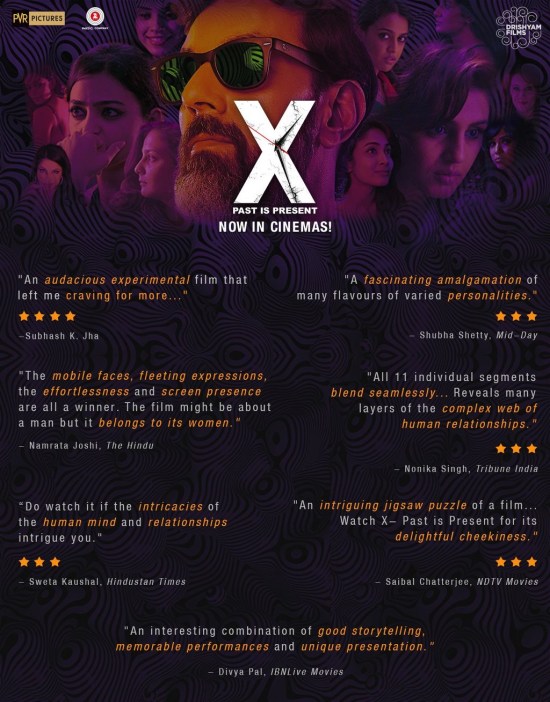
It’s been about two weeks since X: Past is Present released in the halls and we were met with extreme love and hate, reviews ranging from no stars to four stars. I would like to thank each and every person who bought a ticket to watch the film. If you didn’t like the film, as promised, I owe you chai/coffee. Do leave a comment below to claim your chai.

Update: I’m sure we all have at least a friend or two in Singapore. Please spread the word that our little film that has got extreme hate and love is releasing in Bombay Talkies on December 4. Book your tickets here.

We are very curious to find out what Singapore makes of it. Please share this link on your Facebook wall & Twitter TL to help us spread the word.

Here’s a compilation of all the love we got from critics and popular movie bloggers from India & the US.

And if you think we are blowing our own trumpet, here’s Raja Sen & me taking all the bad reviews in our stride too. We loved doing this. Thank you all for watching. Reactions are the most important part of every experiment. If you haven’t seen the film that has polarised audiences, do wait for it on VOD & DVD. Watch this space.

Tamasha: Love in the times of schizophrenia

November 30, 2015 · by sudhishkamath

Tamasha.jpg

When Rockstar released, I wrote a 3000-word review on Imtiaz Ali’s understanding of our confused, spoilt-for-choice, head-over-heart-user generation and stories of our long-winded journeys of self-discovery and love.
Tamasha released a week after X – Past is Present, at a time when I’m not really in the mood to review anything (since I’ve had a long and exhausting journey of my own) and the fact that the film has forced me into putting down my thoughts into words should tell you a little bit about what a powerful – even if far from perfect – film Imtiaz Ali has made once again.
While Tamasha takes the path of all his previous films, as if he is celebrating his own stories for one last time (and I seriously hope this is the last time he’s making films of this template), what I found fascinating about Tamasha is that it is tells us what we are becoming trying to repress love. One step short of full-blown schizophrenia.
The symptoms have always been there.
It was prodromal in Socha Na Tha (think about the number of times Viren changes his mind about what he wants). In Jab We Met, it showed suicidal tendencies. In Love Aaj Kal, it was denial. In Rockstar, it was the angst of repression and complete alienation. In Highway, the alienation leads to a rage against the sacred cow of Indian cinema – the family and home. The next stage is obviously about losing your shit completely and having a nervous breakdown.
Which is why Ved’s psychotic split personality needed to be played up a wee bit more. It’s one of those stages in his journey that deserved a five-minute acting showcase (like DiCaprio’s crawl back home in Wolf of Wall Street or Kartik Aryan’s monologue in Pyaar Ka Punchnama – that one scene tells you what the film is about).
Ali does a bit of this when Ved freaks out his boss (but then again this is only as reminiscent of Jordan’s encounter with the obnoxious record label boss in Rockstar but Ranbir needed a lot more writing to work with here) and earlier in the film when he confronts Tara after their break-up.
I remember the audience in the hall being uncomfortably amused with Ranbir’s bursts of psychotic behaviour and yes, these are scenes that could make any director/producer/actor nervous because it’s impossible to tell what the audience would make of a mainstream movie star suddenly losing his shit in the middle of a movie that seemingly has nothing to do mental illness.
But Tamasha IS about mental health.
The mental health of a generation connected to computers and phones, a generation used to spouting coded jargon through Powerpoint presentations, a generation so lost in the drudgery of the real world that the fantastical situations of movies seem reserved for our off-days or holidays far away from reality.
Being confused for a brief period is one thing but years of confusion (and you can see this confusion play out from a few weeks in Socha Na Tha to a few years in Tamasha) can take a toll.
The finding-love-in-a-world-lost-in-a-rat-race is a pretty old-fashioned nineties narrative and manufacturing consent for your dreams from the father far more older a sub-plot. Which is why Tamasha feels like the same old story despite its interesting hyperbole of making its regular everyday working man lose his mind.
Remember how Howard Beale lost his shit and screamed in the Network: “I’m mad as hell and I’m not going to take this anymore.”
In the last 40 years, we have all become Howard Beale. We are a generation on the verge of depression, dealing with an impending breaking point and a nervous breakdown except that Imtiaz Ali’s narrative sticks to the dated robotic existence context – and NOT modern day clutter – as the bane of our lives.
But then, that’s probably also because Ali is a little older than the current generation that’s hooked to endless Twitter and Facebook updates, where Friends are people with Instagrammed display pictures and Liking is political. Imtiaz Ali, I suspect, grew up watching Cameron Crowe movies in the 90s. I would know because I am probably the biggest Crowe fan in this part of the world. I can spot the Elizabethtown hero on the brink of suicide in Jab We Met before he meets a talkative manic pixie dream girl. I can spot Elizabethtown’s Free Bird in the imagery of Rockstar’s Naadan Parindey. I can spot Jerry Maguire fired from his job when Ved walks out holding his cardboard box.
Like Crowe, Imtiaz has been making the same film over and over again too. About protagonists coping with introspective moments of epiphanies thanks to the Manic Pixie Dream Girl they fall in love with and have trouble accepting. While Crowe loves the small town America, Ali loves his mountains.
To be fair, Ali has outgrown Crowe’s attachment to the family unit. Families in Ali’s universe, especially off late, are not the balm. They are the ache.
But the inheritance of Crowe’s Manic Pixie Dream Girl type continues to haunt Imtiaz Ali’s cinema and is the reason Tamasha falters. The girl remains a type, despite a fantastic Deepika Padukone rising above the material, and taking over the entire first half of the film. But sadly, she’s reduced to saying: “You had me at Hello” in a great fake Chinese accent.
However, Imtiaz Ali is the quintessential Bollywood director who relies more on using song, dance and music than writing (off late, the writing is sounding more and more improvised).
The first chapter of Tamasha is a full-blown Bollywood musical with very little silence but we are not complaining. We are hearing Rahman, watching Ranbir and Deepika in Corsica. With lines sounding more improvisational than crafted, the Boy-meets-girl romance rides purely on charm and the chemistry of its leads.
Chapter 2 seen completely through Tara’s PoV is the film’s finest chapter. So beautifully understated and better written than the rest of the film. But Tamasha really comes into its own only in Chapter 3 – Andar ki Baat that dives deep into the Ved’s identity crisis, nervous breakdown and impending epiphany.
Chapters seem like a fun way to break down the film into parts but the film is practically over the minute we see “Don Returns” (This could have very well have been The End) on screen. Soon, the film uncharacteristically turns all out family and crowd-pleasing.
The last act is the weakest we have seen in all Imtiaz Ali films and that’s a tragedy given that this film plays out like the Bollywood ending of all his films as a celebration of all his stories. (I was half-expecting Tara’s suicide by the time Ved finds himself given all that foreshadowing of how all stories are the same and someone always dies in the end! Stories, like life, are destined towards the same ending, no matter how hard you try to fight or resist the inevitable, I imagined but this is not that dark a film.)
Tamasha is a Spot the Imtiaz Ali filmography drinking game but I’m saying that in a good way. He’s a rare kind of filmmaker who is still making the most personal of films in the mainstream format and no Indian filmmaker understands the confusing dynamics of modern day love more than him. Nobody uses the musical narrative and A. R. Rahman better than him these days. Not even Mani Ratnam.
Will I queue up to watch him do the “same old story” again? I’m not really sure.
Even if I do, I doubt I would write about it. You can just read my old reviews.

There’s a monster in the halls

November 20, 2015 · by sudhishkamath


Dear world,

Just to let you know we have unleashed a monster in over a hundred screens around the country today. We are calling it X: Past is Present.

It’s a monster that has taken us two and a half years to tame.

And now, it’s out in the theatres.

The truth is we never thought it would be this big a release.

When we all got together, we just decided to go out and have some fun doing our own thing and in whatever language we were comfortable in, without any regard for the market and see if we could build a larger film out of it as one story.

Art has been around since the first man scratched the wall of his cave with a stone to express something. For 2.8 million years now.

Myths have existed for at least 5000 years. Films for a little over 100 years. Film studies for half that time. Professional film criticism as we know it today for maybe half of that.

The only thing we can be sure of is this. What we know is just a speck of dust on a canvas that’s been lying around for 2.8 million years old.

Yet, we believe that our observations of the popular story telling format of cinema over the last few decades can be used as some measure of evaluation.

As a film critic and someone obsessed with stories, I have always wondered about the vast unknown. I have had an issue with this very idea of judgment or the unwritten rules deeply entrenched in our minds that one kind of cinema is better than the other though it’s purely a matter of personal taste and preference.

X: Past is Present was started an idea to build a bridge between the different cinemas of India. The idea was to embrace each form of expression, every sensibility and style we find in the mainstream, the regional, the arthouse and the underground – without judgment.

A massively curious experiment of creating a monster with genes of different kinds of cinema and see if we could tame it.

We don’t know we have. And that’s the whole truth of it.

Once we finished making the film, we had to figure out if the world was ready for it. We have to thank Drishyam Films to be brave (or foolish) enough to spend three times the production cost in marketing the film, just to bring it to you in these star obsessed times.

It’s a ballsy experiment from not just us filmmakers, but producers Drishyam too.

But I believe that this experiment is far from over.

Because, you see, reaction is the most integral part of the experiment.

We want to know what you think. We want to know if you would buy a ticket when something like this hits the screen.

We want to know if it makes sense to spend our energies in trying to dive into the unknown ever again.

We want to know if this monster lives on.

It’s a monster we are closely studying. And learning from. Some day, we hope this experiment tells you what to do or not to do.

It taught us a few things. And continues to, with every reaction we get.

So bring it on. Be a part of it if you are as curious as we are.

Here’s the Trailer of X: Past is Present

And here’s where you can book tickets.

  • Create a free website or blog at WordPress.com.
Privacy & Cookies: This site uses cookies. By continuing to use this website, you agree to their use.
To find out more, including how to control cookies, see here: Cookie Policy
  • Subscribe Subscribed
    • MADRAS INK.
    • Join 480 other subscribers
    • Already have a WordPress.com account? Log in now.
    • MADRAS INK.
    • Subscribe Subscribed
    • Sign up
    • Log in
    • Report this content
    • View site in Reader
    • Manage subscriptions
    • Collapse this bar
 

Loading Comments...