• SUDA MING’S CHANNEL
  • TALKING FILMS
  • Good Night | Good Morning
  • My Talk Show
  • PROFILE

MADRAS INK.

Menu

  • Archives
  • Columns
  • Diary
  • Interviews
  • My Films
  • Reviews
  • Good Night | Good Morning

  • Word thru the bird

    Tweets by SudhishKamath
  • Connect with GNGM

    Connect with GNGM
  • About GNGM

    Reviews

    “A cerebral joyride”
    Karan Johar, filmmaker on REDIFF

    “Among the most charming and creative Indian independent films”
    J Hurtado, TWITCH

    ★★★★✩
    “You don’t really need a big star cast… you don’t even need a big budget to get the techniques of filmmaking bang on…”
    Allen O Brien, TIMES OF INDIA

    ★★★★✩
    “An outstanding experience that doesn’t come by too often out of Indian cinema!”
    Shakti Salgaokar, DNA

    ★★★
    “This film can reach out the young, urban, upwardly mobile, but lonely, disconnected souls living anywhere in the world, not just India.”
    Namrata Joshi, OUTLOOK

    “I was blown away!”
    Aseem Chhabra, MUMBAI MIRROR

    “Good Night Good Morning is brilliant!”
    Rohit Vats, IBN-LIVE

    ★★★✩✩
    “Watch it because it’s a smart film.”
    Shubha Shetty Saha, MIDDAY

    ★★★✩✩
    “A small gem of a movie.”
    Sonia Chopra, SIFY

    ★★★✩✩
    “A charming flirtation to watch.”
    Shalini Langer, INDIAN EXPRESS

    “Interesting, intelligent & innovative”
    Pragya Tiwari, TEHELKA

    “Beyond good. Original, engrossing and entertaining”
    Roshni Mulchandani, BOLLYSPICE

    * * * * *
    Synopsis

    ‘Good Night Good Morning’ is a black and white, split-screen, conversation film about two strangers sharing an all-night phone call on New Year's night.

    Writer-Director Sudhish Kamath attempts to discover good old-fashioned romance in a technology-driven mobile world as the boy Turiya, driving from New York to Philadelphia with buddies, calls the enigmatic girl staying alone in her hotel room, after a brief encounter at the bar earlier in the night.

    The boy has his baggage of an eight-year-old failed relationship and the girl has her own demons to fight. Scarred by unpleasant memories, she prefers to travel on New Year's Eve.

    Anonymity could be comforting and such a situation could lead to an almost romance as two strangers go through the eight stages of a relationship – The Icebreaker, The Honeymoon, The Reality Check, The Break-up, The Patch-up, The Confiding, The Great Friendship, The Killing Confusion - all over one phone conversation.

    As they get closer to each other over the phone, they find themselves miles apart geographically when the film ends and it is time for her to board her flight. Will they just let it be a night they would cherish for the rest of their lives or do they want more?

    Good Night | Good Morning, starring Manu Narayan (Bombay Dreams, The Love Guru, Quarter Life Crisis) and Seema Rahmani (Loins of Punjab, Sins and Missed Call) also features New York based theatre actor Vasanth Santosham (Bhopal: A Prayer for Rain), screenwriter and film critic Raja Sen and adman Abhishek D Shah.

    Shot in black and white as a tribute to the era of talkies of the fifties, the film set to a jazzy score by musicians from UK (Jazz composer Ray Guntrip and singer Tina May collaborated for the song ‘Out of the Blue), the US (Manu Narayan and his creative partner Radovan scored two songs for the film – All That’s Beautiful Must Die and Fire while Gregory Generet provided his versions of two popular jazz standards – Once You’ve Been In Love and Moon Dance) and India (Sudeep and Jerry came up with a new live version of Strangers in the Night) was met with rave reviews from leading film critics.

    The film was released under the PVR Director’s Rare banner on January 20, 2012.

    Festivals & Screenings

    Mumbai Film Festival (MAMI), Mumbai 2010 World Premiere
    South Asian Intl Film Festival, New York, 2010 Intl Premiere
    Goa Film Alliance-IFFI, Goa, 2010 Spl Screening
    Chennai Intl Film Festival, Chennai, 2010 Official Selection
    Habitat Film Festival, New Delhi, 2011 Official Selection
    Transilvania Intl Film Festival, Cluj, 2011 Official Selection, 3.97/5 Audience Barometer
    International Film Festival, Delhi, 2011 Official Selection
    Noordelijk Film Festival, Netherlands, 2011 Official Selection, 7.11/10 Audience Barometer
    Mumbai Film Mart, Mumbai 2011, Market Screening
    Film Bazaar, IFFI-Goa, 2011, Market Screening
    Saarang Film Festival, IIT-Madras, 2012, Official Selection, 7.7/10 Audience Barometer

    Theatrical Release, January 20, 2012 through PVR

    Mumbai
    Delhi
    Gurgaon
    Ahmedabad
    Bangalore
    Chennai
    Hyderabad (January 27)

    * * * * *

    More information: IMDB | Facebook | Youtube | Wikipedia | Website

  • Browse: Categories

  • January 2016
    M T W T F S S
     123
    45678910
    11121314151617
    18192021222324
    25262728293031
    « Dec   Jun »
  • Recent Posts

    • Simmba: A departure from the formula
    • Zero: The hero who wasn’t
    • Protected: AndhaDhun: What did that end mean?
    • Love and other cliches
    • October: Where is Dan?

Archive For January, 2016

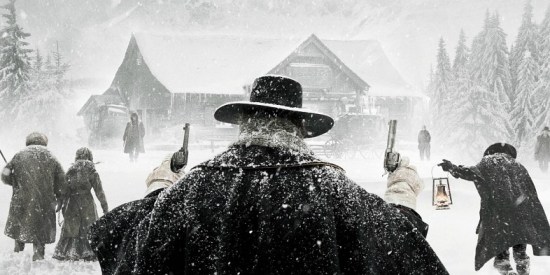
The Hateful Eight: Not just Black & White

January 19, 2016 · by sudhishkamath

Hateful Eight

When Quentin Tarantino’s eighth film begins with a brown wood-sculpted Jesus on a black crucifix, mounted against white snow-clad mountains, we know that the stagecoach trying to get a blizzard off its ass would set the stage for a story about persecution.

The writer-director wastes no time when the white bounty hunter John Ruth, the Hangman (Kurt Russell) who has hired the stagecoach, points a gun and says “Hold it, black fella” when Major Marquis Warren (Samuel L Jackson) a black traveller approaches to ask for a ride to Minnie’s Haberdashery, where they are headed.

The Hangman has a prisoner, Daisy Domergue, who greets the Major with “Howdy, Nigger.” When John Ruth tells her that “darkies don’t like being called niggers… they find it offensive” she says: “I’ve been called worse.”

And right from Scene 1, the politics and the race/gender equations in Tarantino’s cold West Wyoming are clearly defined. A white bounty hunter might even team up with a black one and consider him an equal but the woman is the punching bag.

There’s a reason film criticism needs to be and is taught around all film and journalism schools around the world. Because depiction is not always endorsement and spotting the difference between a character’s beliefs (and this includes misogyny) and the storyteller’s requires some understanding of cinema, politics and closer attention to how the arguments play out, especially in a film that’s designed to be a political commentary on persecution. And discrimination that prevails in America.

The Hateful Eight is a 12 Angry Men-esque narrative that slowly tries to persuade us away from our most hateful judgments. Let’s take a closer look at the Eight and understand their character graphs, just so that we can grasp the politics of the much-hated auteur’s heavily misunderstood complex masterpiece.

Major Marquis Warren: A black trigger-happy bounty hunter who once fought against the confederate army in the Civil War as a part of the Union, is now an outlaw trying to fit in. The character (Tarantino named after Hollywood screenwriter and director known for his Westerns) carries with him the Lincoln Letter now part of legend. Of course, it’s mythical. He wrote it and is protective of the lie he has created. To him, it’s real. He is willing to punch Daisy when she spits on it but later admits it’s not real when he gets called out and explains he made it up because it got him on the stagecoach. He’s willing to trust the most racist of the bunch, the Lost Cause Southerner Chris Mannix, former when it comes to a life and death situation. And by deed and action makes the white supremacist buy his Lincoln letter.

John Ruth, The Hangman: A white misogynistic yet patriotic law abiding bounty hunter who believes in bringing prisoners to justice and lets in a black traveller only because he respects the reputation of the man having heard stories of Marquis being pen-pals with Abraham Lincoln himself. He feels hurt when he finds out that the Lincoln letter he admired was not real. He loses to Daisy. She is the reason he dies.

Daisy Domergue: The strongest and deadliest of the eight if you consider it took all the other men to come together to bring her down. She might get beaten black and blue by both the above men but she’s the one smiling through it all because she’s got a secret. She’s unbreakable even with her hands cuffed almost throughout the film. She is the reason they all die. It’s brilliant subversion. To put a character in chains and make her the supervillain in a universe full of villains. The only thing she dies for is justice. By hanging, as John Ruth would have liked her to.

Chris Mannix: Was on the other side of the law fighting for a rebel renegade as a part of the Southerner’s Lost Cause. His father headed a outlaw gang called the Mannix’s Marauders but now he’s supposed to be the new Sheriff of Red Rock, where they are all headed. Is he lying? Lying or not, he wears his ideology of white supremacy (“When niggers are scared, that’s when white folks feel safe”) as his badge of honour refusing to believe in the Lincoln Letter only to slowly realise that the only one who cares for justice he’s supposed to deliver as the new Sheriff in town now is the black man. Like the Lincoln Letter, it does not matter if he’s the new Sheriff or not, what matters is that he decides to embrace justice and kill Daisy by hanging when it’s just easier to shoot her to death and thereby, also embraces the new world order – or what Lincoln would have liked. He’s the antagonist our anti-hero Marquis has won over by end of the film.

Senor Bob: A Mexican pretending to be the caretaker of Minnie’s Haberdashery but hardly convincing. He turns out to be part of the Domergue gang but within the gang, he’s relegated to subservient duties of attending to horses in the stable and making stew. His character exists just to remind us of the outcasts and how they were treated on an every day basis. Minnie was a black woman facing discrimination herself and yet she despised Mexicans.

Oswaldo Mobray: Whose first lines describe the world as a “White Hell” for a black man (Incidentally, the final chapter is called Black Man, White Hell) and that’s our first clue that this was going to be judgment day. Minnie’s Haberdashery could well be a purgatory where the sinners have to pay for their sins and redeem themselves. Oswaldo claims to be the hangman of Red Rock. Again, we don’t know if he’s lying at first but he sure defines justice in a civilized society as opposed to frontier justice. “The real difference is the hangman… It’s my job… The man who pulls the lever that breaks your neck will be a dispassionate man… that dispassion is the essence of justice. For justice delivered without dispassion is always in danger of being not being justice.” And this could well be Tarantino’s definition of delivering dispassionate justice to Daisy.

Joe Gage: “Looks can be deceiving,” as Gage warns John Ruth about all the characters in the film and we realise that it’s true. Everyone is pretending to play a role. Michael Madsen has the least to do in the film and most of his action is offscreen – like poisoning the coffee. He wants to go home to see his mother for Christmas. And as Senor Bob is playing Silent Night, Joe Gage is poisoning the coffee… in case you thought the Jesus Christ on the crucifix was just some cool image to begin the movie with. This is also probably the weakest character of the bunch because it’s almost an extended cameo.

General Sandy Smithers: Fought the Civil war for the Confederate army opposite Northerners, in the same battle as Major Marquis Warren. And the two have unfinished business… which Warren settles after telling the General how he killed his son with a graphic story that forces the General to point a gun at him. Thus giving him the licence to kill. As if dealing with gender, race, politics, religion and identity wasn’t enough, with Sandy Smithers throws age into the equation to represent old-school white pride and breaks it down with a story about a white man made to suck a black cock. And just like that, Tarantino throws in sexuality into the mix of issues America is facing.

These eight villains will be judged in White Hell that used to be good old Minnie’s Haberdashery – a world in the middle of Wyoming where Americans hung out together and kept Mexicans away. The eight villains get what they deserve. Marquis who forced a white man to suck his cock, gets his dick shot. Daisy gets death by hanging. John Ruth the misogynist gets death and his hand yanked off his corpse. Chris Mannix embraces the Lincoln Letter or the hope it represents and the four passengers die brutal deaths for the cold-blooded massacre they staged at Minnie’s Haberdashery earlier that day.

The film ends with a reading of the contents of the mythical Lincoln Letter. And endings are always the key to read the politics of the film. My critic friend Raja Sen who read the early draft of the script says that the Lincoln Letter was real in the first draft of the script. But here, it had changed. When we first see it, we see it with the glow we saw around the briefcase in Pulp Fiction. It’s seems magical and surreal because it is. That letter is hope.

Tarantino had revised the draft to make it fictional to make it all the more poignant especially after the controversial killing of Michael Brown. Tarantino was among the most vociferous of protestors to call out institutional racism in the police force. And suddenly, the brown Jesus at the beginning of the film could be Michael Brown. Hence, we can assume that Mannix is indeed the new Sheriff.

And what’s most important is that Mannix bleeding to death wants to read the letter he knows is not real.

Here are the contents of the letter:

I hope this letter finds you in good health and stead. I’m doin’ fine. Although I wish there were more hours in the day. There’s just so much to do. Times are changin’ slowly but surely. And it’s men like you that will make a difference. Your military success is a credit not only to you but your race as well. I’m very proud every time I hear news of you. We still have a long way to go. But hand in hand, I know we’ll get there. I just want to let you know you are in my thoughts. Hopefully, our paths will cross in the future. Until then, I remain your friend. Ole Mary Todd is callin’. So I guess it must be time for bed.

Respectfully,

Abraham Lincoln

Mannix likes the ‘Ole Mary Todd’ touch. The most racist of the younger bunch of the eight has been “disarmed”. The scripted Lincoln Letter has spoken to him. It has served its purpose.

As the credits roll to “There won’t be many coming home,” we realise that Hateful Eight is Hollywood’s own cowboy Quentin Tarantino’s scripted Lincoln Letter to white supremacists.

It’s also significant that he has crafted his Lincoln Letter not with classy elitist arthouse idioms but has embraced his love for the widely looked-down upon forms of art – the grindhouse pulp-fiction narrative – that acquired high art status only after he put his stamp all over it.

The big difference between how Robert Rodriguez treated his Grindhouse film Planet Terror and how Quentin Tarantino treated his Death Proof was that while Rodriguez simply recreated the exploitative genre of B-movies, Tarantino embraced it with his sensibility and treated the B-movie a touch of class. He was bringing the untouchables into the mainstream. The perverse, the exploitative, the gory, the violent, the foul-mouthed were given the legitimacy of a celebrated filmmaker’s signature.

If his earlier films tried to borrow from all his influences, The Hateful Eight borrows from his own. He recycles more than one moment here but that will make for an entirely different essay. While most filmmakers choose a white canvas to define black, Tarantino here has chosen a black canvas of all things dark to define white. I’m not talking race here but Tarantino’s spin on noir and contribution in defining neo-noir.

The point I want to leave this piece is simple.

If The Hateful Eight brings out your contempt for gore, tone, violence or language, maybe you are guilty of every thing you accuse the racist, the sexist and the fundamentalists of: Discrimination. Also, persecution.

You don’t become intellectually superior than another class of people just because of what you like to watch. Simply put, if you are an art-Nazi, The Hateful Eight is Quentin Tarantino making you suck his pecker for close to three hours.

“Starting to see pictures, aint ya?”

(This post will be updated after a couple of more viewings in the future given that there’s so much in this film waiting to be discovered. If you liked this piece, you might also like my dissection of Inglourious Basterds)
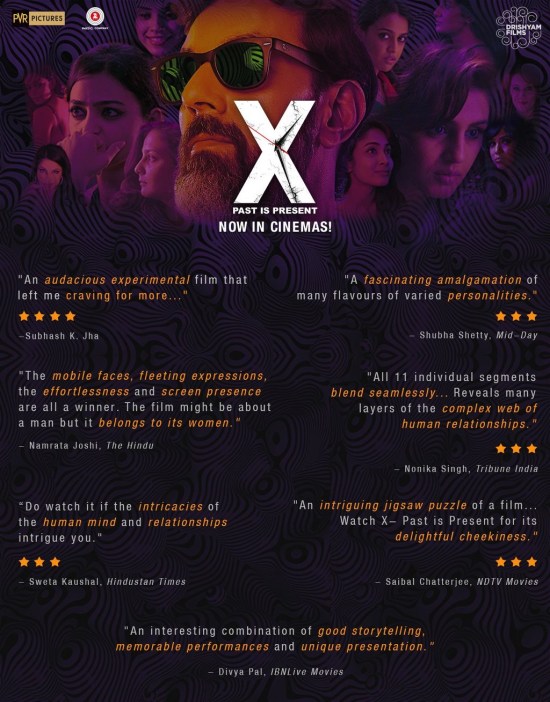
X – Past is Present XPlained

January 11, 2016 · by sudhishkamath

It’s always tricky making a puzzle film because you assume that the audience is smart and/or care enough for the characters to put it together… but wait, this is not to say we made a perfect film. Far from it. Because the execution sometimes gets in the way. But we will let you judge that after you’ve seen it again.

Right from when we started editing and putting the film together, we decided we didn’t want to use supers to tell you which chapter happened when and in which city because we wanted YOU to put the puzzle together. This is like a Lego narrative but you have to put the chapters together.

However, now that the film is out there for all to see (available legally on Spuul), it’s time to let out a few clues and secrets on how the chapters are all inter-connected and why people who have been seeing/judging them as stand alone “stories” missed the bigger picture.

The difference between X – Past is Present and other non-anthology films made by multiple directors is that this movie employs a serialized narrative, not an episodic one. Which means that the chapters are inter-dependent and inter-connected in more ways than one.

So here are the secrets to put the puzzle together. Trust this would help you enjoy the film all the more the next time you see it. In the order, the secrets unfold:

1. In Hemant Gaba’s 17 Presents, Shireen tells young K he’s late as he gets into the car and follows it up with a question: Where’s the watch I gave you?

This is the watch he loses at Aunty’s place during Nalan Kumarasamy’s Summer Holiday. Hence the quick memory flash of Aunty taking off his watch.

There are more flashes that connect this episode with Nalan’s – especially his “First time” with intimacy during the dance to the pop song ‘Tonight’. And this is the song that’s triggered when K hears the mystery girl call her Mom ‘Shireen’ in the opening scene.

2. In Anu Menon’s Oysters, K pitches to a producer in London the story he was inspired from his days in Kolkata… Pratim D Gupta’s Eight to Eight, where he shared a room with a girl he never met.

There are more flashes that connect this episode with the present day narrative when he walks into a girl changing and she asks him: Never seen a girl change before? Not like this, he says because the last time he saw a stranger change, he was filming her.

3. In Rajshree Ojha’s Biryani, K gets a call he disconnects as he lays the table. We hear his phone beep till the person calls him on the landline confirming his wife’s biggest fear – that he’s cheating on her with Ayesha from Abhinav Shiv Tiwari’s Audition. This is mirrored in Abhinav’s episode with similar imagery with him texting someone else – another actress. Both these women drink wine as does Sanjana from Sandeep Mohan’s Fin. K is constantly replacing the character he wants with a different woman. He loves to make Biryani and little does he know how a secret from his childhood was buried in Biryani in Nalan’s Summer Holiday. Also hinted in this chapter is karma of another deed he did in Suparn Verma’s Yaadein when Rija tells K she got rid of the child.

4. In Pratim D Gupta’s 8 to 8, we see the girl after K leaves and see the whole conversation. Because this is not part of his memory. This is the film he made. We know it’s a film he made because we see the same shots being screened at the beginning of Sandeep Mohan’s Fin. He leaves Kolkata because his father died (something we learnt earlier in Anu Menon’s Oysters as he shares his story with Sophie). He has romanticised his stay and turned it into a movie because of the poems exchanged. One of the lines from the poems exchanged end with: Some relationships are best left in closed books. This is why K keeps his relationships in his books and movies. He reveals to the mystery girl that if he met the girl, he would have settled into the mundane boring routine of life. And films are the What Ifs of the things you never got to or will do in life.

5. In Q’s Ice Maid, we see K is tripping on MDMA after all the women have left him at the end of Abhinav Shiv Tiwari’s Audition. He connects himself to Devdas except that as he’s trying to write he’s realised that Paro and Chandramukhi have become the same person for him. His tendency to replace the mistress type with the wife has gone on too long that they have become the same person. He is truly lost. Hence all girls are played by Rii. Everyone he meets in life are the same person… a realization he shares with the mystery girl in bed when she asks him about Ice Maid, a film she had auditioned for. Ice Maid is also K’s last film. He hasn’t been able to write ever since. He’s trying to find out who is he haunted by. Who is the ghost? Woh Kaun Thi is the script he’s trying to write in the present day timeline but he’s blank. This is also the arthouse climax of X Past is Present. If you stop watching the film here, it’s a story of a filmmaker who lost his mind and can’t tell between fact and fiction or girls in life and movies anymore.

6. In Sandeep Mohan’s Fin lies the Happy Ending to the film most people would have missed. But the key to the secret lies in the opening lines: “Do you believe in God? Science? Time-travel?” These are the exact same lines at the end of the movie when K finally gets the closure. Yes, it did seem like mental time-travel and not physical time-travel but if you want to believe, K would have gone back to the happy person he was when he met Sanjana. As mentioned earlier, the film at the beginning is his first film “Eight to eight” and safe to assume he made this movie because of the London producer from Anu Menon’s Oysters.

7. In Abhinav Shiv Tiwari’s Audition, he sends a text meant for Heena to Ayesha at the end of the episode and we finally understand how he moves on and replaces women with the exact kind he’s used to Rija, Ayesha and now Heena. He doesn’t want to have a baby with Ayesha because of his baby issues in Rajshree Ojha’s Biryani and Suparn Verma’s Yaadein. This is a broken man who is constantly running away from anyone trying to tie him down. When he tells Heena that all Woody Allen movies are the same, she shoots back a question: Love fades? Not because all Woody Allen movies echo that sentiment but because K believes that too. And this is also why he believes that every filmmaker including himself has only one story to tell, something he shares with the mystery girl in the present day timeline.

8. In Suparn Verma’s Yaadein, we see a younger K voiced by Anshuman Jha pleading with Avantika to not leave him. He caused an accident he’s haunted by in the dream within a dream and wakes up with a pregnant Rija lying next to him in bed but this time K is older (voiced by Rajat Kapoor). Hence, it’s easy to deduce that K married Rija because he didn’t want to lose another woman because of his fear of commitment. This was also his longest relationship. We know this because Rija gives him a Patek Phillipe watch on his fourth anniversary, one he never wears until she left him. This is the watch he loses in the swimming pool in the present day timeline. Also, at the end of the chapter, we realise that the last thing Avantika said before the car crash was that she was pregnant. She says: You ll kill OUR baby. He had no idea she was pregnant with his child. Which is why Rija aborting the child makes him feel like a baby killer. He jokes about killing a baby in the present day timeline and instantly regrets having made that Bollywood joke. The owl necklace Avantika wear is the car is the exact same necklace the mystery girl is wearing in the room if you watch carefully.

9. In Raja Sen’s Knot, we understand K’s fear of knots – he had a bad experience in Nalan Kumarasamy’s Summer Holiday when Aunty tied him to the bed. He has spent most of his early adult life obsessing about his past. Vina is the one who made K realise he is not the kind to be tied to a corporate job by breaking him down for wholly different reasons, of course but the power trip made him realise he had to change careers and he took up a job in Kolkata as a sound engineer in Pratim D Gupta’s Eight to Eight. We also see how similar Vina is to Sanjana from Sandeep Mohan’s Fin the way they twirl their hair – identical shots. At some level, he likes women who call the shots but also runs away from them when they try pinning him down.

10. In Nalan Kumarasamy’s Summer Holiday, we realise how he lost the watch given to him by Shireen. At the beginning of the chapter, he realise how he is a motherless child and had a Dad in the army and that’s probably why he’s never really learnt love. An incident in the village had scarred him for life and broken his trust in women. The watch stood for time, faith, trust, innocence and life itself. The film was born out of this episode. When Kumararaja came up with this story, we knew this had to be the climax and we had to create a character who was a product of this chapter. This is also the only chapter apart from the present day narrative where we get to look at K directly. In all other chapters, we look at the world through his eyes, we look at the people around him. All other chapters employ the first person narrative and he himself is blurry or out of frame. But at the beginning of Summer Holiday, we see the young K come into focus from an out of focus frame and he takes his wayfarers off. This is who he was before he became the K behind the wayfarers in the present day timeline.

11. In yours truly’s Past is Present, it’s easy to tell who the woman in the lift is even if you don’t recognise her voice. It’s the woman he has had the longest relationship with, one he calls every few months drunk, the one whose watch he started wearing after missing her. The one who loves him and let him go because she has accepted him for who he is. A nomad. A drifter. She has set him free because she knows he has issues. Luckily for K, he meets someone who makes him believe with a series of co-incidences all in one night. One girl had triggered off memories of all the women in his life. At which point does co-incidence become divine design? At which point does a man of science become a man of faith? When the girl gives him a watch she calls a “time-machine” we can either respond to this as a person of science or a person of faith. If you believe in a larger God, maybe K went back in time (grew younger again mentally or physically, whatever you are comfortable believing) to that place he lost his watch/time/faith/trust/innocence/life and got it back with closure. If you believe in Science, maybe a series of co-incidences were what a man under influence needed to introspect, turn back the car to the place he lost his watch/time/faith/trust/innocence/life and got his closure and the choice to use a younger actor is a mere creative choice to show the boy get his watch back.

IMG_9699

  • Blog at WordPress.com.
Privacy & Cookies: This site uses cookies. By continuing to use this website, you agree to their use.
To find out more, including how to control cookies, see here: Cookie Policy
  • Subscribe Subscribed
    • MADRAS INK.
    • Join 480 other subscribers
    • Already have a WordPress.com account? Log in now.
    • MADRAS INK.
    • Subscribe Subscribed
    • Sign up
    • Log in
    • Report this content
    • View site in Reader
    • Manage subscriptions
    • Collapse this bar
 

Loading Comments...