• SUDA MING’S CHANNEL
  • TALKING FILMS
  • Good Night | Good Morning
  • My Talk Show
  • PROFILE

MADRAS INK.

Menu

  • Archives
  • Columns
  • Diary
  • Interviews
  • My Films
  • Reviews
  • Good Night | Good Morning

  • Word thru the bird

    Tweets by SudhishKamath
  • Connect with GNGM

    Connect with GNGM
  • About GNGM

    Reviews

    “A cerebral joyride”
    Karan Johar, filmmaker on REDIFF

    “Among the most charming and creative Indian independent films”
    J Hurtado, TWITCH

    ★★★★✩
    “You don’t really need a big star cast… you don’t even need a big budget to get the techniques of filmmaking bang on…”
    Allen O Brien, TIMES OF INDIA

    ★★★★✩
    “An outstanding experience that doesn’t come by too often out of Indian cinema!”
    Shakti Salgaokar, DNA

    ★★★
    “This film can reach out the young, urban, upwardly mobile, but lonely, disconnected souls living anywhere in the world, not just India.”
    Namrata Joshi, OUTLOOK

    “I was blown away!”
    Aseem Chhabra, MUMBAI MIRROR

    “Good Night Good Morning is brilliant!”
    Rohit Vats, IBN-LIVE

    ★★★✩✩
    “Watch it because it’s a smart film.”
    Shubha Shetty Saha, MIDDAY

    ★★★✩✩
    “A small gem of a movie.”
    Sonia Chopra, SIFY

    ★★★✩✩
    “A charming flirtation to watch.”
    Shalini Langer, INDIAN EXPRESS

    “Interesting, intelligent & innovative”
    Pragya Tiwari, TEHELKA

    “Beyond good. Original, engrossing and entertaining”
    Roshni Mulchandani, BOLLYSPICE

    * * * * *
    Synopsis

    ‘Good Night Good Morning’ is a black and white, split-screen, conversation film about two strangers sharing an all-night phone call on New Year's night.

    Writer-Director Sudhish Kamath attempts to discover good old-fashioned romance in a technology-driven mobile world as the boy Turiya, driving from New York to Philadelphia with buddies, calls the enigmatic girl staying alone in her hotel room, after a brief encounter at the bar earlier in the night.

    The boy has his baggage of an eight-year-old failed relationship and the girl has her own demons to fight. Scarred by unpleasant memories, she prefers to travel on New Year's Eve.

    Anonymity could be comforting and such a situation could lead to an almost romance as two strangers go through the eight stages of a relationship – The Icebreaker, The Honeymoon, The Reality Check, The Break-up, The Patch-up, The Confiding, The Great Friendship, The Killing Confusion - all over one phone conversation.

    As they get closer to each other over the phone, they find themselves miles apart geographically when the film ends and it is time for her to board her flight. Will they just let it be a night they would cherish for the rest of their lives or do they want more?

    Good Night | Good Morning, starring Manu Narayan (Bombay Dreams, The Love Guru, Quarter Life Crisis) and Seema Rahmani (Loins of Punjab, Sins and Missed Call) also features New York based theatre actor Vasanth Santosham (Bhopal: A Prayer for Rain), screenwriter and film critic Raja Sen and adman Abhishek D Shah.

    Shot in black and white as a tribute to the era of talkies of the fifties, the film set to a jazzy score by musicians from UK (Jazz composer Ray Guntrip and singer Tina May collaborated for the song ‘Out of the Blue), the US (Manu Narayan and his creative partner Radovan scored two songs for the film – All That’s Beautiful Must Die and Fire while Gregory Generet provided his versions of two popular jazz standards – Once You’ve Been In Love and Moon Dance) and India (Sudeep and Jerry came up with a new live version of Strangers in the Night) was met with rave reviews from leading film critics.

    The film was released under the PVR Director’s Rare banner on January 20, 2012.

    Festivals & Screenings

    Mumbai Film Festival (MAMI), Mumbai 2010 World Premiere
    South Asian Intl Film Festival, New York, 2010 Intl Premiere
    Goa Film Alliance-IFFI, Goa, 2010 Spl Screening
    Chennai Intl Film Festival, Chennai, 2010 Official Selection
    Habitat Film Festival, New Delhi, 2011 Official Selection
    Transilvania Intl Film Festival, Cluj, 2011 Official Selection, 3.97/5 Audience Barometer
    International Film Festival, Delhi, 2011 Official Selection
    Noordelijk Film Festival, Netherlands, 2011 Official Selection, 7.11/10 Audience Barometer
    Mumbai Film Mart, Mumbai 2011, Market Screening
    Film Bazaar, IFFI-Goa, 2011, Market Screening
    Saarang Film Festival, IIT-Madras, 2012, Official Selection, 7.7/10 Audience Barometer

    Theatrical Release, January 20, 2012 through PVR

    Mumbai
    Delhi
    Gurgaon
    Ahmedabad
    Bangalore
    Chennai
    Hyderabad (January 27)

    * * * * *

    More information: IMDB | Facebook | Youtube | Wikipedia | Website

  • Browse: Categories

  • December 2025
    M T W T F S S
    1234567
    891011121314
    15161718192021
    22232425262728
    293031  
    « Dec    
  • Recent Posts

    • Simmba: A departure from the formula
    • Zero: The hero who wasn’t
    • Protected: AndhaDhun: What did that end mean?
    • Love and other cliches
    • October: Where is Dan?

Browsing Category Archives

Website under construction.

Interview: “I’m not a critical-acclaim junkie” – Ekta Kapoor

May 14, 2011 · by sudhishkamath

“Sorry, I was in a temple,” she says, calling back promptly two minutes after the appointed time for the telephonic interview. I was given five minutes and told to call at 3.25 p.m sharp. The PR also requested if I could avoid any personal questions. After all the “She’s like the Devil in Devil Wears Prada” stories, you hear about her, the last thing you expect to hear is “Yes, Sir.”
In fact, she finishes every sentence with Sir. I am clearly enjoying this and have no heart to tell her I may be younger than she thinks. She’s respectful, polite and prompt and that’s this is the woman who runs an Empire built over millions of drawing rooms around the country. We can be pretty sure that there’s no chance any woman watching TV in this country has never heard her name before.
Ekta Kapoor is full of surprises. Currently, she’s on a roll with back to back releases and much acclaim with Shor In The City two weeks ago and Ragini MMS opening reasonably well. She speaks to us about her tryst with the motion picture business and her relationship with TV and the letter K.

Q:What kind of cinema is Balaji planning to be associated with? Any ingredients that will be common?
A: What I want to do with cinema is keep it as universal as possible. And if it has to do with different niches, give them what you promised. There’s no certain type of cinema but there’s a certain type of promise every film comes with. The agenda is to keep an eye on quality and live up to that promise.

Q: Why is your fare on the big screen and TV so different?
A: TV is more mass-oriented. It’s all about going into various homes… you got to go into a conservative home and a modern home with the same drawing room entertainment because people sit together and watch TV from different areas and different cultures. TV allows and explores unity in diversity. You need to get one interesting idea that connects with a much larger number of people than films can.

Q: How much control or regulation do you personally exercise over themes shown on your TV fare?
A: I have no interest in working against the sensibilities of all the mothers and family members who sit together. They know that if they watch a Balaji show, they will get a certain kind of entertainment. I do NOT want to break that connection ever.

Q: What’s your take on reality shows and society?
A: Anything we watch is a taste being catered to. You cannot ignore the fact that there is a taste. Somewhere we have to remember we are a voyeuristic society, we like shock value. But reality shows don’t get the numbers that fiction get. The staple diet of TV is family entertainment.

Q: First LSD and now Ragini MMS, which from trailers, seems to be quite bold for Indian audiences.
A: We are catering to an existing audience. We are not creating the audience. Youngsters talk like that. They do talk about going away for a dirty weekend. The film does not to try and shock you, it’s just accepting it. It shows a young couple who are comfortable with each other physically as they are mentally. Their conversations are real. They are not selling crass sexuality under the garb of being coy. Which is what happens in most Bollywood… wet duppattas, fluttering eye lashes, biting on the lips and yet we say it is non-sexual when it is actually overtly and covertly sexual.

Q: It was quite surprising to see a film like Shor In The City from your banner.
A: Shor In The City may not have a high level of sexuality but it may have a high level of humour that working professionals will enjoy. I think any kind of film that any audience would enjoy should be made by Balaji. Taryanche Bait, our Marathi film, that came out about a month ago was among the top five grossers. It’s about a middle-class man and his relationship with his son. We knew that the Maharashtrian audience will accept it. So we made it for them.

Q: So are you enjoying all the critical acclaim and going to festivals?
A: I am not going to become a critical-acclaim-junkie at all. I will not start falling for the bait of wanting to please people ever. I will do it the way I always do, with my gut. I cater to a viewer because that viewer’s taste matters more than anyone else’s and I will keep him first in mind and then, if it also appeals to the critics, so be it. On the other hand, it’s a great feeling to be accepted by audiences that have never accepted you.

Q: You have this larger than life image of a head-strong, highly opinionated and even arrogant businesswoman. Is that the right perception?
A: I think I am a bit too individualistic. I try to lead. I do not follow. Even if I don’t lead, I would follow my own path. If that works for people, great. If it doesn’t, great. I rather make my own mistakes and pay for them rather than pay for mistakes that are formulistic. So I just go by my gut.

Q: You seem to have come a long way from being associated only with the K-brand of TV shows.
A: I have just diversified. I don’t think I have come a long way from it. I would always go back to it when I feel the need to creatively do more shows. We underestimate the power of entertaining the country. By just doing niche films, I don’t think I have done some great work. Catering to India was far more challenging. I diversify just to explore my creativity. I believe that TV is a much bigger medium than films and I will always respect TV more.

Q: Do you watch American and British TV?
A: I am a huge American TV addict. I cannot do without my daily dose of American shows. Right now I am watching Shameless, 90210, Gossip Girl, True Blood, Dexter, Californication, Brothers and Sisters, Desperate Housewives. I am the first one to get the DVD here.

Q: Finally, what’s with the K-serial brand? Are you done with it? Do you believe in the superstition?
A: I love the letter K. I am a K-addict. (laughs) But I have taken a small sabbatical. It was an astro-thing. It suited my Mangal. When it didn’t suit me, I didn’t use it. We have currently broken up but we may get back together one day (laughs).
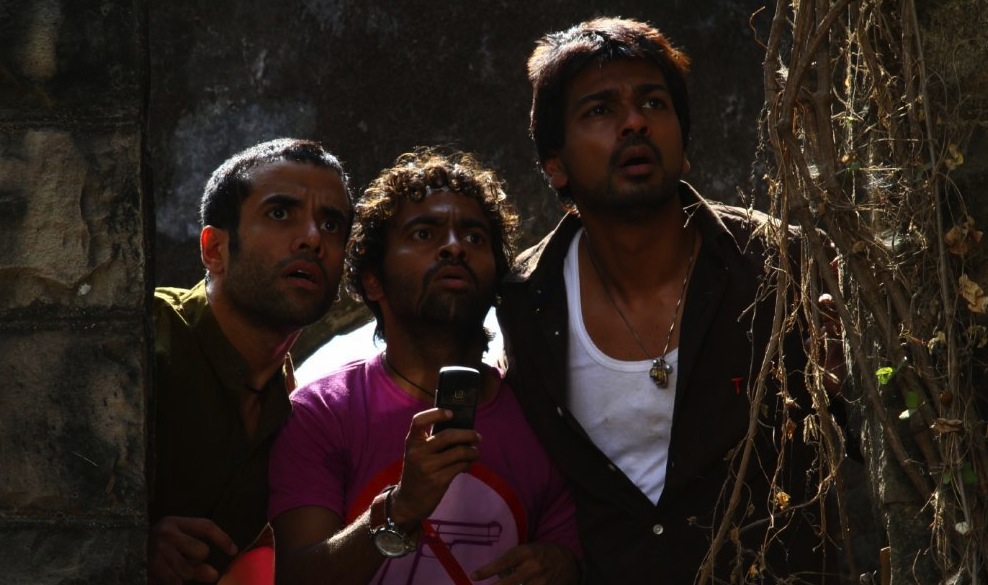
Shor In The City: Go make some noise. Clap, whistle.

April 30, 2011 · by sudhishkamath

Genre: Thriller

Director: Krishna DK-Raj Nidimoru

Cast: Sendhil Ramamurthy, Tusshar, Sundeep Kishan, Nikhil Dwivedi, Mitobash, Radhika Apte, Preeti Desai

Storyline: Three petty crooks find explosives, a NRI gets a threat from the local mafia and an upcoming cricketer needs money to get into the U-22 team and need to do what’s right as the Shor in the city makes the choices simpler for them

Bottomline: A complete, satisfying, explosive cinematic experience about karma and chaos.

It maybe a little too early to give away the best film of the year award to Shor In The City with eight months to go but it will take one hell of a film to beat this.

From the moment the opening credits roll to Sachin-Jigar’s catchy ‘Karma is a bitch’ and Tushar Kanti Ray’s zippy camera takes you on the wrong side of a one-way street, directors Raj Nidimoru and Krishna DK are in complete control of the chaos they want to unleash. Shor In The City is a tribute to the deafening din and the disruptive disorder that defines India.

It’s Bollywood’s upbeat answer to Babel with its theme of interconnectedness, karma, gun-culture, redemption, chaos and the overbearing force of the universe that overrides every decision we make.

The film starts with the text: “The city is just an excuse for you to be good or bad. Mostly bad.” And we see the bad emerge right away in three parallel narratives – petty crooks kidnap an author to boost their book piracy business, a non resident Indian with a dark past has to deal with a fresh set of troubles on homecoming and a young cricketer considers bribing his way into the U-22 team.

This is where we are introduced to the protagonist or antagonist, depending on whose perspective you view it from: A bag of explosives that will rock their world.

Like the Morocco segment of the Alejandro Gonzalez Inarritu film, this is the story of man as a child discovering what guns/arms do. If Babel derived its unifying theme from the religious subtext of its title that binds humanity, Shor borrows from the social significance of the most celebrated festival that unites us. People from different backgrounds and races, irrespective of their differences, get together to celebrate Ganesha’s birthday and send him off in style with the rains cleansing the city and the noise drowning it.

Shor In The City is about fresh starts. It’s as much about the noise as it is about the lull. The moments of calm and quiet are nicely tossed in after every round of deafening action. There’s a lovely track involving the slow, budding romance between Tilak (Tusshar) and his newly wed wife (Radhika Apte), a woman he barely knows. Tusshar in his best role till date is absolutely endearing as the book pirate trying to get read The Alchemist.

The laughs come in regularly thanks to the antics of Tilak’s buddies – Manduk (an incredibly funny Mitobash) and Ramesh (Nikhil Dwivedi) and their adventures in trying to blast the bomb. What’s commendable is the flair with which the directors shift mood from the light to the dark, without ever compromising the emotional core.

The ensemble does a fantastic job. Be it Sendhil Ramamurthy who plays the fish-out-of-the-water NRI Abhay or Sundeep Kishan who plays the cricketer-looking-for-a-shortcut Sawan, the characters gives us enough depth to care about them. So what if you don’t know too much about their backstories beyond a scar or a newspaper clipping. We get just enough insight on a need-to-know basis.

The masterstroke is that the film does not stop to make moral judgments despite its exploration of morality. No moral instructions. Or answers. Just a gripping climax to bring an end to a riveting cinematic experience.

As derived or inspired it may be from Inarritu’s school of filmmaking, Shor In The City is as desi as it gets because it’s so full of hope and smiles, no matter what they have been through. It happens only in India. It’s a country you know and love, despite the chaos. Which is why you leave the hall with a satisfied smile on your face. And you realise why you love the noise.

This review originally appeared here.

I am Afia Megha Abhimanyu Omar: Stories no one told you before

April 30, 2011 · by sudhishkamath

Genre: Drama

Director: Onir

Cast: Nandita Das, Purab Kohli, Juhi Chawla, Manisha Koirala, Sanjay Suri, Rahul Bose, Arjun Mathur, Anurag Basu, Anurag Kashyap

Storyline: A divorcee meets with her sperm donor to have a baby, a Kashmiri Pandit returns home to Srinagar after 20 years, a filmmaker is haunted by child abuse and a gay man is humiliated

Bottomline: A daring indie film about identity, boundaries, sexuality and societal norms

Got an open mind? Make sure you take that with you when you enter the hall to watch Onir’s most honest and powerful film till date.

Because, when you hear a man still haunted by child abuse confess that he felt the love of his step-father strangely comforting that after a point he used to manipulate their incestual relationship for personal gain, you will need empathy to soak in the complexity of this intricately woven tales of people and identity.

Because, when you watch a family of a reformed mujahideen living in Srinagar refer to Delhi as India, you will need the compassion to dig into their tense, military-supervised everyday lives, understand and accept that ideologies have caused irreparable damage between friends.

Because, when you see a divorced woman waver around about wanting to know more about her sperm donor but not wanting him around after the delivery, you need to see it as a fleeting moment of confusion, a perfectly normal thing for an anxious mother.

Because, when you see a powerful man blackmail a struggler into going on a dinner date with him for purely sexual reasons, you need the perspective to understand that there are very few avenues left for gay men to openly flirt with other men.

And because, people are complex.

This anthology of short stories – I am Afia, I am Megha, I am Abhimanyu and I am Omar – is a mixed bag. There are loads of issues packed together into every short story apart from the broad common thread of identity and the role of the system in defining boundaries, so much that each story is complicated in its own unique way.

If the system prevents a mother from meeting a sperm donor in I am Afia (Nandita Das), the system has caused a permanent rift between best friends in I am Megha (Juhi Chawla), the system is in denial about child abuse in I am Abhimanyu (Sanjay Suri) and the system is the two-faced hypocritical oppressor in I am Omar (Arjun Mathur). The last story is more about Jai (Rahul Bose) than Omar though.

Each story, irrespective of the intensity of drama, is treated refreshingly low-key that the dramatic background score actually jars in a couple of places. Despite the extreme nature of the issues explored, nothing is done to shock and awe. With I am, Onir has really come of age as a filmmaker with an original voice. And it’s a voice that needs to be heard.

Interview with Poonam Pandey: The slip between the cup and her hip (UNEDITED!)

April 1, 2011 · by sudhishkamath

By promising to strip for the Indian cricket team in the event of India winning the World Cup, this starlet shot to fame overnight by trending on Twitter for over 72 hours and also became Google India’s most searched personality in the last 48 hours.

And she’s not even 20! Poonam Pandey’s meteoric rise has made Bal Thackeray himself sit up and take notice as the Sena chief warned her against facing the wrath of the Sainiks on Friday afternoon. I caught up with Poonam for a quick telephonic chat on her vow, increasing pressure from fans who expect her to keep her promise, criticism and even the looming threat of moral policing.

Q: Are you aware of the exceptions to Freedom of expression granted under Article 19?

A: Are YOU aware of Articles 34 D? My World Cup is bigger than that! (laughs) Of course, yes. I did consult my friend who’s studying law and she said I could be charged with obscenity. You tell me, is the female human body obscene? Or is it your gaze that makes it obscene? Like beauty, obscenity is in the eye of the beholder. Whoever wants to charge me with obscenity can come and look for themselves if what I do is obscene. I want to see what is it about the female form that disturbs them. I’m sure my form will excite them.

Q: You speak with absolute certainty that India will win the Cup and you will be stripping in the stadium.

A: No, I will not be stripping in the stadium because I have been advised that there will be a law and order problem and the BCCI has refused to meet me over the last two days. But yes, I am sure India will beat Sri Lanka. And it won’t be just me who will have panties in a bunch (laughs).

Q: Lack of permission may seem to be a convenient way out of not being able to stick to the promised deal to your critics and fellow models who have lashed out against you. Aren’t you worried about the backlash?

A: I will certainly not back out of it. There are so many ways to do it. I can do it from my website through a live webcast. I can do it on camera for an exclusive TV channel. We’re still working out the possibilities and I will make an announcement after the result of the match.  I am not worried about anything. The backlash will be there even after I keep my promise. We are a country of hypocrites. Men want to see women naked, they strip women with their eyes but cannot handle it when a woman does it out of her own will because she can do what they can never do. If they took their clothes off, women would close their eyes out in horror. That’s how ugly most men look. Also, they have small (pauses) minds.

Q: Ahem! Thanks. But don’t be too sure.

A: (Laughs) I cannot see you over the phone, so no comment. But you sound nice. Also, my agent told me to be nice to the media. (laughs again)

Q: If you had a daughter, would you be happy if she made a similar promise. Is your family taking it well?

A: My family is bindaas. Also they are not old fashioned. They are very very very old fashioned. Because, back in the day, we explored enough to write a manual on different sex positions. Where did the one billion babies come from? Kamasutra is part of India’s pride. Sex is what keeps us going. And if my daughter were to do it, I’d say: I’ll join you and let’s show the boys some love.

Q: Aren’t you too young to be talking about sex?

A: I am 19. If the law thought I was young, it wouldn’t be allowing 12-13 year olds explore each others bodies. Our law lets us have sex when we are over 15 though it does not let us vote. What does that tell you? Sex is part of our culture. So why make a big deal about nudity?

Highlight to read NSFW portions below:

Q: How come you don’t sound this smart on Twitter?

A: Because, you made up this interview, jackass. Happy Fools Day everyone! =) Go ahead, fool your friends by sending them the link to this interview! Team up and play along like a sport now!

Dongala Muta: The Curious Case of Ram Gopal Varma

March 19, 2011 · by sudhishkamath

Genre: Action

Director: Ram Gopal Varma

Cast: Ravi Teja, Charmi, Lakshmi Manchu, Prakash Raj

Storyline: A couple check-in at a suspicious resort that seems to have been taken over by thieves and now, they can’t leave.

Bottomline: Shot in just five days, this is RGV’s silliest and most amateur film till date.

Like Benjamin Button, Ram Gopal Varma seems to be aging in reverse as a filmmaker. The proof lies in the fact that his most polished and refined films are the ones he made at the beginning of his career and the most amateur, the ones he has made over the last few years.

From the reinvention of the angry young man (the nice guy in college who graduated in inhumanities, as the posters of Shiva told us back then) to staging action-set-pieces (Kshana Kshanam and similar films) to effortlessly shifting gear to musicals and romance (with Rangeela and Naach) and then to gangsters (Satya, Company and Sarkar) and ghosts (Bhooth) to low-brow exploitation films (Phoonk, Agyaat and now, Dongala Muta), RGV sure has straddled many worlds but what’s alarming is the depletion of his filmmaking aesthetic over the years. You know how young filmmakers would go to any extent to just make that debut film?

Even if it means keeping the entire story to a single location, asking friends to help out, being unable to afford quality technicians, resorting to digital hand-held cameras and hurrying up the shoot because every single day of shoot means extra money.

Dongala Muta, shot in five days, with five Canon 5D cameras and no director of photography, begins looking unbelievably homemade with goons in bright costumes looking absolutely silly, thanks to the handycam feel that instantly disconnects you from the larger than life proceedings. That kidnapping sequence looks like it’s from a low budget ‘sweded’ film someone shot as an April Fool prank to make fun of his friends for their acting ambitions, after watching Michel Gondry’s Be Kind Rewind.

Thanks to the silly dialogue, the exaggerated close-ups, the lack of a plot, the space constraints and the video-feel, the entire film looks like a spoof shot today for tomorrow’s cultural fest, especially if you really don’t know who the actors are. The lack of a cinematographer hurts the film further as unflattering voyeuristic close-ups of the leading ladies from the ground level assault your senses every few minutes and make you wonder if those jeans have something to do with the mystery or the resolution.

Reminiscent of RGV’s Daud in its inanely silly sensibility and of Kaun with its space limitations (if Kaun was entirely indoors and just three characters, this one works with the entire resort), this experiment does not prove anything apart from convincing producers that they cannot possibly make a movie with no money and in five days. If they do, it would look like this. Bad. Even if it has Ravi Teja in it and a Brahmanandam comedy track.

It does not inspire and convince film students either that they can make a movie with just a camera because they know that the reason people went to watch the film is because it’s an RGV film with a star-studded cast. Which student will ever be able to convince Ravi Teja to do a film?

But yes, it does prove one thing. If a filmmaker as talented as RGV comes up with a film like this, they surely can do better. If the idea of a film is to entertain, irrespective of merit, then the film works as one big inside joke. It’s so bad that it’s good.

Rumour has it that RGV is shooting his next film using a mobile phone. It may just be a short. Maybe it is good news that RGV is reverse-aging like Benjamin Button. For he may soon enroll in a film school. At least, he’ll learn the basics.

Interview: Sreekar Prasad – The FilmSmith [Uncut]

March 19, 2011 · by sudhishkamath

At the rate he has been walking up to collect a national award for Best Editing every few years, Sreekar Prasad probably has a photo album called Presidents of India with a caption: Same award, different President.

For those who are still keeping count, eight now. From five different Presidents between 1988 (for Raakh) and 2010 (Special Jury award for his work in Kutty Srank, Kaminey and Pazhassi Raja).

Not that he thinks about his date with the President at office every time he sits in a dark room playing God to another man’s fantasy. But surprisingly, for someone who makes all the big decisions, this editor is a simple, unassuming movie buff without even a wee bit of arrogance and a saint-like peacefulness and temperament.

He just finished with different language versions of Santosh Sivan’s Urumi and Bhavna Talwar’s Happi and is currently halfway through Bijoy Nambiar’s Shaitan for Anurag Kashyap’s banner when he agrees to sit down for an interview at his studio in Virugambakkam.

Q: With cinema changing, even dimensionally of late, how important is formal training for an Editor and how did you cope with all that’s been happening?
A: To know the basics, it would be good to go to a school. Some people learn it practically. I never went to FTII. Since my family was in the studio business, I had the opportunity to actually watch what was happening. From there, I got interested in the process of storytelling. Basically, we are looking at storytelling with the material we have. That’s the limitation the editor has. He has access to a certain material, which may not be what the director promised to give him before the film… because there are so many variables in between the first draft and the final take. Through that footage, you’re trying to tell the director’s story. I also try to look at it slightly differently from the director to see if I can tell it more crisply without repeating myself and take a look at the performances. Because finally, editing is intertwined with getting the good performances, getting the right moments and making the story flow in a certain pattern, with a certain pacing depending on the story, the subject and sensibility.

Q: How exactly does one learn on the job?
A: I had done my graduation in Literature and that helped me get into stories, myth and mythology, the role of drama, the hero journey, etc. First, I worked with my father A. Sanjivi who was an editor and then with other editors and in different languages. Sometimes in a Hindi film, sometimes in a Malayalam film, sometimes in a Tamil film. So it kept me balanced because I am not tied to one approach or one sensibility or one culture. From the people I meeting, my experiences are changing. When I’m working with somebody from Assam, whose approach to filmmaking is different from here… they are making films for 25 lakhs where as here are we are making films for 25 crore. All these experiences make you aware of so many things.

Q: So which film turned out to be the biggest lesson of your career?
A: When I was apprenticing, I was working on a different kind of cinema – the regular Tamil and Telugu blockbuster variety. Then I got an offer to edit a film called Raakh made by youngsters (Aamir Khan’s early film directed by Aditya Bhattacharya). It was an eye-opener to me because I was not exposed to that kind of cinema till then. I learnt that cinema is not just about song and dance, it’s also able to bring out the inner turmoil of a character and how you can accentuate it with the visual tone. In most of the films around the country, there was no scope for actors to emote in between the lines. How much footage do I keep for the moment where the character is not speaking? It comes with instinct and you feeling for the character. I can keep eight seconds or 16 seconds of a close up and still make a point. That’s a judgment you need to take for which you need to understand the character.

Q: Did working with Mani Ratnam change your style? Where does your role begin?
A: I would just adapt to the director. I’ve been lucky that for most of my projects in the last ten years, I’ve been involved right from the script discussions. So all the feedback that I would probably give after shooting, in futility, I give in advance by reading the script. Once you have a good rapport, you get a sense of what will work or what will be an impediment as you read the script.
Be it Mani Ratnam or Raam or Vishnuvardhan, I have always been kept in the loop from the script level. The major contribution that comes from the editor is how to tell the story in a way that it flows from A to B to C to D in a way that it does not deviate or distract from the story you are telling. One thing should lead to the other.

Q: In the last two decades, we have had many experiments with non-linear structure.
A: Conventionally, everything here is linear. If anyone wants to do something else, the counter argument is don’t do anything that will tax the audience. I don’t agree with that. But you need to keep in mind your target audience depending on what kind of cinema you are getting into. With the advent of more English films and TV, where we are exposed to lot of information at high speeds and the audience has started seeing a lot of things in between. The exposure has pushed a huge section of people at a more intelligent level, to read between the lines, to get non linear structure and it’s great that people have started experimenting.

Q: How do you resolve Director-editor conflict?
A: I have had less trouble than many people would have had. It’s a question of give and take. I truly believe that the director’s vision is what I’m trying to get on screen. So I don’t see any reason to supersede our arrangement of working together. And if both of them are looking at the betterment of the product, each to his capacity, we can always argue and evaluate both the options with the advent of technology. It’s become much more easier to put together different versions and compare.

Q: Can you illustrate this with an example?
A: The first film I worked with Mani Ratnam was Alai Payuthey. He had already planned for a non linear structure. Basically, at the heart of it, it was a love story. The difficulty for us at that time was to not let the narration overshadow the emotional content of the love story and still have a different sort of a narrative going. So then there was a lot of brainstorming to see how many times we can go back in time and come back to present… In the end, we tried to keep it as simple as possible.

Q: So, the single most important quality for an editor is?
A: Patience, to assimilate a lot of information. Over the years, I’ve developed a system where I do the first cut without the director so that I can get my own input into it. I need to watch all the takes, even the not good takes. Because certain set of actors who are new, they tend to be very good in the beginning and as the takes go on, you can see a drop in their energy levels. So what I do first, I go through all the takes, get all the best moments out of it and then play around with it. We also need to cover up certain things. You can’t expect all actors to be doing a great job, especially the junior actors. So I camouflage him by having the lines over the other person and still drive the scene around. There are always butterflies in your stomach the first time you are seeing the rushes because you want to do something, come up with a certain style of narration. It’s probably a good idea not to cut sometimes. Just because you have the luxury of having other angles, you tend to use it. But if it works undisturbed, you should keep it as it is.

Q: You mean the best cut sometimes is not to cut.
A: Yes. You should always ask why should I cut? The editor’s job is not just to cut and paste. If I cut, I should make a point there. The cut should move it forward. It’s sad that people associate editing with cutting a maximum number of times. Because someone has done it on a music video. But you have to know how it will play out on a big screen. Three minutes with 100 cuts on a TV maybe watchable but on the big screen, it could just be tiring with so much information. You need breathers, you need the ups and the downs.
There will be situations where you need to pack in a lot of information, when you want to pack in intrigue but this trend of cutting so much has to do with people not used to working with a bigger screen. We are used to working on Steenbeck and then watching reel by reel. On an AVID, when you watch on a small screen, the judgement is different. A wide shot of 2-3 seconds may satisfy on a small screen but may not be enough for the big screen.

Q: Every other person’s role in a film except yours is limited to the call sheet. George Lucas said: “A movie is never finished only abandoned”. How do you decide when you’re done? How much work do you put into it on an average?
A: Depends on the scale of the film, it takes me four to six weeks for a smaller film and it would be spread over five to six months for a bigger film that has lots of shoot and reshoots. There is no end to it. What I believe is that the first time you start doing something, you develop a gut feeling about it. That’s when I am most objective about it. After a certain point, like everyone else associated with the film, I could lose objectivity. But wherever we can afford the time, we leave a gap of two weeks so that we chisel it more and look at it with fresh pair of eyes. The deadline of the release is what we work with. Never have I ever felt it is perfect. It’s an ongoing process. It just comes together at some point.

Q: What have been the most challenging films of your career?
A: Vanaprastham. It had so many philosophical layers and a kathakkali backdrop. Kathakkali is a programme that goes on and on, so where do you cut it? So it had to be shot like that. The performance was probably ten minutes but when it is all put together, the kathakkali takes predominance over the actual narrative. So we had to make it concise and make it a part of the story. Then comes the question of whether we are intruding into the creative sphere of kathakali because there would be criticism on how it is wrong to interrupt a performance. So we had to have one or two experts on kathakali to see if we can cut it appropriately for film and then we interwove it with the story.
Another film we did a lot of work was Firaaq. It was a multiple narrative story and after it was shot, we realised it wasn’t getting a climactic moment to end. So then we had to rearrange the second portion of the film and shift a connecting incident to the end. It worked for us because the way it was written there was nothing happening in the end. The other challenging was to keep five stories running parallel and not get bogged down by one story.

The Academy and the movie buff

March 12, 2011 · by sudhishkamath

Do you judge people by their taste and choice of films? You ought to, especially if they are in charge of judging themselves, critics included. Just who are these people who, year after year, give away the most prestigious of all awards to a film that neither the movie buffs loved most nor the one that critics loved the most. Take a look:

Clearly, the Academy voters have a mind of their own.

It has been widely reported that their average age is 57, they comprise of more men than women and over 20 per cent of them are actors. Many of them own real estate on Mulholland Drive but are uncomfortable seeing their own face in the movies.

So what kind of films do they like? Since the selection process requires them to watch the films on DVD at home, we hear that they tend to prefer the family friendly films over the ones that are dark in theme, feature graphic nudity or extreme violence or the ones that mess with your head.

No surprise then, that harmless underdog films like Slumdog Millionaire (2009), The King’s Speech (2011) and A Beautiful Mind (2001) have beaten films that have actually required some amount of thought and intellect – like Mulholland Dr. (2001), Black Swan (2011) or Inception (2011).

In fact, Mulholland Dr. was not even nominated for a Best Picture Oscar (it got David Lynch a nod for Best Director though) because it took Hollywood head-on and frustrated the intellectually challenged with its abstract narrative. Ten years later, nothing has changed.

David Lynch, this year, was replaced by two auteurs who continued to defy convention – Darren Aronofsky and Christopher Nolan – and it’s their turn to be ignored. Nolan was not even nominated for Best Director. Like Lynch, both Aronofsky and Nolan have refused to explain their films.

The beauty is that all three films — Mulholland Dr., Black Swan and Inception — challenge your perception of fantasy and reality as the filmmakers blend the real with the surreal to explore the subconscious of the dreamer/creator/artist. All three films are about what they lose to get what they want. They mark the death of love and innocence in the pursuit of that seemingly impossible dream.

If Lynch’s heroine marked the cold-blooded murder of an artist/actor after her seduction into stardom (with all three actors playing different dimensions of the same person — the aspiring actor who dies, the starlet responsible for the murder and the failed actor of the future haunted by guilt), Aronofsky’s heroine sees the death of innocence as a necessary incidental sacrifice. (There’s a lesbian scene here as well to signify the seduction — only that the seduction is an integral part of the coming of age and transformation from a frail girl living her mother’s dreams to a self-loving woman haunted by the destiny of the one she has replaced. Interestingly, all three women, like in Mulholland Dr., are dimensions of the artist’s past, present and future.) Nolan’s hero, meanwhile, is stuck in a limbo of the future, and haunted in the present by the death of love and innocence after creating the perfect world in the past. As Vanilla Sky, another film in the same genre tells us: The sweet is never as sweet without the sour. This year, The Social Network, David Fincher’s dark tale of modern-day ambition and flexible morality, was not politically correct either. Obviously, the elderly do not take kindly to such darkness.

Since most nominated films are a mix of the most popular films of the year (like The Lord of the Rings or Avatar or Inception) at one end of the spectrum and the indie hits from Sundance at the other (like Winter’s Bone or The Kids Are All Right or Juno or Little Miss Sunshine or Precious) with some safe critically acclaimed politically correct films pitched somewhere in the middle.

Obviously, they don’t want to seem dumb enough to always vote for the most popular film and are too prudish to vote for the extreme content of the indie film. What they are left with is the safe territory: Films that do not offend anyone and are seen as underdogs in the competition featuring protagonists fighting the odds – The Hurt Locker (2010), Crash (2005), Slumdog Millionaire (2009), Million Dollar Baby (2004), A Beautiful Mind (2001) or The King’s Speech (2011); Films that honour previously ignored filmmakers – The Departed (2006), No Country for Old Men (2007), Gladiator (2000) and The Lord of the Rings: Return of the King (2003) and the occasional sure-fire crowd pleasers – Chicago (2002) or Titanic (1997).

So, Messrs. Fincher, Nolan and Aronofsky, I am glad you didn’t play it safe to appeal to out of work, prudish old folk watching an upbeat film with family when they ought to be picking films that push the boundaries, films that are not scared to embrace darkness in their search of perfection, in their pursuit of beauty and as the quote from Black Swan goes: “Perfection is not just about control. It’s also about letting go. Surprise yourself so that you can surprise your audience. Transcendence.”

You gentlemen have managed just that.

The burden of baggage

February 23, 2011 · by sudhishkamath

Two master filmmakers – both have an ear for music, an eye for detail, a fierce commitment to character and a love for literature – attempted to break the mould with films about serial killers in search of love. Or was it really sex? Both films were largely hailed as disappointing, thanks to the burden of baggage.

Auteurs bear the burden of their previous work and are compared against it, irrespective of genre. But, the fact that you expect only the best from a certain actor or director is, in itself, a compliment and acknowledgment of genius.

Vishal Bhardwaj disappointed me with Saat Khoon Maaf. To me, it seemed like the work of a distracted director who did not fully execute his vision of a macabre dark comedy that Tim Burton would have sunk his teeth into, given the bloody subject. I came out let down with all these questions? Why didn’t he just set this story in the 16th century so that we didn’t have to worry about divorce and a civil society? Why was this film devoid of a credible local ethos – the trademark of a Vishal Bhardwaj film that always sounded and smelt of the place it was set in? It doesn’t get more contrived than a whip-fight between a midget fighting a one-legged soldier unless VB just wanted to stage a politically incorrect duel between disabilities? The narrative here conveniently jumps places and spaces restlessly like its protagonist, who caked with bad make-up, never comes across as a real person thirsting for love? OR WAS IT ALL ABOUT SEX?

Usually, filmmakers make up for the lack of depth with broad strokes of humour, larger than life quirks or even inanely random twists just so that they don’t lose the audience halfway. Surprisingly, 7KM has nothing to keep you hooked throughout. Vishal Bhardwaj gives us his version of a teleserial, like Ashutosh Gowariker recently did with What’s Your Rashee, only that he does not find even seven dynamically different types to play with.

Like a man out of ideas to come up with seven different kinds of love (represented by gun, guitar, bust of a poet, err… out of ideas, forget the statues halfway), VB resorts to different kinds of sexual deviance or the absolute lack of mojo to tell the men apart – One is impotent, another is a cross-dresser, the third one is sadistic pleasure seeker, the fourth a promiscuous cheater, the Viagra popping fifth and the shroom-obsessed sixth – implying that she was only sexually incompatible with most of them. And how exactly does that explain the choice of the seventh husband – the resolution of her quest?

The other film of the week, Gautham Menon’s much-awaited Nadunisi Naaygal, was termed a disappointment too by many of his fans. But this time around, I find myself on the filmmaker’s side. He set out to make a genre film and stayed faithful to that, without really giving a rat’s ass about what his fans drunk on love would feel about a psychotic serial-kidnapper who was thirsting for love too?

Menon’s film, but for the last five minutes when he underestimates your intelligence (he gets a doctor to explain the entire story) and tries hard to sound politically correct (the doc kindly clarifies that not all mentally ill are violent killers and some might be victims of child abuse) and then goes on to give us spiel and stats about child abuse. Come on! Screw the activists, Gautham. A psycho-thriller is not the place to be politically correct. Maybe it was that burden of past work that would bring the masses in that forced him to act all responsible towards society and give us gyaan about schizophrenia and child abuse. Seriously, it makes the film a little dishonest and pretentious. If the idea was to make a film about child abuse and schizophrenia, it required a very different story and treatment from that of a serial killer on the prowl template.

Nadunisi Naaygal, ironically now, has been criticised of being the film it is not. Child abuse shouldn’t have been treated so callously and linked to serial killing, the critics of the film say. Maybe they are right. IF it were truly intended to be one about child abuse. In a recent interview with Times of India, Gautham insists it was what prompted him to make the film.

But it is not.

Gautham obviously just wanted to break the mould and prove he can make a film without music since music and love have been the hallmark of his films.

The film titled ‘Nadunisi Naaygal’ isn’t about child abuse as it is about man’s dog-like behaviour under territorial threat display, the basic instinct to chase and conquer and the dark side of desire.

It’s a standard psycho-serial-killer-thriller that packs an interesting twist (one I did not see coming), one that redeems the entire film and reduces his protagonist to a obsessed schizophrenic victim rather than a meticulous cold-blooded killer who has been hoodwinking the law. It’s all done with swift pace that leaves you no time to think or miss the music and to that extent, the film is commendable as an experiment that will pave the way for independent filmmakers. It’s refreshing to see an established filmmaker go back to the basics and embrace an indie approach usually born because you have no choice, no stars, no budget and just the passion to do something different.

Gautham always has stars who want to act for him, he has producers willing to give him the budget, music directors ranging from Harris Jeyaraj to A.R.Rahman associated with his projects. Yet, he chose to make a film like he had nothing else but passion.

Hats off to that. A director is reborn. He launches an actor in Veera. And they both make a decent debut.

So I’ll forget the last five minutes because of the burden of baggage he brings from his past life.

How To: Make a no-budget film

February 16, 2011 · by sudhishkamath

1. Rent a DVD of a film about making a film… Like Bowfinger or Be Kind Rewind. Make elaborate notes on things you can do to cut costs and cheat your neighbourhood as a backdrop for your film.

2. Search the internet for free royalty-free stock footage. Make sure they are at least high definition quality and do not come with watermarks. Sort out similar footage and save the shots folder-wise. Sample: New York road traffic, street traffic, highway traffic, aerial shots etc.

3. Now, find a conflict (For example: Boy needs to go all around town to find a rare book to woo the girl he loves) that requires all these shots and things you can use from your neighbourhood (as learnt from Bowfinger/Be Kind Rewind). Films are just not about conflict (story) but how the conflict plays out (storytelling). So convert this story you’ve written into scenes, each scene broken down into one line. Sample: 1. Boy lives in this neighbourhood. 2. Girl lives next door. 3. Boy bumps into girl. Once you’ve written down the story, tighten to see what all can be established in one line or one moment. Sample: 1. Boy rushes out of home in a tearing hurry and runs into the girl carrying books and accidentally knocks a book down into the gutter.  Each line should be one scene. And each scene is a moment captured at a specific time and space. Ideally, don’t write scenes longer than a minute.

4. Now that you have a script, write down the dialogues or let the actors you’ve cast for the role work on them and rehearse together as you sort out a schedule to shoot scenes set in the same location the same day or consecutive days. Borrow a camera that can shoot Hi Definition and make sure have a cinematographer who knows to exploit natural light and find ways to keep the camera microphone as close to the people speaking dialogue and without the mic being caught on camera.

5. Each scene is divided into shots depending on the drama you want to extract out of the moment. Keep your frame wide to establish, medium to document and close to get into the intimate detail. Make an assistant log each take (make sure you have multiple takes of each shot) and let your assistant know which of the takes is Good so that your editor using iMovie or any editing software can just assemble all the Good takes in the order of your script and fine-cut it depending on the merit of all that you’ve shot. Use royalty-free music from the internet for your background score or get your neighbourhood band to give you music they’ve done.

(The author is an independent filmmaker who is yet to make money from no-budget films. This column originally appeared here.)

Croma Anna Nagar sold me a used demo piece!

February 16, 2011 · by sudhishkamath

Croma Anna Nagar is a disgrace to the Tatas.

On December 29, 2010, I go to check out the New Year’s deals at the store. The salesman Adaikal Raj tells me he can give me a Samsung 3D LED TV 40 inch (MRP Rs.1,19,990) + Samsung 3D player (MRP Rs.29,990) + 3 Blu Ray Glasses + 3 Blu Ray Titles + HDMI cable + Wifi LAN Adapter AND a 22 inch Sansui LCD TV – all for Rs. 1,10,000.

It was a great deal no doubt. After checking with other stores (Sony had a similar offer for 1.2 lakhs minus the free 22 inch Sansui TV but they were giving 10 Blu Ray titles free and how I regret I didn’t take that offer!), I went ahead with Croma because it was closer home and I could always head there if there was any problem with my purchase. My parents were moving away and I wanted to give this to them as a gift for the new house. Which is part of the reason I wanted the best TV in the market.

Finally on January 2, 2011, I paid for it – 1.1 lakh rupees. Swiped my card for half the amount and took a loan on the rest and Raj promises delivery by January 14 because the product is out of stock. Had he told me earlier, I wouldn’t have waited till the evening of January 2 when New year’s deals end in most stores in the city. I would’ve just bought it from another store. I was visiting the store the third time now (my first visit was enquiry, second was to confirm the deal and the third was to make the payment), so I just went for it.

On January 14, I visit the store for the fourth time to remind them about the delivery because nobody answers the Customer Care line. On January 15, they tell me they don’t have stock of the 3D Blu Ray player. So how will you give me a demo for my 3D TV without a player, I ask. They have no answer. So I insist them to bring a demo player along.

The three 3D titles I was promised turns out to be a 3-in-1 title full of documentaries. I get both the TV sets. The 3D Blu Ray player was out of stock and it turned out that the HDMI cable and Wifi Adapter were accessories that came with the player. So I got only half of what I was promised.

Raj over the phone promises to deliver a Blu Ray player on January 17 (Monday). I wait for a full week before putting pressure on him because my parents tell me they may just pass on a faulty demo piece they have. I visit the Anna Nagar store again on January 23 (my fifth visit) to check on the status and Raj tells me that he’s expecting stock in four days.

On January 30th, I visit the store again for the sixth time because Raj does not answer my calls. I’m told he’s on leave and speak with Venkatesh from Customer Care who is visibly amused by this problem. He stifles a laugh on hearing that Raj hasn’t called or returned calls. He assures that I will get my player in a week. Not too convinced by Venkatesh and his body language, I ask for the Department Head, someone who will take responsibility.

Shahul Hameed, who identifies himself as department head, volunteers and assures me that I will get my player in a week. I had billed on January 2 and it was going to be a month. Give me a voucher for the MRP, I ask. He guarantees it. If it does not come in week – by February 7 – I will give you a voucher for the MRP, Shahul Hameed promises. Why just a week, I will wait ten days – till February 10 – and if I don’t get a player by then, give me a voucher, I say. He agrees.

On February 5, I get a call from Croma saying they got stock but they don’t have anyone to deliver the product. The gall! First, they don’t deliver on time and then they want me to come and pick it up. So I visit Croma on Feb 6 (for the seventh time) to collect my Blu Ray player. I find the packaging suspect and tell Venkatesh about it. He assures me it’s a brand new piece and tells me I can call him if it isn’t. I get home and take pictures of the packaging because I have a hunch they have given me a used piece.

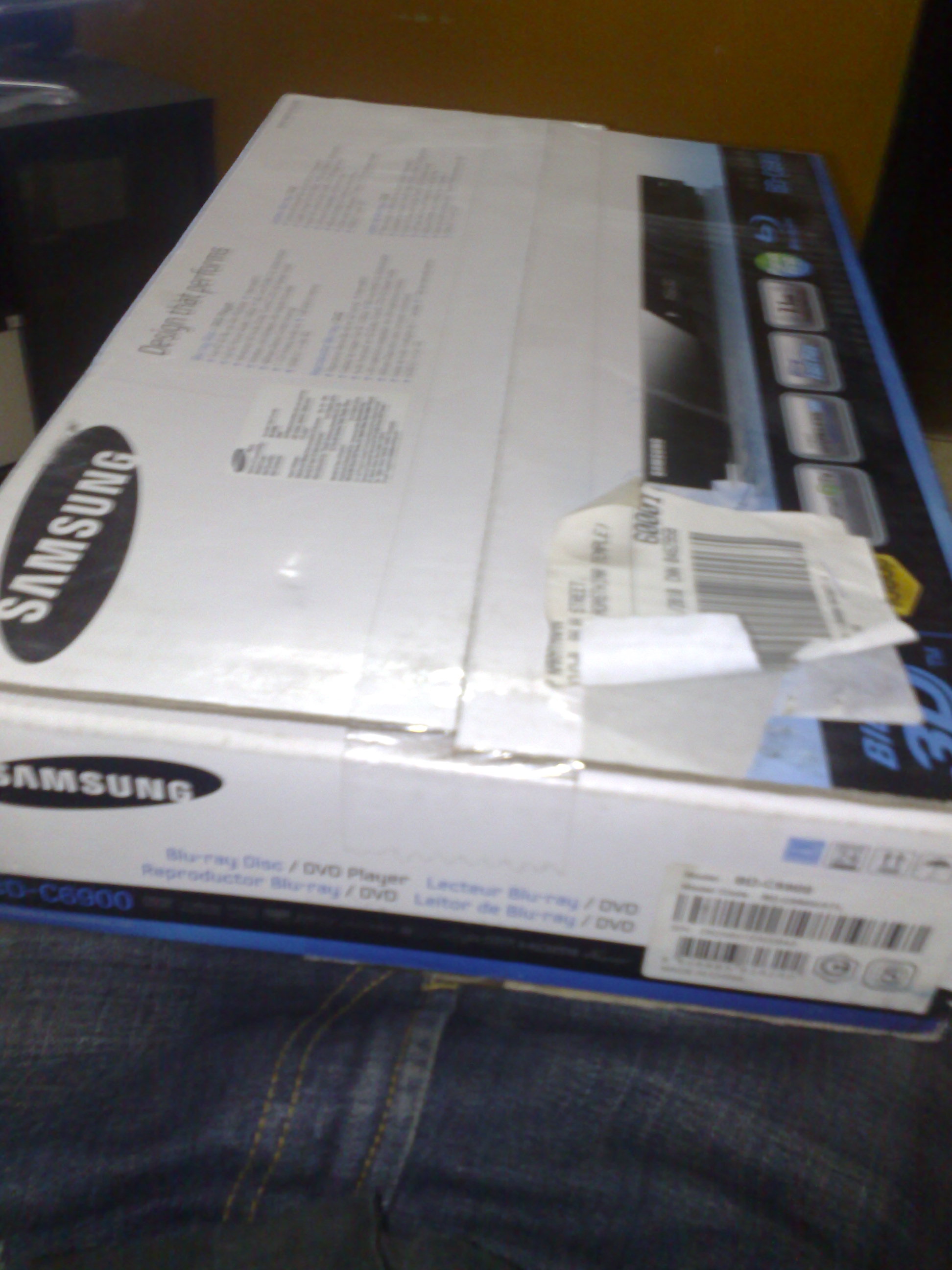
Package sealed by Cello-tape!?

Package carries someone else's name and address - Used box!

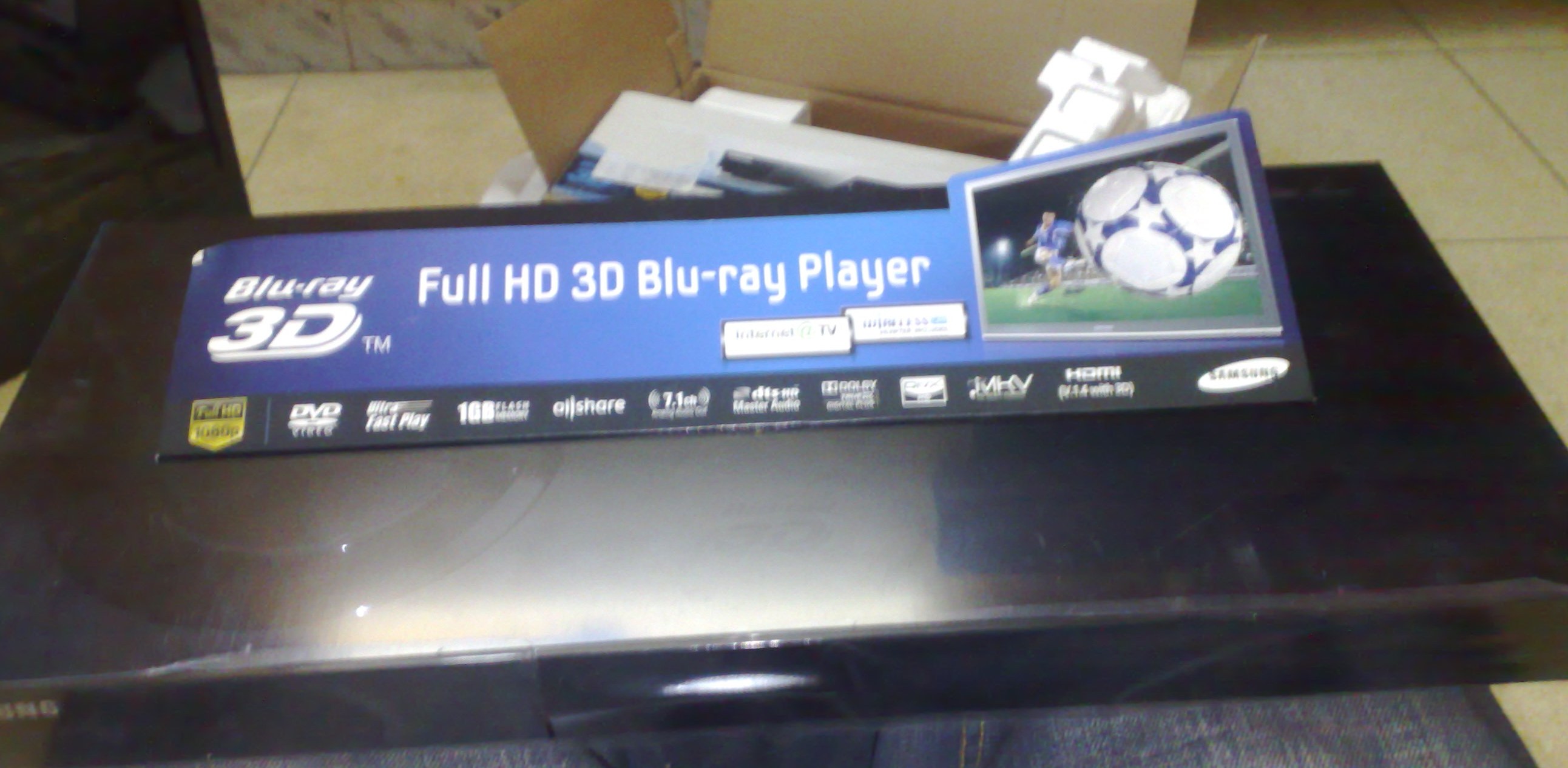
I open it to find the Blu Ray player with the packaging – WITH THE DISPLAY FEATURE CARD GLUED TO IT, with scratches, with the base of the player discoloured, indicating it has been used before.

There it is, the Point of Sale Display Feature Card, NOT sticker, glued to it. Plus scratches!

I call Venkatesh and tell him about this. No response for half hour. Then, I send a text telling him I would complain if I don’t hear from them. In the text, I identify myself as a journalist which is probably the only reason Shahul Hameed called back. I tell him I have studied mass communication and know the difference between a sticker and a display card. Shahul Hameed tells me he’s sending Raj home to attend to the complaint. He asks me to mail him pictures of the player and I do that.

Raj comes home, apologises for not taking calls, tries to convince me it is not a display piece until I show him all the scratches and the discolouration of the base. He apologises again, promises to report back on it and tells him he would give us a fresh piece when it arrives in a couple of days. I tell him I had visited the showroom seven times and I didn’t intend doing more and I expected him to follow up and keep me updated on this.

I wait till February 10 before I go to meet Shahul Hameed at the store (visiting it for the eighth time) at around 8.30 p.m. since I have not heard from anyone from Croma since Raj’s visit. I’m told Shahul Hameed isn’t there. Nor is Venkatesh. Nor is Raj. And the salesman promises me that stock will arrive in 3-4 days. I text Shahul Hameed and ask him to respond. I wait for an update till February 15. No response.

45 Days after billing, I finally lodge a complaint online on the Croma site. My complaint number is 163/150211/Led/150255.

But for the call on February 5 and the call in response to my text on February 6, no one from Croma has never even called me in these 45 days to update me on the status. And I have visited them eight times already!

A 3D TV is of absolutely no use without a 3D player. You can imagine how angry I am.

Page 11 of 88 « Previous 1 … 9 10 11 12 13 … 88 Next »
  • Blog at WordPress.com.
Privacy & Cookies: This site uses cookies. By continuing to use this website, you agree to their use.
To find out more, including how to control cookies, see here: Cookie Policy
  • Subscribe Subscribed
    • MADRAS INK.
    • Join 480 other subscribers
    • Already have a WordPress.com account? Log in now.
    • MADRAS INK.
    • Subscribe Subscribed
    • Sign up
    • Log in
    • Report this content
    • View site in Reader
    • Manage subscriptions
    • Collapse this bar
 

Loading Comments...