• SUDA MING’S CHANNEL
  • TALKING FILMS
  • Good Night | Good Morning
  • My Talk Show
  • PROFILE

MADRAS INK.

Menu

  • Archives
  • Columns
  • Diary
  • Interviews
  • My Films
  • Reviews
  • Good Night | Good Morning

  • Word thru the bird

    Tweets by SudhishKamath
  • Connect with GNGM

    Connect with GNGM
  • About GNGM

    Reviews

    “A cerebral joyride”
    Karan Johar, filmmaker on REDIFF

    “Among the most charming and creative Indian independent films”
    J Hurtado, TWITCH

    ★★★★✩
    “You don’t really need a big star cast… you don’t even need a big budget to get the techniques of filmmaking bang on…”
    Allen O Brien, TIMES OF INDIA

    ★★★★✩
    “An outstanding experience that doesn’t come by too often out of Indian cinema!”
    Shakti Salgaokar, DNA

    ★★★
    “This film can reach out the young, urban, upwardly mobile, but lonely, disconnected souls living anywhere in the world, not just India.”
    Namrata Joshi, OUTLOOK

    “I was blown away!”
    Aseem Chhabra, MUMBAI MIRROR

    “Good Night Good Morning is brilliant!”
    Rohit Vats, IBN-LIVE

    ★★★✩✩
    “Watch it because it’s a smart film.”
    Shubha Shetty Saha, MIDDAY

    ★★★✩✩
    “A small gem of a movie.”
    Sonia Chopra, SIFY

    ★★★✩✩
    “A charming flirtation to watch.”
    Shalini Langer, INDIAN EXPRESS

    “Interesting, intelligent & innovative”
    Pragya Tiwari, TEHELKA

    “Beyond good. Original, engrossing and entertaining”
    Roshni Mulchandani, BOLLYSPICE

    * * * * *
    Synopsis

    ‘Good Night Good Morning’ is a black and white, split-screen, conversation film about two strangers sharing an all-night phone call on New Year's night.

    Writer-Director Sudhish Kamath attempts to discover good old-fashioned romance in a technology-driven mobile world as the boy Turiya, driving from New York to Philadelphia with buddies, calls the enigmatic girl staying alone in her hotel room, after a brief encounter at the bar earlier in the night.

    The boy has his baggage of an eight-year-old failed relationship and the girl has her own demons to fight. Scarred by unpleasant memories, she prefers to travel on New Year's Eve.

    Anonymity could be comforting and such a situation could lead to an almost romance as two strangers go through the eight stages of a relationship – The Icebreaker, The Honeymoon, The Reality Check, The Break-up, The Patch-up, The Confiding, The Great Friendship, The Killing Confusion - all over one phone conversation.

    As they get closer to each other over the phone, they find themselves miles apart geographically when the film ends and it is time for her to board her flight. Will they just let it be a night they would cherish for the rest of their lives or do they want more?

    Good Night | Good Morning, starring Manu Narayan (Bombay Dreams, The Love Guru, Quarter Life Crisis) and Seema Rahmani (Loins of Punjab, Sins and Missed Call) also features New York based theatre actor Vasanth Santosham (Bhopal: A Prayer for Rain), screenwriter and film critic Raja Sen and adman Abhishek D Shah.

    Shot in black and white as a tribute to the era of talkies of the fifties, the film set to a jazzy score by musicians from UK (Jazz composer Ray Guntrip and singer Tina May collaborated for the song ‘Out of the Blue), the US (Manu Narayan and his creative partner Radovan scored two songs for the film – All That’s Beautiful Must Die and Fire while Gregory Generet provided his versions of two popular jazz standards – Once You’ve Been In Love and Moon Dance) and India (Sudeep and Jerry came up with a new live version of Strangers in the Night) was met with rave reviews from leading film critics.

    The film was released under the PVR Director’s Rare banner on January 20, 2012.

    Festivals & Screenings

    Mumbai Film Festival (MAMI), Mumbai 2010 World Premiere
    South Asian Intl Film Festival, New York, 2010 Intl Premiere
    Goa Film Alliance-IFFI, Goa, 2010 Spl Screening
    Chennai Intl Film Festival, Chennai, 2010 Official Selection
    Habitat Film Festival, New Delhi, 2011 Official Selection
    Transilvania Intl Film Festival, Cluj, 2011 Official Selection, 3.97/5 Audience Barometer
    International Film Festival, Delhi, 2011 Official Selection
    Noordelijk Film Festival, Netherlands, 2011 Official Selection, 7.11/10 Audience Barometer
    Mumbai Film Mart, Mumbai 2011, Market Screening
    Film Bazaar, IFFI-Goa, 2011, Market Screening
    Saarang Film Festival, IIT-Madras, 2012, Official Selection, 7.7/10 Audience Barometer

    Theatrical Release, January 20, 2012 through PVR

    Mumbai
    Delhi
    Gurgaon
    Ahmedabad
    Bangalore
    Chennai
    Hyderabad (January 27)

    * * * * *

    More information: IMDB | Facebook | Youtube | Wikipedia | Website

  • Browse: Categories

  • December 2025
    M T W T F S S
    1234567
    891011121314
    15161718192021
    22232425262728
    293031  
    « Dec    
  • Recent Posts

    • Simmba: A departure from the formula
    • Zero: The hero who wasn’t
    • Protected: AndhaDhun: What did that end mean?
    • Love and other cliches
    • October: Where is Dan?

Browsing Category Archives

Website under construction.

Chennai Roof Top Film Festival Revival: Heist Night

September 20, 2011 · by sudhishkamath

It was a tricky start.

After the RTFF Google group failed to agree on one genre with a three way split between heist films, noir films and black comedies, it was totally up to the curator to take a call on what he wanted to do for the very first edition of the revival of Roof Top Film Festival, Chennai, a movie marathon series started by Ganesh APP in 2008.

Smartly, Sandeep decided not to announce the genre so that people have to show up to find out. One of the things we had decided during the on ground meeting of RTFF was that the curator should be comfortable with the genre he’s hosting so that he can pick the best films to screen. And Sandeep felt most confident about heist.

I knew what to expect because Sandeep shared his shortlist with me and though we discussed the best options, the final list was going to be decided at the venue based on the questionnaire handed out to every participant on THE night.

So on September 17, the night of the revival edition curated by Sandeep, every camper was given a questionnaire with a list of 16 heist films and asked to tick the ones they had already seen. We had also decided was that we were surely NOT going to screen the obvious choices – films that every movie buff worth his bootlegged DVD had already seen. Reservoir Dogs, Oceans 11, Italian Job, Usual Suspects, Inside Man or Bank Job. What’s the point watching films you’ve already seen with people who had already seen them? Especially, when it’s really difficult to pack more than 4-5 films a night!

Our guess was right – Over 60 per cent had already seen The Usual Suspects and The Italian Job. Only one person had actually seen Bandits. So Sandeep decided to start with the necessary evil – one mainstream Hollywood film for the night.

I reached the venue about five minutes into the film and I was shocked by his choice. “Dude, this is not even a heist film!”

“But it’s about bank robbers, it’s about the Sleepover Bandits,” he said.

Maybe it was a good choice to start off the festival with a film that generates discussion on what is a heist film. A heist film essentially follows a certain structure and comprises of certain elements that define the genre.

“Inception is a heist film,” I told Sandeep.

“No way,” he said.

We didn’t get down to discussing how Inception was a heist film because that would’ve totally taken over the night but I do wish our Roof Top campers were a little more enthusiastic about talking about the films they had just watched. After every film, someone had to ask them what they thought, every single time. Maybe we should have a moderator chosen by the curator who will facilitate discussions if the curator does not want to talk about the films himself.

It’s the conversation that makes RTTF a social event, after all.

Bandits was a buddy movie, a love triangle that was more about stealing your best friend’s girl than the money but thankfully, a decent climax after a long winded detour into the romance portions restored the theme for the night – heist.
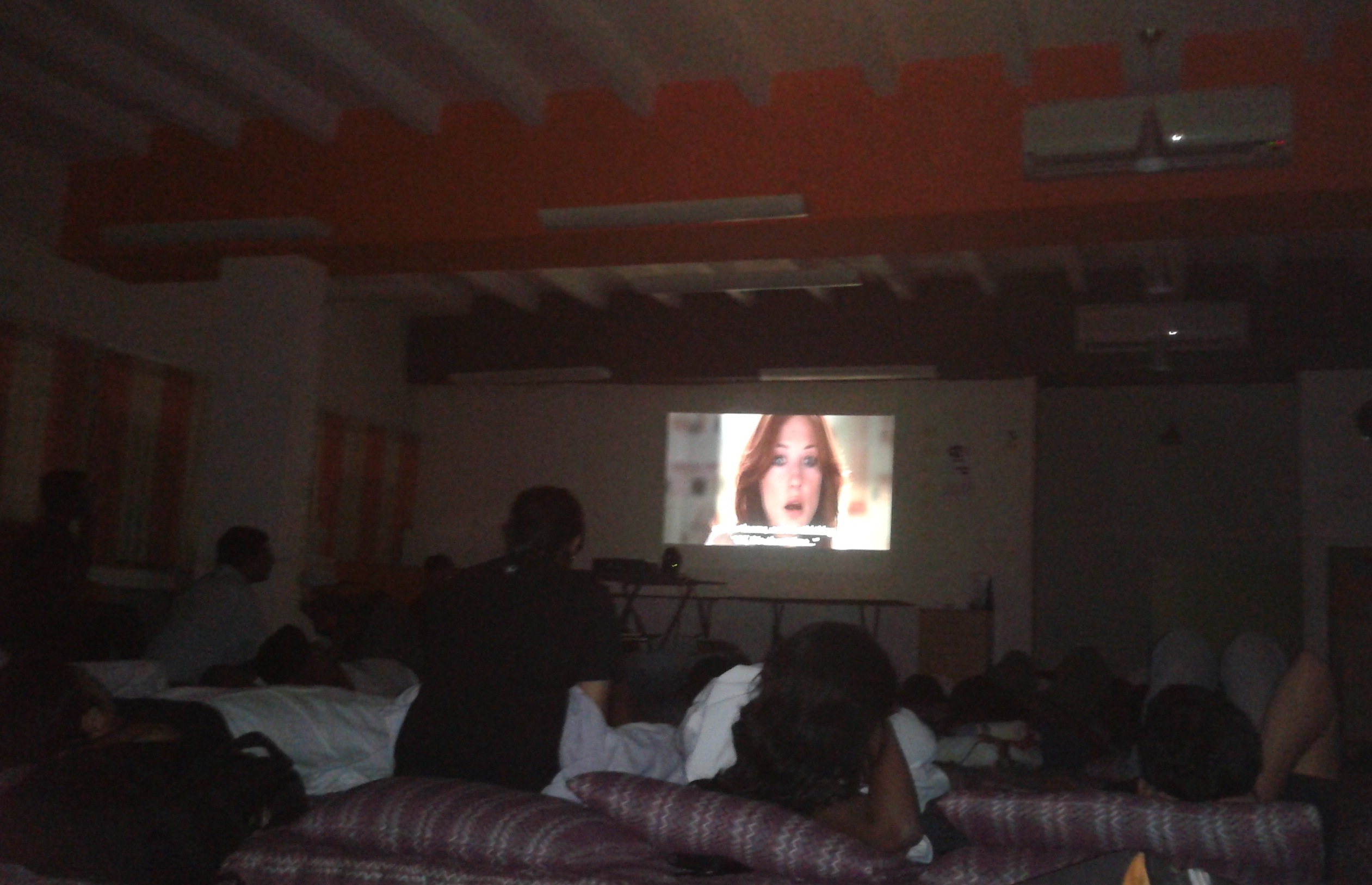
It helped that the film brought in laughs at regular intervals and though, at least on paper, NOT the ideal start to revive the RTFF, it turned out to be just fine. Nobody objected because they watched a movie they hadn’t watched before.

It was also the longest movie that night – well over two hours and it was better slotted at the first film than somewhere in the middle being the weakest of the lot Sandeep had with him.

Sandeep wanted to start off with Godard’s Band of Outsiders, the film that’s been described as an anti-heist film, one that inspired Tarantino to call his banner A Band Apart. But due to a technical glitch (the DVD played only on a Mac and not Windows), he decided to play The Score but even that disc decided not to play. And so, Bandits it was. A harmless way to get things started, a buddy film with plenty of feel good & a cheeky ending to save us the blushes.

The big surprise for the night was kept under wraps because it would have been a huge disappointment had our mystery guest been unable to make it for some reason, especially with all the rain. Venkat Prabhu, who directed the superhit Mankatha, one of those rare heist films made in Tamil, had agreed to drop by and talk about his experience. Since he was expected around midnight, we decided to kill some time under the pretext of ordering dinner and playing a short film till it arrived.

We played Shor at 12.20 a.m, the 20-min short directed by Raj & DK that went on to get critical acclaim and also served as a pitch for them to make their feature on the same theme – Shor In The City. When people applaud at the end of the film, you know the fest is doing something right.

The next film for the night was Stanley Kubrick’s The Killing, one of the classic, definitive heist films ever made, one that inspired Quentin Tarantino to make Reservoir Dogs.

Before we could play that, the floor was open to discussing elements of a heist film. And the group seemed to reach a consensus that heist films have four parts – The Players, The Plan, The Execution & The Consequence/Getaway with plenty of scope for twists and turns and surprises.

On this note, we discussed where Mankatha worked despite its deviations into hero-worship and just when we were about to hit Play to get The Killing started, Venkat Prabhu made an entry. Surprise at 1 a.m!

The next one hour was spent discussing how he made his heist film and how it changed considerably with market forces.

Of course, since most of it was off-the-record, on request by the director, we won’t blog about every candid detail he wanted to share with us. The old version of The Italian Job was the starting point for Mankatha. It wasn’t a script originally written for Ajith, it was meant to be a small film with his regular bunch of boys. And the fact that Ajith wanted to play one of the boys was one of the biggest reasons Venkat Prabhu decided to make this a bigger film than planned, especially with the potential and opportunity it presented with one of the biggest stars in showbiz agreeing to play a role that wasn’t typically heroic. But that was also what made it more and more original.

The crowd was hooked. Everyone got to ask him what they wanted and some more over dinner. We watched Kubrick’s The Killing after that and the film ended to more applause with its fantastic ending.

We discussed how the talkie nature of the film meant that every minutest detail was spelt out through voiceover and that this had to be evaluated in the context of evolution of cinema itself.

The next film only highlighted how cinema itself had changed. From black and white to Eastman Colour, from talking to showing as the focus shifted from dialogue to action in The Italian Job, something Sandeep decided to screen though one third of the group had already watched it because Venkat Prabhu had just spoken about that film. Italian Job was not just funny, it also boasted of spectacular action sequences. Turned out to be the perfect choice for the third film as a contrast to The Killing.

When the film is good and people are sleeping, you know it’s not the curator’s fault. More than 60 per cent of the campers had already gone to sleep or left when we decided to play the last film for the night at around 4.45 a.m. Ringo Lam’s City on Fire, another film that inspired Tarantino to make Reservoir Dogs, the film about the undercover cop and a heist gone wrong, with its men in suits shades walking in slow-mos and the bloody Mexican stand-off for a finale.

By the time, we called it a night, it was already about 7 in the morning. A night well spent.

And RTFF got off to a start with a bang, thanks to Sandeep Makam, the curator and Vijayanand, founder of Startup Centre, Alsa Mall, our host for the night.

The next edition of RTFF will happen in October and will be curated by Vijay Venkataramanan, who used to programme for the Indian Film Festival of Los Angeles. Vijay is a professional film editor with quite a few films to his credit, including my own ‘Good Night Good Morning’.

He already has a bunch of films he has sourced and one thing’s for sure, you will not get bored. Follow @ChennaiRTFF & @vsnipz to stay tuned about the theme for the next edition. Also join the RTFF Google Group & like the Facebook page to stay updated about upcoming fests.
Critics: 10 Things You Hate About Them

September 8, 2011 · by sudhishkamath

Disclaimer: This could have been written by any film critic in the world and is addressed to every critic of theirs. So please don’t read this as a personal expression directed at you if you hate me/opinion. Best read with a little distance – like a party watching the fight from the best seat in the house.

You don’t hate your milkman, postman or watchman. In fact, you tip them once in a while. Or your family doctor or the architect who designed your house. You pay them for consultation. You probably hate a few celebrities, film and sport-based, and of course, politicians. Over the last decade, journalists, especially critics, commentators and analysts have joined the most hated club.

It’s understandable that you don’t like sportsmen or entertainers when they don’t perform or politicians when they don’t deliver what they promised and extending the same logic to commentators, analysts and critics, you could say you don’t like the way they do their job… which is to say you don’t always like the points they make. They all have opinions that somehow don’t always match with yours.

Let’s forget all the work experience, educational qualifications or specialised courses that got them these jobs, just like they got you yours, for a moment. Because once we bring that up, there is no further debate once you accept that just like doctors, engineers, lawyers, architects, these are professionals paid for their expertise in a certain area.

You don’t even pay them personally (unless you want to include your cable and newspaper bill which put together per month will be way less than what you pay your doctor per sitting or what you would spend on a single trip to the movie theatre with friends) yet you find this dislike surface every now and then. Why?

Here’s ten things you hate about them.

1. You want their job. Or you wish you had their job. You just can’t come to terms with the fact that you are stuck doing something else while someone there is bumming around on TV or typing away on a computer to make a living, watching cricket matches, interviewing influential people or just watching movies. And probably making more money than you.

2. You think you are always right. You may decide to resolve an argument with friends with the usual “Let’s agree to disagree” or by calling them names before changing the topic… Or sometimes, by producing proof that you are right by quoting from a person of some authority. And these critics sometimes happen to be those very people quoted back to you. From there on, it’s just your opinion versus theirs. Your hubris will never let you believe you are wrong, even if you deep down know that you don’t know enough.

3. You have an axe to grind. This usually happens when you or something you are associated with, has been at the receiving end of criticism in the past – either a long string of bad reviews as an established filmmaker/producer/affiliate or negative feedback as someone starting out. Imagine this. You want them to give you a line you can put on the cover of your DVD. They don’t find anything positive to say and politely decline. The next thing they know you are either going around town crying how they were mean and that they think too much of themselves. Or worse, you mail back saying that you understand, thank them for their honest feedback and then go on a hate campaign.

4. You want their attention. It’s probably cathartic to get it all out and have some closure but very rarely are you able to get them to hear all about what you think. How long can you handle this one-way communication? At some point you want them to know how you feel. Most troll behaviour on the internet is about attracting attention.

5. You hate their success. Schadenfreude. You derive immense pleasure watching someone slip-up, however minor. As Green Goblin told Spiderman: “The one thing they love more than a hero is to see a hero fail.” Underdogs make news when they succeed while the successful make news when they fail. Your Schadenfreude is validation of their success.

6. You like to sail against the wind. You don’t want to be just another person agreeing with the majority. You don’t want to be ordinary. You want to be a rebel, cause or not, and would do anything to stand out. You can always say you are too intelligent to agree with a majority. Whatever floats your boat!

7. You have nothing else to do. As civil right activist, Eleanor Roosevelt once said: “Great minds discuss ideas. Average minds discuss events. Small minds discuss people.” With Twitter, Facebook, blogs and many more avenues to do absolutely nothing, you feel the need to discuss but are unable to go beyond people.

8. You know it’s easier said than done. You are the types who could give Mahendra Singh Dhoni advice on whether he should bat or bowl first. Or tell Dravid when to change gears between offense and defense. As singer Helen Reddy says, “Hindsight is wonderful. It’s always very easy to second guess after the fact.”

9. You forget it’s just one person’s opinion. As a fellow film critic, Mayank Shekhar says: “If you go to Australia and come back and write that you didn’t have a good time there, it does not mean Australia is a bad place. It just means you didn’t like it.” But here’s a thought. Would you take travel advice from someone who has just been to one part of Australia or someone who has been to more places there than you have?

10. You don’t see the futility. Do you criticise someone saying they cannot take criticism because they criticised your criticism of their criticism? If all criticism can be criticised, then every counter-criticism becomes the subject of further-criticism between all parties involved in an argument and if everybody has a right to their opinion, what is the point of it all? It’s like a Mexican stand-off with a bunch of people saying Fuck You to each other. Forever.

That Girl in Yellow Boots: That Sheep In Lion’s Clothing

September 4, 2011 · by sudhishkamath

Genre: Drama

Director: Anurag Kashyap

Cast: Kalki Koechlin, Prashant Prakash, Gulshan Devaiya, Naseeruddin Shah

Storyline: A girl comes to India in search of her father and works in a massage parlour servicing the seedy underbelly of Mumbai

Bottomline: A predictable but brave effort but not as bold as it pretends to be

For a film that with an ending you can guess even from the synopsis or just the storyline, it’s amazing how Anurag Kashyap keeps it all well concealed. If you thought a good film cannot be made with a bad script, Kashyap proves you wrong in his best directorial effort yet.

Direction is one department that becomes a whole lot easier when you have a strong script, good actors, the best of technicians, budgets etc. Here, all Anurag Kashyap has is a half-baked script full of clichés, indulgence, not the best actors for the part or the budget of a big film to hire the best of technicians or more days of shoot. Yet, every scene is crafted and staged with a touch of brilliance as Kashyap stamps his class over the most mediocre material he has worked with and turns it into a mood piece.

Didn’t think you would find clichés in a Kashyap film? Every guy in big bad Mumbai the 20-year-old girl turns to for help is a lech and wants sexual favours or money. How is this any different from a Madhur Bhandarkar film ridden with bad city stereotypes? If this film were made by Bhandarkar, it would be called Massage Parlour and he wouldn’t even need to change the script.

But at least Bhandarkar would not hold back the punches. He is more daring filmmaker than Kashyap in this regard. Kashyap’s heroine services this seedy underbelly of the ugly city by doing sexual favours to repressed men frequenting  the parlour out of her own choice to make a quick buck but does not put out completely. She does not go all the way because apparently that would make it a movie cliché and is less disturbing than offering them her “handshakes”. It is obvious that the intention here is to shock and awe by employing something that’s rarely been spoken about on the Indian screen than do justice to what the film requires the character to be.

So, like most Yash Raj heroines, the girl is virginal, even when her profession demands the danger of it being threatened. So she has not even slept with her boyfriend because she can only think of finding her father. She would do anything to find her father and yet, when the situation arrives that she has to cater to a group of rich diamond merchants, the director checks that need with a convenient solution of her boyfriend showing up.

The bane of this film is that its idea of sex does not involve the act of sex itself. Since the girl hasn’t crossed the line of virginity, the ending of the film is way less shocking or disturbing than the script demands. Kashyap shows ambitions of being Gasper Noe but ends up being more conservative than even Robert Zemeckis. Even family-friendly Back to the Future showed more inappropriate behaviour than what’s in this supposedly bold adult film.

The impact is also diluted because of the way the rituals are shown in the film. We see shots her chucking tissues, washing her hands, routinely repeating it every day. While this “handshake” business may be shocking to the aunt next door, to people who are used to world cinema, this is a literally watered down version.

Yet, the film keeps you intrigued because of the way Kashyap has shot this material. His shot-taking (cinematography by Rajeev Ravi) and blocking will serve as a master-class for independent filmmakers with budgetary limitations.

The extremely natural, seemingly improvised quips of Gulshan Devaiya and Puja Swarup go a long way in providing the lighter moments the film needed to balance its one-note brooding mood. Kalki’s histrionic limitations are exposed when she has to share frames with Gulshan or Puja. Kalki is fantastic when she has to let her eyes do the talking (again, an example of director making up for the script without a single memorable line) and when she doesn’t need to get dramatic. It’s the screechy, high-pitched outbursts that she can’t seem to get right. They are always a notch above what the camera can handle, a performance that would’ve been more appreciated on the stage. Prashant Prakash is a victim of this stage-to-film transition too but shows great promise with his body language and timing.

How do you make a predictable plot less guessable? Throw in red herrings. That’s exactly what Kashyap does. It is gimmicky, of course, but without these misdirections, this is a film with an ending you would’ve guessed within the first five minutes.

In his efforts to divert and distract, he also gets the casting of the father wrong and the otherwise intense climax suffers hugely from this. The score by Naren Chandavarkar and Benedict Taylor is just what the film needed to get its mood right, especially towards the final frames.

Overall, this is a film that, like That girl, sits on the wall. It may be virgin territory for India but done with far more intensity outside. And the Yellow Boots remain far from soiled.

(An edited version of this review appeared here.)


Bol: Brave voice from Pakistan

September 4, 2011 · by sudhishkamath

Genre: Drama

Director: Shoaib Mansoor

Cast: Humaima Malik, Mahira Khan, Iman Ali, Atif Aslam

Storyline: A girl about to be hanged tells her story and of Pakistan’s population woes

Bottomline: World cinema corrupted by Bollywood

When you watch films like Majid Majidi’s Baran (Iranian) or Siddiq Barmak’s Osama (Persian), you get a haunting picture of how things work behind the veil in the Islamic world. It’s one of those bitter pills that hit you at the gut, so grim and with very little hope.

And then, in complete contrast is Hindi cinema’s take on the arthouse – the multiplex movie which still wants to end on a positive note and because films without any feel good rarely find takers at the box office. Maybe it’s also the effect of mainstream Bollywood on the arthouse that films end with hope.

Shoaib Mansoor’s new film (he had earlier made the critically acclaimed Khuda Kay Liye) takes us into the household of a hakim’s family in Lahore to give us a hard-hitting film on the state of affairs, treatment of women and transgenders in Pakistan but the impact of this punch is rather watered down because of its Hindi cinema influences – the need to end with feel good.

So we have the film begins quite dramatically with a woman facing death sentence, granted permission to call for a press conference – straight from the very spot she’s about to be hanged. Once you suspend your disbelief and ignore the filmy acting by its leading lady Humaima Malik in these opening portions, the film comes into its own in the flashback.

Considering that what the film wants to say is in the flashback and that it does it so effectively without holding back any punches, the very setting for the story to unfold seems unwarranted.

The narrator of the film was among the seven sisters born to an orthodox Hakim in Lahore on the brink of poverty with the advent of private clinics. After repeated efforts to yield a boy, the eighth attempt results in the birth of a transgender much to the frustration of the father, whose initial instincts are to kill the baby.

It’s a fantastic premise for the story to unfold as the family spirals further down into poverty, the father unwilling to let any of the girls work or step out of the house. It’s quite commendable how the filmmaker Shoaib Mansoor has managed to bring out the hypocrisy of the patriarch and his convenient interpretation of the Koran to justify everything he does. The laughs in this otherwise serious film come our way as his hypocrisy is further exposed when he’s asked to produce a girl child for a courtesan Meena (Iman Ali plays a Pakeezah fan) to pull himself out of financial trouble. Now this is a man so staunch in his beliefs and value systems that he threw a fit when his daughters playfully told him that they had crushes on Tendulkar and Afridi.

There’s surely a gem of a film somewhere in there in between of all that Hindi cinema packaging, one that’s so bleak and yet offers a little hope through its Atif Aslam-Mahir Khan romance track.  Given the entire gamut of issues relating to gender, religion and social norms, it is tragic that the filmmaker ends the film choosing to spell out just one moral, the least interesting of them. “Why make babies if you can’t raise them?”

Bol has a lot more that’s interesting to say and show us than that issue. Despite its failings (in its the first five minutes and the last five), it’s a brave voice from Pakistan that deserves to be heard. Surely the pick of the week among the Hindi releases.

(This review originally appeared here.)

Bodyguard: Another showcase for Sallu’s body

September 4, 2011 · by sudhishkamath

Genre: Drama

Director: Siddique

Cast: Salman Khan, Kareena Kapoor, Raj Babbar, Rajat Rawail, Hazel Keech

Storyline: A bodyguard falls in love with a mysterious caller over the phone

Bottomline: Salman makes this tighter remake work

Salman Khan has clearly figured a way out to play it safe at the box office. Take films that have done really well from the South and then Salman-ise them with elements that fans expect from his films.

Though the original film (Bodyguard in Malayalam, Kavalan in Tamil) was a sappy, long-winded drama that relied solely on the twist at the end to deliver, here the twist is just an excuse to wrap up another full-blown Sallu showcase.

Like Salman really needed an excuse to take of his shirt and shift the attention from script to his body, this film gives him enough reason to go flex his muscles. So, right from the moment he’s introduced when he’s doing the muscle-dance, flaunting his biceps, he’s doing what he does best – the gym routine.

He’s walks around like the Hulk, fights bad guys and sends them flying and bullets never seem to find him, even if his frame occupies two thirds of the screen. Sallu is Lovely Singh, a bodyguard assigned to protect Divya (Kareena Kapoor) who prank calls him from an unidentified number, the series of phone calls leading to an unlikely old-fashioned romance where Lovely does not care what she looks like because love does not stem from the eyes, it stems from the heart.

If a playing a Bodyguard does not let him do all that he does in other films anyway, what will? There’s a scene where he slips into uniform that’s loose and works out just to fit into it. That says everything you need to know about the film. It isn’t a tailor-made role for Salman. It’s Salman filling out an already designed loose shirt with his muscle.

The writers haven’t been able to write many punch-lines this time? Does not matter. Salman will manage saying the same line three times in the film. “Do me a favour. Do me no favour.” Never mind if it makes him sound indecisive. But surprisingly, Salman is quite subdued this time and he also gets to put his acting muscle to use when he has to act all soft and sincere.

The laughs are entrusted to debutant Rajat Rawail who brings the house down with physical comedy, his huge frame and flabby torso in drag responsible for most of the laughs while Raj Babbar performs with the gusto of an eighties villain in a role that would have ideally preferred Amrish Puri.

It’s the Salman version of a Karan Johar film of the nineties that is bound to be compared with the sappiness of Kuch Kuch Hota Hai, given the drama at the end and another few-year-old almost saying “Tussi Mat Jao,” a cue for the ladies in the hall to weep silently.

Kareena puts in an effortless performance (her sister Karishma has dubbed for the phone call portions of the film for her) and looks absolutely ravishing in the ‘Teri Meri’ song placed before the climax. If the film works even somewhat, it is because of the presence the leads command. Kareena and Salman raise the game to a different level and this remake is probably the best this script can be.

So please, Siddique. Don’t make this again in another language. We have endured enough already.

(This review originally appeared here)

Mankatha: Ajith plays his cards right, finally

September 1, 2011 · by sudhishkamath

Ajith’s character does not exist in the film. That’s the ending.

He’s a figment of Vaibhav’s imagination. The Keyser Soze. The dangerous diabolic villain Vaibhav ‘Verbal Kint’ makes up as he comes up with a story he makes up in the interrogation room from plot points he remembers in Tamil films.

First Vaibhav creates a Nayakan character. A Dharavi don, we don’t know if he’s Nallavara Kaettavara (good or bad?).

Then he makes the Nayakan Don marry him off to the girl he loves like Mammootty does for Rajnikant in Thalapathy.

They plan a heist involving a geek hacking into the traffic light system of the city, like in the Italian Job. And there’s Ajith sporting his natural greys like Clooney in Oceans.

There’s a hint that he’s making up stories from Tamil films he watches because there’s a Kamal Haasan poster in his room and he’s sporting the same beard as Kamal. In a Trisha-Ajith song, there’s a song from Kireedam playing on the TV behind.

Vaibhav makes up this story about an imaginary character called Vinayakam played by Ajith and walks away into the sunset with “500 crores. Ainooru Kodi. Money. Money. Money. Money.”

Mankatha da!

Gotcha suckers! Was kidding. I made up that ending, to mess with those who are reading reviews before watching the film. “My f***ing game”.

On a serious note though… The pop culture nods/references are so many that you think you’ve cracked it but Venkat Prabhu keeps messing with your head, the references just used to tease and nothing more. Just as you think it’s going the Ocean’s way, it’s not. You think it’s going the Italian Job way, it’s not. You think it’s going the Usual Suspects way, it’s not. You think it’s going the Reservoir Dogs way, it’s not. It’s a fairly original film, even if long-winded and a tad conveniently slapped with a twist ending.

Personally, I would have liked one of the other boys in the film to emerge as the hero in the end but I guess mainstream Tamil cinema is not ready for that yet.

After Aaranya Kaandam, Mankatha is one of those rare Tamil noir films. Neo-noir, like the Thiagarajan Kumararaja film, with all its pop culture tributes, plot derivatives and spins on film noir narratives.

If at all you hear the film is ripped off from such and such film, it’s because whoever told you that has probably seen only that one film in that genre.

Noir is not just treatment, noir is a genre with a clearly identifiable template and recurring themes – evil dominates, almost every character is grey or black hungry for money and could kill for it, the deadly femme fatale, allies turning against each other, betrays, greed… you get the idea, a complete exploration of all that has to do with the dark side of human nature.

Calling it a noir film does not automatically become a compliment just like calling a chick flick a chick flick does not by default make it a good film.

I won’t get into the plot details (though it is pretty much what is expected from the genre template) but hats off to the director to take the genre that typically explores the dark side of man and turn it into a completely light-hearted mass entertainer. I can think of wickedly delicious and dark crime comedies that employ the noir template but it’s one of the first films (Farhan Akhtar’s Don did this too) that takes something that is primarily dark (and hence restrictive in reach by genre) and turns it into a celebration of the morally bankrupt by a mainstream hero worshipped by millions without failing to glorify its “hero” who is in reality the scum of all scums.

As the opening titles roll out, Venkat Prabhu gives you the first hint – Mankatha – Strictly No Rules. There are no rules for this “hero”. He drinks to the point of total memory loss, he cheats on his girlfriend, manipulates friends for his own gain and wouldn’t think twice about killing anyone. Yet, he’s still the Thala – that stupid sobriquet that blurs the line between the star’s real life persona and the character he plays in films. I hope he uses his head and drops that Thala baggage at the earliest.

Stars play the same role again and again in all movies (MGR, Rajni, Vijay, Ajith) because people pay to watch them do the same things while actors do different roles again and again (Sivaji, Kamal, Vikram, Suriya, Dhanush) because people pay to watch them do different things.

In recent times, we have had some stars preferring to do actor roles (Vijay with Kavalan, for eg. or Rajni with Enthiran) and some actors preferring to do star roles (Suriya in Aadhavan or Singham or Vikram in Kanthasamy) and that’s where our problems begin because here we have this blind idiocy of hero-worshipping the guy who can beat up people on screen.

He maybe bald, he may have a paunch or a triple chin or be as tall as a midget in real life, does not matter. As long he has a sobriquet (Ilaya Thalapathy or Thala or Little Super Star or Captain) and fan clubs, there will be idiots around who will pay to watch them do the shittiest movies in history of Tamil cinema and also have the nerve to defend them.

Which is why I respect Suriya, Dhanush and even Vikram (his Chiyaan is just based on a character he became popular for), unlike this Worship-Me-I-Am-Your-Leader self-styled sobriquets… Thala or Thalapathy, that flaunt their ambitions of being the Thalaivar (leader). There is no doubting that Ajith can act, so can Vijay. Like all actors do, why don’t they just do their jobs instead of being on this narcissistic trip of being worshipped by fans?

So I would be the first to applaud Ajith for taking a step in the right direction and playing an actor who essays a role that’s usually used to describe the villain.

Which brings us to the problem area, that in the context of our cinema for the masses, fans are so blind and loyal that they actually think that by virtue of the hero doing certain things considered inappropriate, it becomes acceptable and legitimate to do that.

Now, I watched this film with hardcore fans of Ajith on the first day. So it was disturbing that they seemed to applaud the fact that he would drink to the extent of memory loss every night. Like he just echoed their thoughts. I heard some of the most obscene, sexually frustrated comments every time Lakshmi Rai or Andrea made an appearance and I am really wondering if the time is still right for us to make a film where the hero can play evil, not grey… completely and absolutely evil, with no redeeming feature. Almost.

Spoiler alert (Highlight to read): If he is that unabashedly evil given the number of people he kills in the film, would he need the friend or ally when he could technically keep all the 500 crores to himself, instead of splitting it? Why not kill the friend as the last ultimate move of villainy? But no, this is commercial movie. There has to be some good to make Thala likeable. With this ending generating feel good, Mankatha becomes a complete celebration of greed just like how fantasy films celebrate the good. 

The morals are a little unsettling in the Indian context of drunk fans and blind hero worship, at least given the bunch of people I shared the hall with. The last thing we want is drunk folk going around calling women “thevidiya mundais”.

To Venkat Prabhu’s credit, he uses quite a few alienation techniques to remind us that this is all just a story not to be taken seriously… there’s green blood to make it more children friendly, the jokes are of the nature of your best friend spoofing cult movie moments, the stunts are unbelievably larger than life and the really bad visual effects like glass shattering ensure that you always know that it just campy, cartoonish pulp fiction that you are watching, especially with Premgi’s presence (I found his quips to be the best part of the film) and Mahat. Good to see Action King Arjun and Laxmi Rai given something to play with but not enough but the rest of the cast, including Trisha, Andrea, Anjali, only get extended cameos. It’s quite nice that Venkat Prabhu is creating these small heroes who can support the smaller filmmakers – In addition to Shiva, Jai, Vaibhav, Premgi, Sampath, Arvind Akash, now add Mahat & Ashwin to that list.  The biggest bonus is the goof reel at the very end that assures kids that it’s just a bunch of friends having fun making a film, playing a game rather, and that who dies and who does not is immaterial because it was just a story to be forgotten instantly.

Mankatha is just that. It is forgettable but fun while it lasts. But it lasts too long. Ajith is given ample scope to perform and play a badass and this is probably the best role he has done in a while (considering Billa didn’t involve acting, it just needed him to show up to work and walk, Vishnu even keeping dialogues minimal). It’s refreshing really to see this side of Ajith. Make sure you stay till the end credits to see him have a blast on the sets, enjoying himself. As an actor mature enough to play his age or take digs at his own paunch, Ajith is evolving into a down to earth, likeable actor.

Venkat Prabhu does not seem to have the heart to cut anything out of his though quite a bit of it is indulgence as expected from a mass film made for fans on the occasion of the 50th film. He also has no heart to cut out the rest of the ensemble and makes sure he gives them all a song each at least and quite a bit of importance than you would usually not find in a solo hero film.  The result is a long film with which songs feels even longer though Yuvan does rock the score, the violin bit with slow motion action choreography being one of the best parts of the film.

Though it’s more thought out than most heist films made, the convenience with which everything is tied together in the end is a little disappointing. It’s as if the masses wouldn’t understand if it were any more complicated.

In the end, we have a film that looks more smarter than what it really is. Venkat Prabhu wins the guessing game (though you may guess the ending from a throwaway scene earlier on in the film) not by outwitting you playing by the rules but by cheating. Sorry, bongu.

But then, the tag line warned us. Strictly No Rules.

Rating: 6.5/10

P.S: I really hope Ajith and Vijay soon get tired of the hero-worship (and drop Thala / Ilaya Thalapathy from their names) and do their jobs as actors more often. The first step towards becoming a more serious actor is getting rid of the baggage that comes with the stardom. Yes, I am guilty of cheering for Vijay in the past too when Thirupaachi and Sivakasi came out. You know what that got me? One bad film after another. They kept making the same film again and again with him to the point of irritation that even the badly directed Kavalan seemed like a good break. The greatest disservice to an actor with potential is to worship a bad film. Stop defending the Aasals, aas***l*s.

Chitkabrey: Secrets Seven

August 27, 2011 · by sudhishkamath

Genre: Drama

Director: Suneet Arora

Cast: Ravi Kissen, Rahul Singh, Rajesh Shringapure, Svetlana Manolyo, Akshara Gowda, Pitobash

Storyline: Seven friends, each representing one of the cardinal sins, plus one more, meet at a reunion to find themselves trapped by an avenging junior from college

Bottomline: If you watch only one film a year, this is it. It will convince you why you were right staying away from films.

Promoted as the boldest Indian film made, Suneet Arora’s Chitkabrey – Shades of Grey, is indeed the most brave film to have hit the screens in recent times if it really thought that people will queue up to see a mostly naked Ravi Kissen.

There’s plenty of assorted nudity and love-making scenes thrown to spice up the amateur staging of what seems like a play with its Big Boss-like set-up. Like Big Boss, instructions are given by a mysterious stranger whose voice booms through the speakers to the occupants of the house.

So if you watch Big Boss as a guilty pleasure, you might just dig this. You will enjoy it for the same reasons as you watch the reality show. Laughing at it than with it most of the time. How can you keep a straight face and not laugh when a bad actor sobs to his wife that: “I let my boss enjoy with me” soon after a shot of two men sharing a shower.

A victim of ragging Rakesh Chaubey (Ravi Kissen) keeps the group captive at gunpoint and asks them to spill the beans on their dirty past.

Now, though Ravi Kissen’s character speaks chaste Hindi and quotes from his Hindu upbringing, he reproduces seven Biblical cardinal sins (and not the six arishadvargas from the Indian ethos) which is our first hint that the film has probably borrowed its core from another source and was desperately trying to find its footing in the Indian milieu.

A quick search online suggests a similar play by award-winning American playwright Kash Goins who wrote ‘VII Deadly Sins’ also about a reunion of eight classmates after a decade (changed to 15 years in this film though).

The caricatures that the makers of Chitkabrey give us:

Lust: Jaggi, the Sikh businessman with a big heart, is guilty of doing the naughty with a hottie and cheating on his wife. He was also the mastermind behind ripping off Ravi Kissen’s underpants during the ragging sequence.

Envy: The still-single Shankar betrays his successful rich friend Jaggi and also does the naughty with Jaggi’s wife on the sly.

Wrath: Angry young Deepak beat his 11-year-old because the kid got only 92 on 100 and also used to hit his wife because the salt in the daal wasn’t right.

Greed: Gujarati Jayan married for dowry and then ran off to Canada to start a fresh life with a brand new wife.

Pride: Rekha, the only girl in the gang, is so vain that she “prefers rape to a favour”. She “sells girls” for a living, while her husband is away picking up the soap for his boss. She used to be so vain that she once asked Ravi Kissen in college what he thought of her balls! Eyeballs, she clarifies after he uncomfortably says: Nice.

Gluttony: Aman Ali Siddiqui made a girl suck his pen in public back in college and is punished when his wife Fauzia Javed Khan has to eat kulfi in front of all his friends.

Sloth: Bengali babu Buddhadeb had taken to the bong (Yes, drugs in college!) and now dreams of being a bum in Bahamas because after ten years of marriage, he only thinks of his Biwi as his Behen!

Manipulation: New sin invented because the makers realised that they have eight characters but only seven sins, like in the American play. So smart South Indian Balaji who used to sell drugs in college goes chasing the Great American Dream and scores a Russian girl for a wife! Immoral foreign girl who likes to lure unsuspecting masseurs into a three-way with her husband in the middle of a massage.

Smell stereotypes? Just one of those things that makes this film so bad that it’s good. Enjoy with your friends. Not the way the word is used in this movie though.

(A censored version of this review originally appeared here.)

Not A Love Story: Did a horny midget shoot this film?

August 21, 2011 · by sudhishkamath

Genre: Drama

Director: Ram Gopal Varma

Cast: Deepak Dobriyal, Mahie Gill, Ajay Gehi, Neil Bhoopalam, Zakir Hussain

Storyline: A possessive boyfriend pays his aspiring actress girlfriend a surprise visit, finds a naked man at her place and kills him in a fit of rage and the two decide to clean up the mess

Bottomline: Part fact, part fiction, partly engaging, partly pornographic

Why would a filmmaker go all out to stick to details of real incidents (including geography, time, modus operandi and circumstances, also acknowledging the building that was the scene of crime) if he really wanted to take creative liberties with the consequence of it all to manufacture a twisted love story when the reality of the case is much richer than the clichés he has had to resort to?

While it can be argued that RGV’s fiction probably goes deeper into the reality of murder itself, there’s no doubt that the filmmaker was in such a hurry to make a sympathetic film before the judgement that he got social subtext of the case quite wrong. People will do anything to protect themselves, even if it means turning your back against love, Mr. Varma.

Meenal Baghel, the author of the book ‘Death in Mumbai,’ who has documented the Neeraj Grover murder in her book, raises a pertinent question. Though Maria was Jerome’s girlfriend, did she really love him? Even after her release, Maria has maintained that she’s not close to Jerome.

The casual sex angle is given filmy legitimacy as an act of thanksgiving by a helpless aspiring actress to the man to gave her a break and the love story between the accused lovers has been romanticised for the screen with absolutely no depth whatsoever, given the heinousness of the crime and the scarring consequences it could potentially have.

Instead of giving us that compelling, intense, psychological drama, the film chooses to linger up the skirt and down the blouse, with a pointless sense of perversion. The crotch-obsessed camera does not spare any man, woman or delivery-boy as unflattering bottom-angle shots distract from the emotional quotient. It’s tragic when the actors (Poor Mahie Gill is exploited with the shortest skirts and Deepak Dobriyal is reduced to playing an obsessed psychotic nut) are going all out, even if they are a little too loud than they ought to be.

While Ram Gopal Varma usually revels in crime stories given his intimate portrayals of the underworld (in Satya and Company), the only intimacy we see here is the underworld that’s below the belt. Why would any non-porn filmmaker repeatedly choose to go that close to legs throughout the film unless he has a midget crew running around with cameras unable to make eye-contact with actors?

The love story itself (written by Rohit G. Banawlikar), despite all its ambitions of projecting the love the accused shared (the film ends with text that informs us that they WANT to be killed together!) ends up looking like a passionate tale of inexplicable lust with the frequency that the boyfriend hogs her face. There is no tenderness or warmth in this love, just jealousy and lust.

If the film is somewhat watchable in between all the frequent distraction and constant assaults on aesthetic, it is only because of the inherent drama in the situation – the murder, what led to it and what happened after it.

If you set aside your basic urge to know what led to the murder, there’s very little that the film offers. It’s tabloid recreation, a sensational, titillating reconstruction of events that’s glossed over by a cosmetic psychological study and killed by sheer romanticism. In the hands of a more sophisticated filmmaker and any half-decent cinematographer (this film was shot by students), this is a story that could have ripped your heart out.

Too bad it lost focus chasing the skirt.

(A polite version of this review appeared here)

Chatur Singh Two Star: The Murder of Inspector Clouseau

August 20, 2011 · by sudhishkamath

Genre: Torture

Director: Ajay Chandhok

Cast: Sanjay Dutt, Ameesha Patel, Gulshan Grover, Anupam Kher

Storyline: A bumbling Inspector must solve a crime and find lost diamonds despite his epic stupidity

Bottomline: The film is a lot stupider than its hero and unfunny to the point of torture

Peter Sellers would regret he ever played something that inspired this. Steve Martin may just shoot himself. Sanjay Dutt, for the good of his own health, should never watch this when he’s sober. And Anupam Kher, we hope made a lot of money to sell his soul like this.

This insanely asinine adaptation of The Pink Panther is an insult to the franchise, one best avoided in loving memory of Inspector Clouseau. Sanjay Dutt is like a fish out of water, served roasted on a plate with chips on the side, completely exposed and burnt. His limited range never quite picks up the right vibe for the role, the hideous wig and the pencil-thin moustache making his face look worse than he’s ever looked all his life.

And there’s poor Ameesha Patel, ambitiously entrusted with comedy, not quite finding her feet, looking lost like a mermaid in the woods. Even her plunging neckline fails to distract your attention from her complete lack of comic flair while Gulshan Grover should consider himself lucky to be killed off halfway into this disaster.

Chatur Singh Two Star has absolutely no redeeming quality, not a single gag good enough to make you smile (unless you will settle for Sanjay Dutt trying on baby clothes in the trial room). It takes phenomenal talent to pull off half jokes and poor jokes.  Given the absence of talent or half-decent jokes, the laboured attempts at humour result in a film that even Ed Wood would call dead wood.

The travesty of such bad writing is to be seen to be believed but please, trust the survivor who made it out alive. Take his word and skip this ticket to trauma. If you ever catch a glimpse on TV, make sure you have a remote to change channels or the reflexes to pull the plug, especially if you are a Clouseau fan.

P.S: This review has a lot more jokes than the film. Should you feel the need to still buy a ticket to the film, please also consider sending this writer a cheque as well, dear Chatur Singh. Two stars? Hello! They both can’t act.

This review originally appeared here.

Aarakshan: Why it must be watched

August 15, 2011 · by sudhishkamath

Remember how Jerry Maguire typed out a ‘Mission Statement’ in the middle of the night just because he couldn’t sleep because of bad pizza or an epiphany. He makes a case against commercialisation of sport, loses his job and has nothing to hold on to but just his ideals.

Cameron Crowe was lucky to embark upon a rather simple issue there. Replace Sports with Education. Add the extremely flammable issue of reservation. Then, caste politics, players and parties affected. This is India. Throw a stone in the air here and it will hit and hurt at least one person. How do you make a film that is treading into a territory rigged with land mines?

Writers Prakash Jha and Anjum Rajabali set up the debate through the key players in a private university called Shakuntala Thakral Mahavishvavidyalaya (STM). It’s managed by an idealistic disciplinarian Anand Prabhakar (Amitabh Bachchan may just win every Best Actor award for this role next year) unwilling to compromise on his principles, no matter how much pressure there is from the rich trustees of the college. He teaches underprivileged students irrespective of their caste free of cost at home and considers deserving cases for admission on the basis of economic background than caste.

It’s a nice touch that the poor University clerk’s son is not a Dalit but a Pandit and it is a Dalit (Saif Ali Khan is convincing as Deepak Kumar) who happens to be the University topper. Anand’s daughter Poorbi (Deepika Padukone, surprisingly effective) represents the love and friendship between the hardworking Deepak and the carefree rich upper caste kid Sushanth (Prateik Babbar in a career worst).

The ‘Us versus Them’ divide surfaces with the Supreme Court’s judgement on reservation as opportunists (led by the Vice Principal Mithilesh played by Manoj Bajpai) turn friends into enemies. The film then becomes a platform of heated debate between Deepak and Sushanth.

For Deepak, his identity is a sensitive issue. As he says, it’s a story that dates back thousands of years and reminded to him every single day. He has reached the top through sheer hard work fighting the odds. He is pro-reservation.

When Sushanth realises that he will not get admission in a government college to do the mass communication course he wanted to do because of the quota system, he’s bitter. He is anti-reservation.

“Earn it through hard work,” is Sushanth’s first argument. Deepak reminds him of the hard work and service his people have done over centuries.

“You people are too scared to compete,” Sushanth responds. Deepak tells him there have been no avenues open to them to compete.

“Why don’t you earn it through merit,” asks Sushanth. Deepak tells him they would love to but… “In a race, the starting line should be the same. If started from the same place we did, it would have been a fair race.”

When the Principal pulls them up both for indulging in politics inside the campus, Deepak wants him to make his stand clear. “You are either with us or against us,” he says. Deepak suspects that the Principal is helping the underprivileged as charity. He does not want charity.

The Principal represents the conscientious Indian teacher. To him, all students are equal. He would leave politics out of it and stick to teaching. Yet, he is forced to take a stand by every other character in the film, including his own wife. Even then, there’s a fine sense of balance. While the father (head of system) says personally he does not see anything wrong about the Supreme Court judgement, the mother of the home (Tanvi Azmi) says that any law that plays with the future of children is bad.

That comment straight from the heart, coming without even a wee bit of political intent, becomes what the Mission Statement was to Jerry Maguire. Sticking to his ideals, Anand prefers to quit than continue as a party to the dirty politics only to find that there is no escaping it. Now, here’s where Jerry Maguire becomes a Rajnikanth film (Annamalai, Baasha, Padayappa or Sivaji) in Aarakshan as the protagonist goes from zero to hero, fills the film with unbelievably fairytale idealism, manufactures instant change of hearts and mobilizes thousands, only not as fast as it happens in a Rajnikant film.

This is the portion of the film that is grossly misread by many critics. Political cinema or any mass communication of political nature needs to be studied keeping in mind historical context, representation, technology and social relations. Yes, I remember my political communication lectures.

1. Historical context demands you get to the root of the issue and study solutions employed in the past and modern day application. How did Gandhi address the divide? He worked with them, practiced pluralism and inclusion, leading by example. Anand Prabhakar does exactly the same, and Prakash Jha, unlike a more mainstream director like Hirani, doesn’t see the reason to brand it ‘Gandhigiri’ or have Gandhi talk down to the masses. He creates a modern day Gandhi (he says he does not believe in non violence and he responds to all insults by focusing on what needs to be done, choosing to respond in action and deed than preachy diatribe like Munnabhai would). These very critics who want subtlety here had no such problems with Munnabhai because it was entertaining.

2. Representation is not about looking at whether a character has bad hair dye or a big nose or if they are drinking red wine, these are cosmetic issues (which are certainly relevant if the film needs to be rated for technical flair alone). Sometimes men play women in street theatre. Sometimes they don’t even have the props they need to tell the story and it is possible that they are not always the best of actors. A bourgeois art critic may just be amused by this depiction and dismiss it as amateur without considering the purpose and the relevance of it to their lives. What needs to be checked in representation, the key issue in political cinema, is the basics of balance. Are all parties represented, if yes… How? So are all the rich upper caste folk drinking wine like villains? The three villains are representatives of Commerce (the Vice Principal Mithilesh who expressly says that education is a business), Politics (the Minister played by Saurabh Shukla and later, we learn the leader of Dalits is a petty politician himself – exactly the reason the film didn’t go down well with Punia, who objected to the release of the film) and power hungry Educationists (one of the Trustees of the college). Are all educationists bad? Not really, among the upper caste are also the protagonist himself (who does not hesitate to write a cheque or stand guarantee to help the poor) and the other Trustee played by Darshan Jariwala who offers his house for teaching.
Just because a film goes away from discussing reservation, it does not mean that the film has forgotten the issue. The ideology is very clear. The first step towards addressing the complex issue of reservation is to convince those affected that the head of the system is all for inclusion, he sees every student as the same and recognises that some students need more attention than the others and that every student who cannot afford education needs to be helped out. This is exactly how you get to the root of the issue. The issue thrives on discrimination. The film gets right to that and makes sure that the protagonist never discriminates and yet addresses the issues and forces that brought reservation and quota into play – the lack of avenues for education, lack of supplementary/remedial education for the downtrodden. How is talking about inclusion going away from discussing reservation? It is going deeper into the subject. The points of the debate were made in the first half of the film. Now, in the second half, the film was working at solutions, yet failing where Hirani succeeded – in appealing to the urban bourgeois because of its tacky execution, a shame given the scale and the budget of the film, something street theatre never has access to.

3. That brings us to the issue of technology itself. Cinema as a technology used for this communication has become bloody expensive and is governed by forces of its own. The plague of star system, the hyper-sensitive political groups, social climate and the economics of marketing a film when there are more films made and few channels of distribution open to reach a mass. Technology determines the content and it cannot be ignored while studying political communication.

4. Social Relations. The issue still evokes polarized reactions in society, caste system still prevalent, even among the educated urban elite whose sensibilities may have changed but biases continue. With globalization, they may have embraced high art and developed condescension towards anything downmarket unless it is to appear cool enough to be seen loving the Singhams and the Dabanngs or Robots. There is a hidden condescension in that too but that’s a different story. Which part of the social equation does the film address? Education.

Due credit must be given to the makers for reminding us that, reservation or no reservation, it is the duty of every teacher to empower the underprivileged, irrespective of caste, whether it’s inside a classroom or a cow shed. Forget caste, think economic strata. Education is a great leveller. When you provide quality education, the rich will have no choice but to sit with the poor.

The point is made when a rich father asks if the teacher can conduct private tuitions separately for the rich. “You know, they don’t bathe. They stink,” he says, rather stupidly only to be sternly told by the protagonist, the biggest superstar of the nation, “It’s your thought that stinks.”

Despite the sloppy second half that is long-winded and idealistic, Aarakshan deserves to be watched for it advocates inclusion as a solution to the issue of reservation. It’s a complex truth that needs to be examined by the easily provoked who need to be shown that not every leader representing the minority is actually looking out for them. Case in point, the objections raised to this film by Punia who selectively quoted some of the anti-Dalit dialogues without acknowledging the powerful responses given by the protagonist of the film. Some times, bad leaders make all activism look silly.

As the villain of this film ironically sums activism: “Azaadi hai. Jo chahe nautanki kar le.” (There’s freedom. Anyone can do any drama.)

Like Anurag Kashyap told Punia during a recent debate on TV, if I want to address the issue/reality that Dalits are not allowed to enter a temple in Orissa, the first person to object would be the head of SC/ST board. Why would then anyone be brave enough to tread into that territory.

By objecting to Aarakshan and raking up a controversy where it was not needed, Punia has turned this film completely meta. The film has become the stand and the answer to the question raised by the likes of Punia – If you are not with us, you are against us.

It needs to be seen so that people know that system is not anti-Dalit. In fact, the truth is that an upper caste filmmaker made a film whose heart beats for the Dalit as much as it does for every poor student who cannot afford education.

Before I have more art critics pouncing on me approximating Aarakshan to Madhur Bhandarkar (whose films have no depth or balance from the socio-political perspective. Yes, Jha who is described as ‘Madhur Bhandarkar with a JNU background’ with his understanding of political communication is any day better than a multiplex-audience seeking sensation who exploits stereotypes. Jha employs archetypes to make his point and advocate solutions through mass media. Jha’s caricatures reveal more about reality than Bhandarkar’s pseudo-realistic portrayals) or B-grade films depicting rape (exploitation films dishing out sex and violence) because of the inherent cheese and tackiness quotient in Aarakshan, let me clarify two points.

1. Not all cinema is high art or even good art. Social films by design need to simple not to because people are stupid but because our politicians/ people representing groups are capable of twisting the most innocuous representations for political gain – do look at the number of victims of caste instigated violence and self-immolations that are related to the issue.

2. Debate/Social commentary is not always good cinema, some of them are obnoxious enough to keep running their public service messages on a loop. Yet, we need our cinema to address social issues in a way that they reach the mass simply because cinema’s role as mass media as a tool for change has been grossly underutilized. How many set out to make a Mother India today? The economics and business of cinema has changed phenomenally from the days of Mother India. With the amount of marketing spends needed to reach out to a mass, stars are a necessary evil.

Aarakshan is not great or even good cinema, but there’s no denying that it is a balanced social debate in mass media, not bad at all given all that it achieves through representation. Also, with Bachchan at the centre delivering one of the best roles of his career, Aarakshan despite all its other failings merits a watch. Not because it’s the best in the genre. Because not many make films in this genre. Films close to the real heartland of India. Our cynical urban upbringing has taken us far away from the charms of street theatre and social films. Sadly, this curious hybrid spawned by a big budget is all we get these days.

Genre: Drama
Directed by: Prakash Jha
Cast: Amitabh Bachchan, Saif Ali Khan, Manoj Bajpayee, Deepika Padukone, Prateik Babbar
Storyline: A principled Principal gets sucked into a political debate he does not want to entertain & gets his focus back
Bottomline: A brilliant socio-political debate halfway becomes a Rajnikant film without Rajnikant

Page 8 of 88 « Previous 1 … 6 7 8 9 10 … 88 Next »
  • Blog at WordPress.com.
Privacy & Cookies: This site uses cookies. By continuing to use this website, you agree to their use.
To find out more, including how to control cookies, see here: Cookie Policy
  • Subscribe Subscribed
    • MADRAS INK.
    • Join 480 other subscribers
    • Already have a WordPress.com account? Log in now.
    • MADRAS INK.
    • Subscribe Subscribed
    • Sign up
    • Log in
    • Report this content
    • View site in Reader
    • Manage subscriptions
    • Collapse this bar
 

Loading Comments...