• SUDA MING’S CHANNEL
  • TALKING FILMS
  • Good Night | Good Morning
  • My Talk Show
  • PROFILE

MADRAS INK.

Menu

  • Archives
  • Columns
  • Diary
  • Interviews
  • My Films
  • Reviews
  • Good Night | Good Morning

  • Word thru the bird

    Tweets by SudhishKamath
  • Connect with GNGM

    Connect with GNGM
  • About GNGM

    Reviews

    “A cerebral joyride”
    Karan Johar, filmmaker on REDIFF

    “Among the most charming and creative Indian independent films”
    J Hurtado, TWITCH

    ★★★★✩
    “You don’t really need a big star cast… you don’t even need a big budget to get the techniques of filmmaking bang on…”
    Allen O Brien, TIMES OF INDIA

    ★★★★✩
    “An outstanding experience that doesn’t come by too often out of Indian cinema!”
    Shakti Salgaokar, DNA

    ★★★
    “This film can reach out the young, urban, upwardly mobile, but lonely, disconnected souls living anywhere in the world, not just India.”
    Namrata Joshi, OUTLOOK

    “I was blown away!”
    Aseem Chhabra, MUMBAI MIRROR

    “Good Night Good Morning is brilliant!”
    Rohit Vats, IBN-LIVE

    ★★★✩✩
    “Watch it because it’s a smart film.”
    Shubha Shetty Saha, MIDDAY

    ★★★✩✩
    “A small gem of a movie.”
    Sonia Chopra, SIFY

    ★★★✩✩
    “A charming flirtation to watch.”
    Shalini Langer, INDIAN EXPRESS

    “Interesting, intelligent & innovative”
    Pragya Tiwari, TEHELKA

    “Beyond good. Original, engrossing and entertaining”
    Roshni Mulchandani, BOLLYSPICE

    * * * * *
    Synopsis

    ‘Good Night Good Morning’ is a black and white, split-screen, conversation film about two strangers sharing an all-night phone call on New Year's night.

    Writer-Director Sudhish Kamath attempts to discover good old-fashioned romance in a technology-driven mobile world as the boy Turiya, driving from New York to Philadelphia with buddies, calls the enigmatic girl staying alone in her hotel room, after a brief encounter at the bar earlier in the night.

    The boy has his baggage of an eight-year-old failed relationship and the girl has her own demons to fight. Scarred by unpleasant memories, she prefers to travel on New Year's Eve.

    Anonymity could be comforting and such a situation could lead to an almost romance as two strangers go through the eight stages of a relationship – The Icebreaker, The Honeymoon, The Reality Check, The Break-up, The Patch-up, The Confiding, The Great Friendship, The Killing Confusion - all over one phone conversation.

    As they get closer to each other over the phone, they find themselves miles apart geographically when the film ends and it is time for her to board her flight. Will they just let it be a night they would cherish for the rest of their lives or do they want more?

    Good Night | Good Morning, starring Manu Narayan (Bombay Dreams, The Love Guru, Quarter Life Crisis) and Seema Rahmani (Loins of Punjab, Sins and Missed Call) also features New York based theatre actor Vasanth Santosham (Bhopal: A Prayer for Rain), screenwriter and film critic Raja Sen and adman Abhishek D Shah.

    Shot in black and white as a tribute to the era of talkies of the fifties, the film set to a jazzy score by musicians from UK (Jazz composer Ray Guntrip and singer Tina May collaborated for the song ‘Out of the Blue), the US (Manu Narayan and his creative partner Radovan scored two songs for the film – All That’s Beautiful Must Die and Fire while Gregory Generet provided his versions of two popular jazz standards – Once You’ve Been In Love and Moon Dance) and India (Sudeep and Jerry came up with a new live version of Strangers in the Night) was met with rave reviews from leading film critics.

    The film was released under the PVR Director’s Rare banner on January 20, 2012.

    Festivals & Screenings

    Mumbai Film Festival (MAMI), Mumbai 2010 World Premiere
    South Asian Intl Film Festival, New York, 2010 Intl Premiere
    Goa Film Alliance-IFFI, Goa, 2010 Spl Screening
    Chennai Intl Film Festival, Chennai, 2010 Official Selection
    Habitat Film Festival, New Delhi, 2011 Official Selection
    Transilvania Intl Film Festival, Cluj, 2011 Official Selection, 3.97/5 Audience Barometer
    International Film Festival, Delhi, 2011 Official Selection
    Noordelijk Film Festival, Netherlands, 2011 Official Selection, 7.11/10 Audience Barometer
    Mumbai Film Mart, Mumbai 2011, Market Screening
    Film Bazaar, IFFI-Goa, 2011, Market Screening
    Saarang Film Festival, IIT-Madras, 2012, Official Selection, 7.7/10 Audience Barometer

    Theatrical Release, January 20, 2012 through PVR

    Mumbai
    Delhi
    Gurgaon
    Ahmedabad
    Bangalore
    Chennai
    Hyderabad (January 27)

    * * * * *

    More information: IMDB | Facebook | Youtube | Wikipedia | Website

  • Browse: Categories

  • December 2025
    M T W T F S S
    1234567
    891011121314
    15161718192021
    22232425262728
    293031  
    « Dec    
  • Recent Posts

    • Simmba: A departure from the formula
    • Zero: The hero who wasn’t
    • Protected: AndhaDhun: What did that end mean?
    • Love and other cliches
    • October: Where is Dan?

Delhi Belly: When life hits the bottom

July 3, 2011 · by sudhishkamath

Genre: Comedy

Director: Abhinay Deo

Cast: Imran Khan, Kunaal Roy Kapoor, Vir Das, Shenaz Treasury, Vijay Raaz, Poorna Jagannathan

Storyline: Three roommates are on the run from gangsters after having a particularly bad day when a package of diamonds gets swapped with a sample of stool

Bottomline: The film is like what causes the titular condition. Unhealthy yet inviting street food not necessarily in good taste.

As the opening credits roll out leisurely to the tune of Saigal Blues, there’s a cheeky mid-shot of a fat guy’s partially exposed lower back (as Mr. Chow says in the Hangover: It’s funny because he’s fat). We are shown this visual at least thrice just in case we miss the obvious wisecrack there. It’s the “hero introduction shot” to not-so-subtly let you know where most of the jokes in this frat-house film would come from.

Thankfully, though that is sort of true, there’s more to this film than just toilet-humour.

Not entirely mindless, ‘it’ from the film’s tagline, happens as a metaphor for a particularly bad day. It’s because you got “it” from something you did unwittingly. While the fat guy Nitin (Kunaal Roy Kapoor, simply the best thing in the film) gets ‘it’ literally from eating Tandoori Chicken by the street-stall, Tashi (a new improved thick-stubbled Imran Khan) gets into ‘it’ when his girlfriend Sonia (evergreen Shenaz Treasury) springs a surprise engagement on him and Arup (finely restrained Vir Das) goes through ‘it’ when he is stood up and subsequently dumped by his girlfriend. Not the perfect day to lose a package of diamonds that gun-toting gangsters led by Somayajulu (Vijay Raaz puts the sin in sinister) are looking for. And surely not the place to be in once you’ve sent him a sample of stool instead unwittingly.

That’s all you need to know about the plot because it’s really just an excuse to let out all that’s been repressed in Bollywood for decades together.

So when it proverbially hits the fan and brings the roof down and we see the shocked expression on the faces of the elite kathak-trained prudes from the floor above – a room that has its walls lined up with photo frames of Gods. That’s probably the reaction you will get from your older uncles and aunts because as one of the guys tell us right at the beginning, nothing is sacred here (we are specifically told this when photographer Nitin puts a flower on the ear of a corpse for fun when on assignment).

The problem when you are watching a smart film is that you expect it to be smart throughout unlike say, a stupidly inane Dhamaal or an asinine Ready. Delhi Belly isn’t able to stay consistent in tone though it makes up for it by keeping the laughs coming.

What’s not consistent?

One, though Hinglish seems like a smart choice of language between three Delhi-based yuppies, when the uncouth gangsters enter the scene, the English-Hindi-Hinglish jumps seem obvious.

Two, profanity, by itself, isn’t humour. Wicked application of it is. While associate director and writer Akshat Verma (easily one of the best discoveries of the year) tucks some of it in smartly between jokes, some of it seems used for effect rather than need.

Three, lack of depth in characterisation. Of the three central characters, the cartoonist Arup (Vir Das) gets a raw deal because his love story is too undercooked for us to care enough for him or understand his random need for a tonsured head while some like Menaka (Poorna Jagannathan) are just so well-defined in spite of her limited presence in the film. As a result of this uneven mishmash, Delhi Belly remains a few notches below the subversive comic classic it could have been. There are many fine touches that lend themselves brilliantly to a comic book adaptation. But surely, this is a film that’s destined for cult status with the youth simply because they haven’t seen anything like this out of Bollywood, however derived it is from Messrs. Farelly Brothers, Todd Phillips or Quentin Tarantino.

Oral sex is not just spoken about but also shown as a matter of fact. There are shots of arousal – both human and canine – used for comic relief. Many words, some expletive and some just explicit, never uttered on screen before make their entry into Hindi cinema parlance. Music is used creatively as a part of the narrative and not just as an excuse to choreography the most successful song in the album (Bhaag DK Bose just appears as a part of the score). And like Dhobi Ghat, there’s no interval here either. So, there’s plenty to party about. After all, Bollywood just turned old enough to check into a frat house.

(This review originally appeared here)

Bbuddah Hoga Tera Baap: Fanboy Bachchanalia

July 3, 2011 · by sudhishkamath

Genre: Action

Director: Puri Jagannadh

Cast: Amitabh Bachchan, Hema Malini, Sonu Sood, Sonal Chauhan, Raveena Tandon, Prakash Raj

Storyline: A retired gangster comes back to his old hunting grounds on a mission

Bottomline: B-movie with a heart that works because of nostalgia and the Bachchan-Dreamgirl chemistry. Strictly for fans only

Imagine if some Hongkong-based hotshot director who makes martial arts movies for a living, one day, decides to make a Clint Eastwood tribute with good old Clint himself and ends up making one steeped in Schezwan sauce instead of Salsa and noodles instead of spaghetti just because they seem to look the same! An Eastern interpretation of the Western International phenomenon.

Bbuddah Hoga Tera Baap is a lot like that. A Southern interpretation of a Northern National phenomenon. Distinctly South Indian in its sensibility and tone, Puri Jagannadh’s film thinks it has brought back the Chora Ganga Kinaarewala back to the big screen. Has it really? No and yes.

Though it must be said that hardcore Bachchan fans, like yours truly, should book their tickets right away to just watch the Go Meera Go medley featuring a remix of Bachchan’s Greatest Hits without reading any further.

In fact, throughout the first half, despite Bachchan’s presence, you feel like you are watching a Tamil or a Telugu film from the over the top glares given by stuntmen and of course, the choice of villain – Prakash Raj. Equally cheesy are the looks of awe on everyone’s face as he shows off his sharp shooting skills. Also, though it does remind you of a recent Suriya starrer in terms of it’s father-son/assassin-target plot, the knot here is just an excuse to unleash Big B’s larger than life persona through punch-lines and hero-worship. Whichever way you look at it, this is strictly a B-movie made for fans.

Puri overdoes his fanboy adulation quite a bit so much that he does not know when to stop repeating himself. His Viju (Bachchan) seems to get provoked and angry every time someone calls him a Bbuddah and each occasion turns into an excuse for him to say the film’s title just in case we forget what the film is called.

And there are needless unflattering long shots in slow motion that reveal age. Isn’t it the film’s core objective to show us that age hasn’t really taken a toll on what he can do? And though Bachchan is in top form, commands a presence and even shakes a leg with commendable agility, Puri lets quite a bit of unwanted flab get in the way of the film’s narrative. Throughout, Viju does nothing but walk around getting offended on being called old and flirts with women, young and old, when the villain seems to be in a tearing hurry to eliminate the honest cop ACP Karan (Viju’s own son).

Sonu Sood is cast so perfectly as the son that in the early portions of the film, you would be forgiven to mistake him for a younger Vijay in police uniform. While Raveena in a cameo looks ravishing though silly, it is Hema Malini who really works up the magic and brings the much-needed Hindi fillum feel and her scenes with Bachchan are easily the best in the film.

Not just because they share a great chemistry but also because suddenly, the drama in the film seems more mature and is served up just right as Bbuddah finally finds its feet in the third act. Even if he’s just narrating a story borrowed from a popular email forward, Bachchan makes it his own and delivers it in his own inimitable style. The Action Jackson. The School of Cool, as the title song calls him.

Senior Bachchan simply owns the climax, be it the action scenes or the drama heavy last scene when he forces that tear down your cheek. Now, that’s more like the Bachchan we know. And miss.

(This review originally appeared here.)

How To: Be taken seriously

June 28, 2011 · by sudhishkamath

1. The first step towards being taken seriously by friends and strangers is to take yourself seriously. Sport your greys. If you don’t have any, dye your hair salt and pepper. Unless you are under 25. If you are under 25, nobody should take you seriously. Just so that you can do whatever the hell you want and say, “Dude, I’m young, don’t take me seriously.”  If you are over 25, do everything you do with a dead serious face. You need to consider yourself to be the most important person alive and the only person whose opinion matters. If you don’t believe it, nobody else will.

2. Speak less. Smiler lesser. The only time you must smile is out of condescension.  The more you talk, the more you expose yourself and the more you allow people to judge you. Keep to yourself as if everyone around is a lesser mortal and rather hang out with people in your league. On occasions that you speak or write or need to give a speech, make sure that the ratio of regular words to words-that-require-listener-to-refer-a-dictionary is 10:2. Always introduce yourself as a mysterious recluse who likes to keep to himself till it catches on lest they can see through your arrogance. Don’t add everyone on Facebook, let them add you. And accept very few. On Twitter, just follow a chosen few like Obama, CNN and one or two of
your famous friends who talk to you.

3. Never offer unsolicited advice. Give it at a premium, in terms of cash or at least, beer. And then, stamp your authority every time you are asked for opinion or advice. Authority could be in terms of your age, experience, exposure, qualification, awards won, positions held or once held. When you are speaking to those who don’t know you all that well, make sure you subtly talk about: “When I was…” and end with “That was a long time ago, anyway.” This shows that you not only
did something cool but also that you’ve been there and done that ages ago. Make sure you give out visiting cards with all your degrees and positions held to everyone who meets you.

4. You need a professionally shot photograph with a moderated smile. Too wide and you’ll look like an idiot. Too thin, you’ll look like a serial killer. Don’t make it too goofy, it needs to make you look intelligent. This picture must go with any articles your friends in the media can do on you. Else, use that as the header on your blog.

5. Always ensure that your wisdom can be defended by actions of Gods in mythological epics or by great thinkers and philosophers. Do you know about the man who built a management school by re-interpreting managing principles from the Mahabharatha and sued anyone who called it shady? Learn from him, don’t allow people to talk trash about you. Sue the hell out of them. Freedom of expression is overrated.

(The author owns this blog. Look at the picture on the header and judge for yourself. This column originally appeared here.)

How To: Start a cult

June 7, 2011 · by sudhishkamath

1. It all begins with you. Your face and your name define the brand.  First, take a good look at yourself into the mirror. Or some form of freakish hair growth on your face or head that would make people take you seriously? A flowing beard is interpreted as a sign as wisdom. Also, it makes sure people don’t even get a good look at your face behind all that hair. Your name needs to command reverence. So prefix your name with an honorific like it was given to you at birth and suffix it with a Swami. For example, I would call myself Free Free Free Sudhishaswami if I want to propagate free thinking. People like free stuff. Plus, it’s catchy and marketable.

2. People need to be able to relate to your philosophy. It needs to be explained in a few words, preferably in half a sentence and want to do it. If you want to appeal to the youth, think of things they want to do. For example, Joy of Loving. Ideally, make it a free course to compete with all the paid programmes in the market. Add trademarks for all your programmes so that people take it seriously.

3. State the obvious or even stuff that may not make sense with the most peaceful calm face you can keep. The key to it all is the confidence and the calm you state it with. Try some of this for starters: There is no spoon. There is no free laundry. There is a shortcut but the bus will not stop there. You are the autorickshaw and I am your driver. A hungry man needs food. A book must be read. And so on. Make sure all of this is printed as a book. After ten years and once you’ve sold about a hundred copies through Facebook friends and family, you can call it a bestseller. Cults take time to catch on.

4. All are not welcome. Make it exclusive. Even if there’s not a single person enrolled in your cult, no one will know because it’s an exclusive group, a highly secret society whose practices will not be spoken about to outsiders. Like Fight Club. Nothing gets people going than curiosity. So that once they are chosen, they feel like they’ve accomplished something many haven’t.  They will become your biggest ambassadors.

5. Make sure there are ashrams or centres for people to hang out, socialise and practice what you preach. Some form of meditation needs to be practiced. So close your eyes.  *Zzzzzz*

(The author is the founder of the Art of Loving. He has laid… well, only the foundation stone until now. This column originally appeared here.)

Interview: What have you got against Luv?

June 3, 2011 · by sudhishkamath

His film Pyaar Ka Punchnama has met with polarized reactions from the sexes. Most men love it and most women seem to hate it.

After garnering critical acclaim, the film picked up collections in the second week through word of mouth and is hailed as a cult film about relationships as seen through the male perspective. On the flip side, the filmmaker Luv Ranjan has been accused of being a misogynist by some.

He talks to Sudhish Kamath about the overwhelming response, the brickbats, the bouquets and the satisfaction of making a much-debated debut with six newcomers.

Q: Your film didn’t open really well but seems to have picked up?
A: It’s doing really well. The collections on Monday were better than the Friday it opened. And it steadied throughout the week and it’s dropped only by 24 per cent in the second week. It’s a huge hit in Punjab and doing well even in the smaller cities. Now getting into its third week, even with Ready set to release, we are doing above 60 per cent even on a weekday. There’s a huge repeat audience for the film as guys watch it together as a gang.

Q: You were mentioning this wasn’t technically your first script?
A: Yes, I had a script but the budget was higher to shoot that and I had to shoot in the Delhi winter. Time came when I realised that I would miss the winter deadline. Pyaar Ka Punchnama was a story idea I had earlier. Once I knew the winter film wasn’t happening, I worked on this script for two months. My only condition to the producer was that I will do it with new comers. The casting took six months and the music took seven months. So it wasn’t a film I made in a hurry.

Q: What was the central idea of what you wanted to do?
A: Basically, I wanted to make a comment on modern relationships. Not a serious comment but a tongue-in-cheek take on it. I found relationships to be very funny. So I wanted to show the funny side of it from the perspective of a man.

Q: Do you think it’s ok to show stereotypes of women in a genre that’s the anti-thesis of chick flicks infested with male stereotypes or are you saying that you haven’t shown stereotypes? You’ve been called a misogynist.
A: I don’t give a fuck! There are so many films that show men as cheaters. The problem is that in India, films have only shown one side of women. Just like there are bastards and there are nice guys, similarly in women there are nice women and the not so nice. Every heroine is the sati-savitri type and one who’s not is presented as a vamp. Why is Shashikala always the vamp and not the lead heroine? My next film is a romantic drama that explores the beauty and complexity of love in modern relationships. It’s not that every story I want to tell is anti-women. You take any Martin Scorsese film and see the portrayal of women in them. Is he a misogynist? Even politically, there are so many feminist groups that talk about women’s rights. But are there is domestic violence against men as well. Nobody talks about it because men feel ashamed to complain about being beaten up by women because there’s a social stigma attached to it. This is probably the first attempt to show men in a certain light and women is a certain light and some people are finding it a little difficult to accept. I am glad that it’s taken seriously and not just viewed as a light comedy film. I don’t want them to agree with me. I am a success if I start a debate.

Q: Your film is certainly more Woody Allen than Suneel Darshan who you started off assisting.
A: I assisted Suneel Darshan in 2003-2005 in three films – Barsaat, Mere Jeevan Saathi and Dosti… all hardcore commercial films. Sanjay Bhansali was Vidhu Vinod Chopra’s assistant. You only learn the craft from them, the art is all yours. Since I’m a newcomer and am expected to mention someone as an influence, I have to name Woody. The way he is able to look at relationships in a cynical but funny way. But I am my own filmmaker. I spent three months in the New York Film Academy to brush up my writing skills, traveled around the world – London, US, Chennai – just writing. I spent two years writing a film that I designed completely but I don’t have the tendency to pitch to many producers or studios because it ruins the equation. I like to shoot films my way even if it’s going to take time. You have to be patient to do that. I will always be possessive about creative independence, why is why I can’t work with stars. I don’t even let actors come to the monitor and see the shot.

Q: You found Kartik, one of your leads, on Facebook.
A: Yes, I found Kartik through Facebook and he was so nervous getting photographed that when the producers saw him, they thought he wouldn’t be right. A month later, I called my stylist and showed the producer the pictures. He liked him this time without even knowing it was the same boy. I then did a four-month workshop with him. He also did acting and dance classes.

Q: How did you arrive on your five-minute monologue that seems to be a hit with the audience?
A: The scene was that this guy Chaudhary had to ask the other what’s he fighting with his girlfriend for? When I started writing what the problem was, I couldn’t stop. When I completed, I realised it was four pages. It flowed well and I thought we haven’t even seen a monologue like this, so let me shoot it in one shot. It will send across the frustration of the boy in a humourous way. It wasn’t planned that way.

Q: You had some disagreements with your publicists?
When we started promotions of the film, I had to fight with the producers and publicists that I do NOT want to put any shot of kissing in the trailer. I said I will not put in the bikini shots in the trailer. Even an Anurag Kashyap today feels the need to promote Shaitan with a kiss between two girls. I don’t want to support that trend. In fact of not getting an opening, my film has worked purely on merit. This is a message that needs to go out. You don’t need sex and controversy when your film has merit.

Q: Started work on the other film you wrote?
I’m still working on the PR for this film and will start with the next in the next two weeks. Have tentatively called it Saathi. I like to design the whole film including the music. I have written all but one song in PKP and also composed Kutta.

Pyaar Ka Punchnama: Punch Drunk Love

May 21, 2011 · by sudhishkamath

Genre: Drama

Director: Luv Ranjan

Cast: Kartikeya Tiwari, Raayo Bhakirta, Divyendu Sharma, Nushrat, Sonalli, Ishita

Storyline: Three guys deal with the bittersweet pangs of love

Bottomline: No matter how cool, strong or smart, every man is fool in love 

When she says she’s leaving him, our hero falls in her lap and cries helplessly, like a child that does not want his mother to leave on the first day of school. He has no words, just helpless resignation and shameless tears. She’s broken him down good. She knows exactly what buttons to hit to reduce the most self-respecting man to a submissive child stripped of all ego.

It’s very rare to see an Indian film show this side of the modern woman and more importantly, this aspect of the modern man. The image of the macho hero is broken and shattered to bits, thanks to Luv Ranjan’s heartwarming bittersweet tale of buddies, bonding and girl trouble.

Be warned, this is not a date movie. Far from it. In fact, taking your girlfriend to this film guarantees a fight unless she can deal with what goes on in a guy’s mind. Pyaar Ka Punchnama is a film that’s straight from a heart that you never knew existed in men and it’s likely to be celebrated as a cult film for its depiction of man as the weaker sex, struggling to understand the complex creatures that women are and failing to cope with the pangs of living with them.

The Hollywood celebration of this vulnerability has resulted in some truly memorable films of all time. From Billy Wilder’s The Apartment in the sixties to Woody Allen’s Annie Hall in the seventies to Cameron Crowe’s Say Anything of the eighties or Nick Hornby’s High Fidelity in the nineties, all the way to the recent 500 Days of Summer, the hopeless romantic is a timeless type.

What’s refreshing in Pyaar Ka Punchnama is that director Luv Ranjan decides to tell us the story of not just one but three seemingly different men in three different kinds of relationships with a purposeful sense of capturing the larger truth about women and relationships. Rajat (Kartik), Choudhary (Raayo) and Liquid (Divyendu) are best buddies who fall in love with three girls with varying attitudes towards commitment. Rajat’s girlfriend is committed, Choudhary’s fling does not understand commitment while Liquid’s “just-friend” does not even acknowledge let alone accept their bond.

Never has so much relationship gyaan been pumped into one film and this is clearly the When Harry met Sally of our modern cinema. Sample the six minute long single shot monologue where Rajat lets out all the pent up angst after a fight with his girlfriend. Understandably, the audience in the hall was in splits for the entire duration of that rant because someone there on screen said out loud what not many men wouldn’t find words to articulate. A fantastic thesis on the behavioural patterns of the woman during an argument.

It’s interesting that the girls go beyond stereotype. They aren’t just evil, plain cunning or opportunists as films in this genre often turn out to be. They are real people who want love too and know to get it from exactly who they want and when they want. They can bring you extreme happiness, joy and shower you with love but are totally capable of hitting the demolish button at their will and fancy.

If the highly selfish, larger than life, rich kids from Dil Chahta Hai set the mood and tone for the youth over the last decade, the more relatable guys next door from Pyaar Ka Punchnama manage to do the same for this generation without commanding any of the star appeal and hype that the Khans brought to the Farhan Akhtar film. And that is testimony to the quality of writing and acting of this ensemble.

It would be unfair to call this a coming of age comedy. It’s an utterly romantic bromance that takes a candid look at relationships and that wretched thing called love. Luv Ranjan, clearly the debut filmmaker of the year, has an uncompromising vision and confidence to switch from laugh out loud comedy to indulgent drama to angst-ridden rock and even paces it as unevenly as life itself, something that may not go down well with those looking for just laughs.

But, Guys, if you will watch only one movie this year, this is it. Girls, if you have ever wondered what goes on in the mind of every guy, this is it.

Sometimes, the baby. Sometimes, the substitute and sometimes, the dog. Such is the life of man.

This review originally appeared here.

Stanley Ka Dabba: The food of love

May 15, 2011 · by sudhishkamath

Genre: Drama

Director: Amole Gupte

Cast: Partho, Numaan Sheikh, Abhishek Reddy, Divya Dutta, Amole Gupte, Raj Zutshi

Storyline: A boy who never brings his lunch box to school needs to figure out a way to cope with the increasing pressure of academics and a teacher who wants his lunch.

Bottomline: A heartwarming take on the pangs of childhood that chokes you in small doses all through.

The Dabba is a metaphor really. And food is what makes their world goes round. Every day, during lunch hour, children open up their dabbas to each other and share a bit of that homemade love. Lunch hour at school could be a defining social leveller, a melting pot in a country of different tastes, cultures and social backgrounds.

Stanley, the spirited protagonist, has a bunch of great buddies as his support system, a caring English teacher who he has a crush on, a never-say-die drive to learn and oodles of talent. When it comes to intelligence, he’s the anti-thesis to the dyslexic Ishaan (Darsheel Safari) in Amole Gupte’s first script, ‘Taare Zameen Par’ (He was also the director of that film before Aamir Khan took over the project and Gupte was credited as Creative Director). Stanley is tougher than Ishaan. And smarter. In his own way though, not always conforming to the system.

The film is our window to his world and to many like him. And we watch him closely from a distance as the camera lingers on the children at their most candid behaviour. Never has innocence between captured like this before and Amole Gupte hits the bull’s eye in getting a pitch-perfect natural and realistic performance from his entire ensemble cast that is filled with fresh young faces, led by Partho (Gupte’s son who plays the titular Stanley).

It’s refreshing to see a film that employs love or food as the currency for every day life. Kids are sent to school with food, rewarded with chocolates and even taxed by a teacher in denominations of food. Because, that’s how it used to be. No money? No problem. Your friend would have it. No lunch? No problem. Eat from your friend’s dabba. But guess who wants a share of that love? The Despicable Me-Hindi teacher, nicknamed Khadoos by the kids, wants to eat their lunch. Devoid of love in his life, hated by all, the miserly and greedy teacher (played by Gupte himself) makes life difficult for Stanley because the boy does not bring his own lunch. His parents are away.

The English teacher, Rosy Miss, on the other hand, rewards the kids with chocolates every time she’s impressed with their home-work.  Stanley always manages to impress her. The Science teacher, Ms. Iyer, likes her students to conform to the syllabus while the Math teacher approaches arithmetic with anecdotes to make the learning more fun for children.

The school is the world the film inhabits, so we don’t get a glimpse of their homes. A clever conceit. And Gupte captures the routine of school without ever letting the monotony get repetitive for the audience.

Stanley Ka Dabba is about the role of the teacher-as-parent. It’s about how every action of theirs shapes young minds. It could encourage them or make them withdraw into a shell. It chokes you in small doses all through (easily moved Mommies will shed buckets of tears), and the drama is done so subtly and elegantly and never for manipulation… until the very end when a slap jolts you out of the rhythm of understatement.

While the dramatic revelation is crucial to the film and makes us revisit everything we’ve seen in fresh light, it seems slapped on us as afterthought.

Yet, this is a great companion piece to Taare Zameen Par, even outdoing the former in sensitivity and freshness. If you are not put off by message movies (I am), you would, like Rosy Miss, give the director a pat on the back and a Five Star chocolate.

Interview: “I’m not a critical-acclaim junkie” – Ekta Kapoor

May 14, 2011 · by sudhishkamath

“Sorry, I was in a temple,” she says, calling back promptly two minutes after the appointed time for the telephonic interview. I was given five minutes and told to call at 3.25 p.m sharp. The PR also requested if I could avoid any personal questions. After all the “She’s like the Devil in Devil Wears Prada” stories, you hear about her, the last thing you expect to hear is “Yes, Sir.”
In fact, she finishes every sentence with Sir. I am clearly enjoying this and have no heart to tell her I may be younger than she thinks. She’s respectful, polite and prompt and that’s this is the woman who runs an Empire built over millions of drawing rooms around the country. We can be pretty sure that there’s no chance any woman watching TV in this country has never heard her name before.
Ekta Kapoor is full of surprises. Currently, she’s on a roll with back to back releases and much acclaim with Shor In The City two weeks ago and Ragini MMS opening reasonably well. She speaks to us about her tryst with the motion picture business and her relationship with TV and the letter K.

Q:What kind of cinema is Balaji planning to be associated with? Any ingredients that will be common?
A: What I want to do with cinema is keep it as universal as possible. And if it has to do with different niches, give them what you promised. There’s no certain type of cinema but there’s a certain type of promise every film comes with. The agenda is to keep an eye on quality and live up to that promise.

Q: Why is your fare on the big screen and TV so different?
A: TV is more mass-oriented. It’s all about going into various homes… you got to go into a conservative home and a modern home with the same drawing room entertainment because people sit together and watch TV from different areas and different cultures. TV allows and explores unity in diversity. You need to get one interesting idea that connects with a much larger number of people than films can.

Q: How much control or regulation do you personally exercise over themes shown on your TV fare?
A: I have no interest in working against the sensibilities of all the mothers and family members who sit together. They know that if they watch a Balaji show, they will get a certain kind of entertainment. I do NOT want to break that connection ever.

Q: What’s your take on reality shows and society?
A: Anything we watch is a taste being catered to. You cannot ignore the fact that there is a taste. Somewhere we have to remember we are a voyeuristic society, we like shock value. But reality shows don’t get the numbers that fiction get. The staple diet of TV is family entertainment.

Q: First LSD and now Ragini MMS, which from trailers, seems to be quite bold for Indian audiences.
A: We are catering to an existing audience. We are not creating the audience. Youngsters talk like that. They do talk about going away for a dirty weekend. The film does not to try and shock you, it’s just accepting it. It shows a young couple who are comfortable with each other physically as they are mentally. Their conversations are real. They are not selling crass sexuality under the garb of being coy. Which is what happens in most Bollywood… wet duppattas, fluttering eye lashes, biting on the lips and yet we say it is non-sexual when it is actually overtly and covertly sexual.

Q: It was quite surprising to see a film like Shor In The City from your banner.
A: Shor In The City may not have a high level of sexuality but it may have a high level of humour that working professionals will enjoy. I think any kind of film that any audience would enjoy should be made by Balaji. Taryanche Bait, our Marathi film, that came out about a month ago was among the top five grossers. It’s about a middle-class man and his relationship with his son. We knew that the Maharashtrian audience will accept it. So we made it for them.

Q: So are you enjoying all the critical acclaim and going to festivals?
A: I am not going to become a critical-acclaim-junkie at all. I will not start falling for the bait of wanting to please people ever. I will do it the way I always do, with my gut. I cater to a viewer because that viewer’s taste matters more than anyone else’s and I will keep him first in mind and then, if it also appeals to the critics, so be it. On the other hand, it’s a great feeling to be accepted by audiences that have never accepted you.

Q: You have this larger than life image of a head-strong, highly opinionated and even arrogant businesswoman. Is that the right perception?
A: I think I am a bit too individualistic. I try to lead. I do not follow. Even if I don’t lead, I would follow my own path. If that works for people, great. If it doesn’t, great. I rather make my own mistakes and pay for them rather than pay for mistakes that are formulistic. So I just go by my gut.

Q: You seem to have come a long way from being associated only with the K-brand of TV shows.
A: I have just diversified. I don’t think I have come a long way from it. I would always go back to it when I feel the need to creatively do more shows. We underestimate the power of entertaining the country. By just doing niche films, I don’t think I have done some great work. Catering to India was far more challenging. I diversify just to explore my creativity. I believe that TV is a much bigger medium than films and I will always respect TV more.

Q: Do you watch American and British TV?
A: I am a huge American TV addict. I cannot do without my daily dose of American shows. Right now I am watching Shameless, 90210, Gossip Girl, True Blood, Dexter, Californication, Brothers and Sisters, Desperate Housewives. I am the first one to get the DVD here.

Q: Finally, what’s with the K-serial brand? Are you done with it? Do you believe in the superstition?
A: I love the letter K. I am a K-addict. (laughs) But I have taken a small sabbatical. It was an astro-thing. It suited my Mangal. When it didn’t suit me, I didn’t use it. We have currently broken up but we may get back together one day (laughs).

Shor In The City: Go make some noise. Clap, whistle.

April 30, 2011 · by sudhishkamath

Genre: Thriller

Director: Krishna DK-Raj Nidimoru

Cast: Sendhil Ramamurthy, Tusshar, Sundeep Kishan, Nikhil Dwivedi, Mitobash, Radhika Apte, Preeti Desai

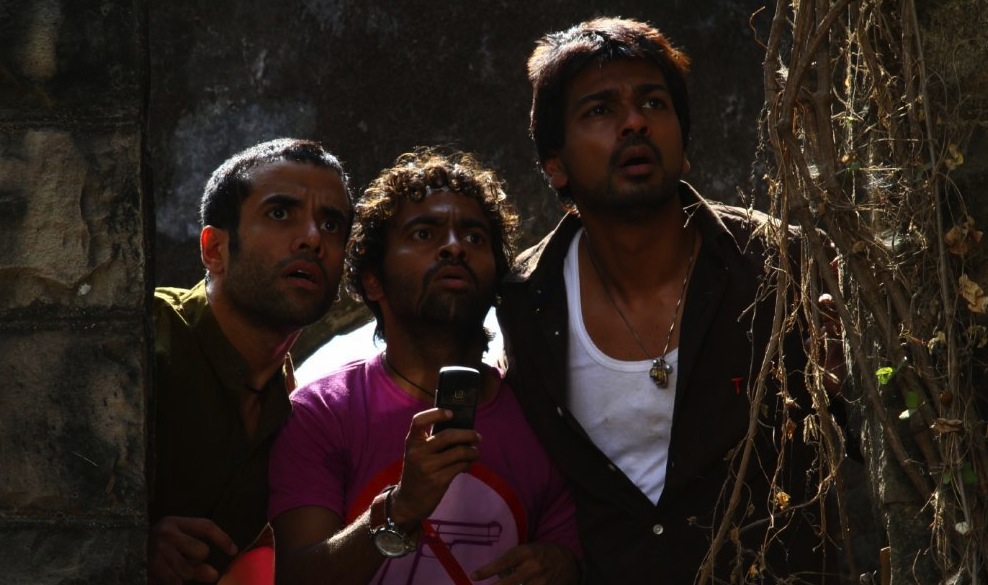
Storyline: Three petty crooks find explosives, a NRI gets a threat from the local mafia and an upcoming cricketer needs money to get into the U-22 team and need to do what’s right as the Shor in the city makes the choices simpler for them

Bottomline: A complete, satisfying, explosive cinematic experience about karma and chaos.

It maybe a little too early to give away the best film of the year award to Shor In The City with eight months to go but it will take one hell of a film to beat this.

From the moment the opening credits roll to Sachin-Jigar’s catchy ‘Karma is a bitch’ and Tushar Kanti Ray’s zippy camera takes you on the wrong side of a one-way street, directors Raj Nidimoru and Krishna DK are in complete control of the chaos they want to unleash. Shor In The City is a tribute to the deafening din and the disruptive disorder that defines India.

It’s Bollywood’s upbeat answer to Babel with its theme of interconnectedness, karma, gun-culture, redemption, chaos and the overbearing force of the universe that overrides every decision we make.

The film starts with the text: “The city is just an excuse for you to be good or bad. Mostly bad.” And we see the bad emerge right away in three parallel narratives – petty crooks kidnap an author to boost their book piracy business, a non resident Indian with a dark past has to deal with a fresh set of troubles on homecoming and a young cricketer considers bribing his way into the U-22 team.

This is where we are introduced to the protagonist or antagonist, depending on whose perspective you view it from: A bag of explosives that will rock their world.

Like the Morocco segment of the Alejandro Gonzalez Inarritu film, this is the story of man as a child discovering what guns/arms do. If Babel derived its unifying theme from the religious subtext of its title that binds humanity, Shor borrows from the social significance of the most celebrated festival that unites us. People from different backgrounds and races, irrespective of their differences, get together to celebrate Ganesha’s birthday and send him off in style with the rains cleansing the city and the noise drowning it.

Shor In The City is about fresh starts. It’s as much about the noise as it is about the lull. The moments of calm and quiet are nicely tossed in after every round of deafening action. There’s a lovely track involving the slow, budding romance between Tilak (Tusshar) and his newly wed wife (Radhika Apte), a woman he barely knows. Tusshar in his best role till date is absolutely endearing as the book pirate trying to get read The Alchemist.

The laughs come in regularly thanks to the antics of Tilak’s buddies – Manduk (an incredibly funny Mitobash) and Ramesh (Nikhil Dwivedi) and their adventures in trying to blast the bomb. What’s commendable is the flair with which the directors shift mood from the light to the dark, without ever compromising the emotional core.

The ensemble does a fantastic job. Be it Sendhil Ramamurthy who plays the fish-out-of-the-water NRI Abhay or Sundeep Kishan who plays the cricketer-looking-for-a-shortcut Sawan, the characters gives us enough depth to care about them. So what if you don’t know too much about their backstories beyond a scar or a newspaper clipping. We get just enough insight on a need-to-know basis.

The masterstroke is that the film does not stop to make moral judgments despite its exploration of morality. No moral instructions. Or answers. Just a gripping climax to bring an end to a riveting cinematic experience.

As derived or inspired it may be from Inarritu’s school of filmmaking, Shor In The City is as desi as it gets because it’s so full of hope and smiles, no matter what they have been through. It happens only in India. It’s a country you know and love, despite the chaos. Which is why you leave the hall with a satisfied smile on your face. And you realise why you love the noise.

This review originally appeared here.

I am Afia Megha Abhimanyu Omar: Stories no one told you before

April 30, 2011 · by sudhishkamath

Genre: Drama

Director: Onir

Cast: Nandita Das, Purab Kohli, Juhi Chawla, Manisha Koirala, Sanjay Suri, Rahul Bose, Arjun Mathur, Anurag Basu, Anurag Kashyap

Storyline: A divorcee meets with her sperm donor to have a baby, a Kashmiri Pandit returns home to Srinagar after 20 years, a filmmaker is haunted by child abuse and a gay man is humiliated

Bottomline: A daring indie film about identity, boundaries, sexuality and societal norms

Got an open mind? Make sure you take that with you when you enter the hall to watch Onir’s most honest and powerful film till date.

Because, when you hear a man still haunted by child abuse confess that he felt the love of his step-father strangely comforting that after a point he used to manipulate their incestual relationship for personal gain, you will need empathy to soak in the complexity of this intricately woven tales of people and identity.

Because, when you watch a family of a reformed mujahideen living in Srinagar refer to Delhi as India, you will need the compassion to dig into their tense, military-supervised everyday lives, understand and accept that ideologies have caused irreparable damage between friends.

Because, when you see a divorced woman waver around about wanting to know more about her sperm donor but not wanting him around after the delivery, you need to see it as a fleeting moment of confusion, a perfectly normal thing for an anxious mother.

Because, when you see a powerful man blackmail a struggler into going on a dinner date with him for purely sexual reasons, you need the perspective to understand that there are very few avenues left for gay men to openly flirt with other men.

And because, people are complex.

This anthology of short stories – I am Afia, I am Megha, I am Abhimanyu and I am Omar – is a mixed bag. There are loads of issues packed together into every short story apart from the broad common thread of identity and the role of the system in defining boundaries, so much that each story is complicated in its own unique way.

If the system prevents a mother from meeting a sperm donor in I am Afia (Nandita Das), the system has caused a permanent rift between best friends in I am Megha (Juhi Chawla), the system is in denial about child abuse in I am Abhimanyu (Sanjay Suri) and the system is the two-faced hypocritical oppressor in I am Omar (Arjun Mathur). The last story is more about Jai (Rahul Bose) than Omar though.

Each story, irrespective of the intensity of drama, is treated refreshingly low-key that the dramatic background score actually jars in a couple of places. Despite the extreme nature of the issues explored, nothing is done to shock and awe. With I am, Onir has really come of age as a filmmaker with an original voice. And it’s a voice that needs to be heard.

Page 13 of 90 « Previous 1 … 11 12 13 14 15 … 90 Next »
  • Blog at WordPress.com.
Privacy & Cookies: This site uses cookies. By continuing to use this website, you agree to their use.
To find out more, including how to control cookies, see here: Cookie Policy
  • Subscribe Subscribed
    • MADRAS INK.
    • Join 480 other subscribers
    • Already have a WordPress.com account? Log in now.
    • MADRAS INK.
    • Subscribe Subscribed
    • Sign up
    • Log in
    • Report this content
    • View site in Reader
    • Manage subscriptions
    • Collapse this bar
 

Loading Comments...