• SUDA MING’S CHANNEL
  • TALKING FILMS
  • Good Night | Good Morning
  • My Talk Show
  • PROFILE

MADRAS INK.

Menu

  • Archives
  • Columns
  • Diary
  • Interviews
  • My Films
  • Reviews
  • Good Night | Good Morning

  • Word thru the bird

    Tweets by SudhishKamath
  • Connect with GNGM

    Connect with GNGM
  • About GNGM

    Reviews

    “A cerebral joyride”
    Karan Johar, filmmaker on REDIFF

    “Among the most charming and creative Indian independent films”
    J Hurtado, TWITCH

    ★★★★✩
    “You don’t really need a big star cast… you don’t even need a big budget to get the techniques of filmmaking bang on…”
    Allen O Brien, TIMES OF INDIA

    ★★★★✩
    “An outstanding experience that doesn’t come by too often out of Indian cinema!”
    Shakti Salgaokar, DNA

    ★★★
    “This film can reach out the young, urban, upwardly mobile, but lonely, disconnected souls living anywhere in the world, not just India.”
    Namrata Joshi, OUTLOOK

    “I was blown away!”
    Aseem Chhabra, MUMBAI MIRROR

    “Good Night Good Morning is brilliant!”
    Rohit Vats, IBN-LIVE

    ★★★✩✩
    “Watch it because it’s a smart film.”
    Shubha Shetty Saha, MIDDAY

    ★★★✩✩
    “A small gem of a movie.”
    Sonia Chopra, SIFY

    ★★★✩✩
    “A charming flirtation to watch.”
    Shalini Langer, INDIAN EXPRESS

    “Interesting, intelligent & innovative”
    Pragya Tiwari, TEHELKA

    “Beyond good. Original, engrossing and entertaining”
    Roshni Mulchandani, BOLLYSPICE

    * * * * *
    Synopsis

    ‘Good Night Good Morning’ is a black and white, split-screen, conversation film about two strangers sharing an all-night phone call on New Year's night.

    Writer-Director Sudhish Kamath attempts to discover good old-fashioned romance in a technology-driven mobile world as the boy Turiya, driving from New York to Philadelphia with buddies, calls the enigmatic girl staying alone in her hotel room, after a brief encounter at the bar earlier in the night.

    The boy has his baggage of an eight-year-old failed relationship and the girl has her own demons to fight. Scarred by unpleasant memories, she prefers to travel on New Year's Eve.

    Anonymity could be comforting and such a situation could lead to an almost romance as two strangers go through the eight stages of a relationship – The Icebreaker, The Honeymoon, The Reality Check, The Break-up, The Patch-up, The Confiding, The Great Friendship, The Killing Confusion - all over one phone conversation.

    As they get closer to each other over the phone, they find themselves miles apart geographically when the film ends and it is time for her to board her flight. Will they just let it be a night they would cherish for the rest of their lives or do they want more?

    Good Night | Good Morning, starring Manu Narayan (Bombay Dreams, The Love Guru, Quarter Life Crisis) and Seema Rahmani (Loins of Punjab, Sins and Missed Call) also features New York based theatre actor Vasanth Santosham (Bhopal: A Prayer for Rain), screenwriter and film critic Raja Sen and adman Abhishek D Shah.

    Shot in black and white as a tribute to the era of talkies of the fifties, the film set to a jazzy score by musicians from UK (Jazz composer Ray Guntrip and singer Tina May collaborated for the song ‘Out of the Blue), the US (Manu Narayan and his creative partner Radovan scored two songs for the film – All That’s Beautiful Must Die and Fire while Gregory Generet provided his versions of two popular jazz standards – Once You’ve Been In Love and Moon Dance) and India (Sudeep and Jerry came up with a new live version of Strangers in the Night) was met with rave reviews from leading film critics.

    The film was released under the PVR Director’s Rare banner on January 20, 2012.

    Festivals & Screenings

    Mumbai Film Festival (MAMI), Mumbai 2010 World Premiere
    South Asian Intl Film Festival, New York, 2010 Intl Premiere
    Goa Film Alliance-IFFI, Goa, 2010 Spl Screening
    Chennai Intl Film Festival, Chennai, 2010 Official Selection
    Habitat Film Festival, New Delhi, 2011 Official Selection
    Transilvania Intl Film Festival, Cluj, 2011 Official Selection, 3.97/5 Audience Barometer
    International Film Festival, Delhi, 2011 Official Selection
    Noordelijk Film Festival, Netherlands, 2011 Official Selection, 7.11/10 Audience Barometer
    Mumbai Film Mart, Mumbai 2011, Market Screening
    Film Bazaar, IFFI-Goa, 2011, Market Screening
    Saarang Film Festival, IIT-Madras, 2012, Official Selection, 7.7/10 Audience Barometer

    Theatrical Release, January 20, 2012 through PVR

    Mumbai
    Delhi
    Gurgaon
    Ahmedabad
    Bangalore
    Chennai
    Hyderabad (January 27)

    * * * * *

    More information: IMDB | Facebook | Youtube | Wikipedia | Website

  • Browse: Categories

  • April 2015
    M T W T F S S
     12345
    6789101112
    13141516171819
    20212223242526
    27282930  
    « Jan   May »
  • Recent Posts

    • Simmba: A departure from the formula
    • Zero: The hero who wasn’t
    • Protected: AndhaDhun: What did that end mean?
    • Love and other cliches
    • October: Where is Dan?

Archive For April, 2015

Interview: Aishwaryaa R Dhanush – From darkness to light

April 30, 2015 · by sudhishkamath

Vai Raja Aishwarya

What do you do when your father is a superstar of the masses, your husband is one of the best actors ruling the trade and your mentor is a much acclaimed maverick filmmaker with blatant disregard for formula?

Aishwaryaa R Dhanush decided to step out of the shadows – of Rajinikanth, Dhanush and Selvaraghavan – when she started work on her second film Vai Raja Vai releasing on Friday.

Her first film 3, a serious dark drama about a violent bi-polar protagonist was hijacked by the unexpected virality of the promotional song “Why This Kolaveri” (that had very little to do with the tone of the film) and shocked audiences who weren’t quite prepared for a depressing film. Critics found the film closer to her mentor Selvaraghavan’s school of filmmaking than the commercial type her father and husband are associated with.

While she had Dhanush help her out right from scripting back then, this time around Aishwarya decided she had to do it all by herself – with very little support from the family. I spoke to a nervous Aishwarya on the phone earlier this week to find out all about the new film. Here are some snatches from that conversation.

I’ve been watching your Dad’s films in the order they were made for my book on him and find his transformation quite fascinating. Have you seen them in the order they were made?

“No. Not really. But I’ve read some of the books on him. None of them have been able to get the facts right.”

I guess it’s always difficult to piece together accounts of a man’s life from memories of people who knew him. Luckily, my book is not about the facts. It’s not about the person but the onscreen persona that emerges from his films.

“Then, it’s subjective. You can write what you want.”

From the trailers of Vai Raja Vai, I can tell there’s a significant change of mood from the darkness of 3. This seems like a fun film.

“That was a very conscious thing. 3 was very intense and very dark and I tend to gravitate towards the darker side of storytelling. So, I consciously didn’t want to do that. I wanted to go out of my comfort zone. I find myself comfortable portraying complex relationships and concentrated emotions. Commercial cinema was very challenging for me.”

The story goes that you came up with this over coffee?

“I wasn’t ready with a script. I hadn’t planned what I would do next when I met this friend of mine – Archana Kalpathi (the daughter of Kalpathi S Aghoram of AGS Cinemas). When I briefly told her how I wanted to explore intuition, she took the idea back to her father. Having explored bi-polar disorder in 3, I’ve been very interested in the psychological aspects of the human being.I find intuition very intriguing and wanted to see how I can bring that idea into the film. AGS has always been particular that the script has to be different. So that’s what interested the producer. I didn’t have a bound script. Everything just fell into place.”

You wrote this yourself?

“Yes, I wrote it alone.”

In Tamil?

“I type Tamil in English.”

Would we see the Selvaraghavan influence or have you made an effort to come out of his shadow?

“I would say this has a combination of influences from my Dad’s kind of cinema and Selva’s. There are certain shots that would remind you of a Selva film but a lot more comparisons can be made with my Dad’s films. It’s a good balance.”

Why don’t you use Dad’s name in your credits? 

“I just feel it would be too long. I don’t see the reason why I should announce it. Everybody knows who I am. I am proud of my initials. While a person shouldn’t change their surname, the husband shouldn’t be denied his place in my life… It’s all right. I’m happy to be Aishwaryaa R Dhanush.”

You wrote a film without Dhanush as the hero but you’ve given him a cameo.

“I wanted to do something independently. It’s not fair to keep going back to him. I was working out of my comfort zone. Last time, he was around to support and help. This time, it was a conscious decision to do something on my own. But he’s done a cameo playing Kokki Kumar, one of my most favourite characters he has ever played (Kokki Kumar from Selvaraghavan’s gangster epic Pudhupettai). When we had a chance to intersperse it in our narrative, I didn’t want to let it go.
But it’s just a one scene. We shot for five hours. He has been busy shooting films in Hindi and Tamil. It was nice of him to do this.

Vai raja still

You have worked with a young cast led by Gautham Karthik. How did that fall into place?

“Each of them fell correctly into character. Daniel Balaji, Tapsee and Vivek have always been selective about their roles. When they heard the script, they knew it was a multi-star cast. The characters demanded these people. And I was lucky to get the right artists playing the characters I wrote.”

A while ago, we thought the market was ready for offbeat films but a whole bunch of good films (Kaaviyathalaivan or Ennakul Oruvan, for example) didn’t work. Nor have the big films worked (Lingaa, for example). What do you think is going on? What does the market want?

“The beauty of film business is that we can’t ever gauge what the audience wants. But yes, people have become broad-minded and the audience wants to see good cinema – doesn’t matter big or small. Jigarthanda and Darling were critically acclaimed and did well commercially. I think the release date has become more important. Promoting films has become so important.”

Also, do you see the game changing as the movie watching experience today is interrupted with the presence of the mobile phone in the hall? Nobody watches movies alone anymore. You are plugged into a network and reacting live.

“It is very unhealthy to have a running commentary going and people commenting on scenes as they are watching the film. Making cinema has become much more challenging. Today, if a film runs for two weeks it’s as much a success as a film that ran 50 days in the past. And that’s such a big challenge.”

What if you had the chance to make a film with your father? What kind of film would you make?

“I’m happy just being his daughter. I don’t think I’m experienced enough to direct him. It’s very difficult for me to see him as anything but a father. The equation we share is very personal. I can’t go out and pretend to be something else – like a director on the set. When you are a director, you have to treat people a certain way.”

Whoa! You sound like you slave-drive your crew.

“I’m a taskmaster. I’m not at all pleasant.”
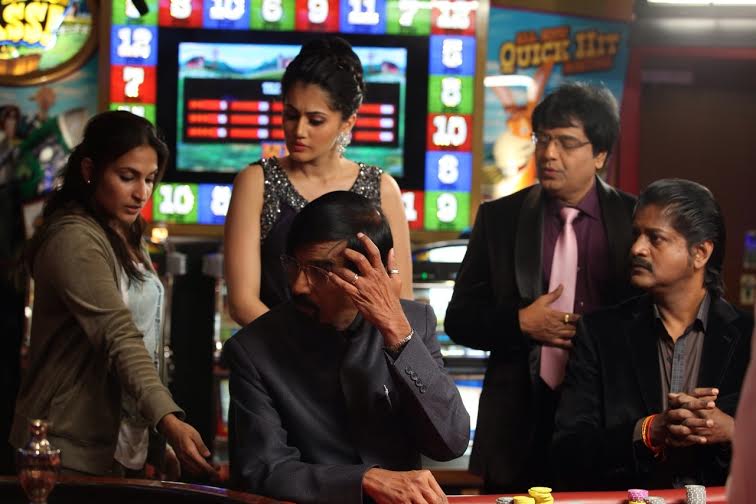
Vai Raja Vai

Did you learn that from Selvaraghavan?

“The first advice he gave me was: Don’t look weak. You have to be the bad person. Only then, work will get done.”

Do you still go to Selva for inputs?

“He lets you be. He has so much confidence in me. I don’t think even I have that confidence in myself. If and when I go back to ask him anything, he’s like: Why ask me when you know the answers.”

Has he seen Vai Raja Vai?

“He’s been travelling, writing his own script but is eager to watch it.”

What about your father and husband? Have they seen it? How did they react?

“They have seen it and were quite surprised. They were very happy about it. My father thought 3 was very serious but this, he said, is perfect for the summer vacation. Timepass.”

(The film is releasing in Mumbai and other metros with English subtitles.)

OK Kanmani: Unlimited thaali please, we are South Indians  

April 18, 2015 · by sudhishkamath

Director: Mani Ratnam
Cast: Dulquer Salman, Nithya Menen, Prakash Raj, Leela Samson
Rating: Liked it*

✰✰✰✰

OK Kanmani for blog

About twenty years ago, Mani Ratnam made a movie about two young people from different communities who elope and make Bombay their home.

In Mumbai 2.0, or OK Kanmani as Madras Talkies insists, the young lovers are not fighting communal tensions but the prison of marriage or what it represents: commitment for life.

Now, I wish Mani Ratnam lived in Mumbai.

Because he would have enjoyed the freedom Jaideep Sahni had with Shuddh Desi Romance (a not-so-perfect film redeemed by a great ending) because OK Kanmani could have been THAT film that challenged the sacred thread. Or the knots often worshipped as thaali (Before you think of a bad pun, Yes… also one that gets you – both men and women – unlimited meals for life and we are not just talking about food here).

While Shuddh Desi Romance intentionally made young people seem flippant and confused about what they want, OK Kanmani is about two confident, independent young individuals – consenting adults – who choose to live and sleep together knowing very well what the future holds for them.

Mani Ratnam basically takes that Trisha-Siddharth (or Vivek Oberoi-Kareena Kapoor) love story from Aayitha Ezhuthu and fleshes it out with all the things people have come to expect out of him – the modern middle-class family dynamic, the irreverent tone (with which you call your parents by name), public transport (trains, of course), great looking houses with tasteful production design (even if it’s meant to be a seedy lodge, it better have a swing, Yo!), talkative kids who are quick to spot lovers up to mischief, people professing love sitting across the room, attractive people dancing to Rahman’s funky music, terse dialogues in staccato Mani-Ratnamspeak, magic hour and finally, rains to resolve everything. A squeaky clean petrichor feel good ending. You know you love it.

By now, a Mani Ratnam film is genre by itself. And you can’t question the genre because the man invented it. It’s like telling Jobs or Cook: Dude, in my opinion, the new iPhone 6 bends. You used to make cooler phones.

You know what you are getting when you buy an iPhone and the upgrades just make it more relevant for apps you tend to use more. Even if an Android has better specifications, nothing quite matches the feeling of wielding a highly acclaimed, incredibly beautiful, classy symbol of the elite (and the aspirational upper middle class.)

As much as I enjoyed the home comfort and the easy-on-the-eye sophistication of Mani Ratnam’s storytelling (and the writing truly marks a return to form – he should just stop collaborating and polluting his writing with substandard pulpy writers), I did find the old-fashioned endorsement of marriage a little too outdated. But then, Mani Ratnam’s films have not just respected the sanctity of marriage. They celebrate marriage.

In Mouna Raagam, he made a dysfunctional marriage (marred with baggage from the past) work. In Roja, he made a woman from a small town get in to war territory in search of her husband. In Bombay, the marriage of people from two communities was a symbolic representation of India as a secular State. In Alai Payuthey, lovers who secretly marry almost lose each other before they understand the true meaning of marriage.

Mani Ratnam continues this tradition of making even the most commitment-phobic young people FUCKING TOE THE LINE!

While you could expect someone on the other side of 50 to not understand how young people meet and greet these days (Yes, I found that long drawn meet cute at the wedding contrived), it is a little disappointing personally to see Mani Ratnam’s persona as a filmmaker change from the rebel (I always see Mani Ratnam as Karthik – Manohar from Mouna Raagam, or say Suriya – Michael from Aayitha Ezhuthu) to the father figure (now I see him as Arvindswamy – from Kadal or Prakash Raj – from OK Kanmani) – the preacher! That annoying uncle who has only one question to passive-aggressively ask every time he meets you: “Eppo Kalyanam?” (When good news?)

OK Kanmani is unfortunately that Uncle who makes you believe that marriage is the answer to your conflict of living in without any expectations from each other. He wants to say it’s good to have expectations. It’s good to miss each other madly and want to hold on to each other. Marriage is so good you know you want it. It promises you unlimited meals of chicken soup for the soul. Go marry already. I want to eat your Kalayana Saapad, unlimited thaali please.

But ideological differences aside, I LOVED the exquisitely framed (PC Sreeram) modern day fable on the soul-stirring beauty of good old-fashioned marriage (where you are there for the other, in good health and bad). Especially because the chemistry between the lead pair of Dulquer Salman and Nithya Menen is crackling (the young actors make you live their confusion) and equally adorable is the portrayal of the older couple (Prakash Raj and Leela Samson are terrific) in an Amour situation.

Yet, it’s a lost opportunity. Towards the end, there’s a lovely scene in there when the boy gifts her a necklace. He may not believe in a mangalsutra/thaali but gets her a parting gift that symbolically means the same damn thing – I love you and want you to wear this around your neck so that I know you love me. Isn’t that enough surrogate and subtle endorsement of marriage enough? Why take it all the way to a literal court acknowledged State-approved registered marriage with a vengeance, Mani Uncle.

As it is, it’s very difficult for young people to find houses in Mumbai (especially, bachelors – forget live-in) and you KNOW this (especially because you had to pass off spacious bungalows and five-star hotels from Chennai as Bombay though I must add it’s a big come down for The Park’s Pod to be de-promoted from New York in Good Night Good Morning to Bombay in OK Kanmani).

So pardon me if I don’t agree with the convenient solution of marriage to resolve complex relationship issues of space (physical and mental) and choices (professional and moral).

But I remember the ground reality of home.

It is not yet legal in Tamil Nadu to speak about pre-marital sex. Ask Khushboo. (As a friend’s father often says in denial when told that young people these days do things other than sleep on a bed together: NEVER BE!) And any discussion on the need for a thaali is interpreted as an insult to your own mother. Ask Puthiya Thalamurai.

Which brings me back to what I started this review with.

I wish Mani Ratnam lived in Mumbai.

(P.S: My rating scale goes from: Loved it. Liked it. Liked it but. Didn’t like it. Hated it.)

Thoughts before THE jump: The flutter of the big butterflies

April 3, 2015 · by sudhishkamath

About 16 years ago, I was sitting at the computer lab at Manipal Institute of Communication – super nervous. What next?

I have never been a believer. I’m a cynic. Maybe that’s why I was right for criticising everything.

I looked at my resume.

I had morphed the cover of Gentleman. It featured a guy in a trash bin on the cover and I put my face over his; I changed magazine name to Gentlemen, and modified the featured blurbs to Freshly Dumped (out of a communication school – in fine print), Looking for a job, For Hire… you get the idea.

The rest of my resume – formatted in two-column magazine layout – with generous use of pictures to support each section came to three pages (as opposed to the single page resume we are taught to submit).

I printed three copies before the computer wiped out the file that took me two weeks of work. The back-up floppy disk got corrupted.

I took a chance and sent one copy to the newspaper I grew up reading. I didn’t hear from The Hindu for a month and a half. So I sent the second copy of the three with a reminder. It worked. I never had to use the third printout of my resume for 16 years.

That brings us to today.

I’m sitting staring at the laptop screen in my apartment in Andheri at the heart of the film industry – super nervous. With the same old question. What next?

I quit my job at The Hindu last week.

It was a very difficult decision – one I never saw myself making all these years – because of pure economics. It just wasn’t feasible anymore and I had drained all my savings trying to keep the job going for the last nine months.

Bombay is an expensive city and nobody living outside can even imagine the complexities of living here – say, simple things like finding a house on rent when you are a bachelor – let alone traffic and topography. It was my choice to come here to report on films. It was my price to pay.

I quit on a high with the satisfaction of doing the job to the best of my ability.

I had the unique record of getting eight of my stories (with seven bylines) on the same day (February 22, 2015) in different supplements of The Hindu.

I had turned in 55 stories in my last 68 working days this year – in fact, I filed a big one a day after I resigned.

* * *

The truth is I never saw myself doing films full-time. It was a passion I entertained with savings from my journalism career. Over the last 15 years, I’ve made three films. X, the third one, a collaborative project with 10 other filmmakers, is all ready for release mid 2015.

You know the feeling when you have been married to one person for as long as you can remember… and then suddenly one day, you are single. This feels just like that.

I really don’t know what it is to be single. It’s like I’ve always been committed. I always had that job that supported me, despite my flirtations with cinema.

Now, that’s gone. And there’s nothing to fall back on.

The Hindu was home to me. It still is. But if you don’t leave home, how do you know where all you could go?

I know what I don’t want to stop doing.

I do not plan to stop reviewing films or chatting with people because I never saw that as a job. Thankfully, I still have a base of readers on social media and I hope to continue to give them what they follow me for. This just means my own WordPress, Twitter, Facebook and YouTube channels will be a little more active.

It may not bring me money but I can do with the love. And of course, the hate because that’s always pushed me to do better.

* * *

It was just last month that I took a motorcycle trip across the South.

I did Madras – Tiruvallur – Bangalore – Hampi – Goa – Chiplun all the way to Bombay. I felt I owed it to the cruiser I bought, ten years ago, with the resolution that I will go cross-country riding some day.

When I got home last month, I saw the motorcycle rotting at home and I remembered the resolution. I was eaten by guilt. I borrowed money from a friend, got it fixed and decided to do what I had always only dreamt of doing.

It didn’t matter that the furthest I had done was Madras to Pondicherry.

But if I had done it once, I could do it a few times. I told myself I just had to take it 50 kms at a time. And then, worry about the next 50.

That’s how I finally did it.

I stopped every 45 minutes to an hour, clicked photos, enjoyed the journey, live-tweeted, rode all day and chilled with friends – old and new – in the evenings. One day at a time. 50 kms a session.

One week later, I had finished something I never imagined I could do.
Today, I think that trip happened for a reason. It was by design. I had code-named that trip The Road of Trials (because that’s how much I love Joseph Campbell).

Today, I realise it was exactly that.

It was a trip that was preparing me for this moment.

Just like that one-way trip on a plane that took me sky-diving. It was a trip I did to tell myself: If you can do this, you can do anything.

I have jumped off a plane.
I rode 1748 kms on a motorcycle.
I’ve made three films as an extended hobby.

Today, I’m all set to take a full-time plunge into films.

Because that’s what I love most. The first two films I made wiped me off Rs.35 lakh rupees of my savings of 15 years. But the third one earned itself a producer. It even changed the way I look at cinema today. It probably happened to make a snooty critic like me look at the unlimited, varied possibilities of storytelling in a non-judgmental, inclusive manner without delusions of superior self-intellect.

I can feel the flutter of giant butterflies in my stomach and it’s not something I ate. It’s that jittery feeling that comes pre-exhilaration.

Conventional wisdom says I should shift from my house to a hole just to save money that will keep me afloat for a few more months. But when have I ever been conventional? I’m not quitting the life I am used to that easily.

In fact, I’m moving into a more comfy home even if it means a little more rent. It took me a week of bunker-mode depression and introspection to figure this out. But now, I can see it clearly.

I came to Bombay to be a fly on the wall reporter and do my reviews a little earlier.

Today, life has given me a chance to be more than that.

Maybe I’m not here to pay rent. I’m here to buy this fucking house.

Maybe I’m not here to deconstruct films. I am here to construct them.

My best friend lent me $9000 when we were making Good Night Night Morning. I asked him then: “What if the film doesn’t recover even this much?”

He said: “I’m not investing in the film. I’m investing in you. I have full faith in you. You will return it someday, say, with a 10 per cent interest?”

It’s also time to channel the faith that people have in me.

It’s time I embraced faith, not blind-folded, but with a clear vision of where I am going.

It’s time to take that leap.

Because: “There’s no such thing as half a leap of faith. You either jump. Or you don’t.” (X)

(Originally posted here.)

Detective Byomkesh Bakshi: Case of the missing opium

April 3, 2015 · by sudhishkamath

Director: Dibakar Banerjee

Cast: Sushant Singh Rajput, Anand Tiwari, Swastika Mukherjee, Divya Menon, Meiyang Chang, Neeraj Kabi

Rating: Liked it but*

Swastika

If cinema is the opium of the masses, with his new film, director Dibakar Banerjee shows us that he’s not the best drug dealer. Because he tends to smoke it all.

Detective Byomkesh Bakshi is an opium dream.

One moment naturalistic, and then over the top. One moment smart, and then a tad too expositional. One moment quiet, one moment heavy-metal loud. One moment for style, another for substance. One moment a thriller, and suddenly a rare moment of slapstick. Taken individually, these moments work but Banerjee’s erratic storytelling that opts for substance-influenced style over substance makes Detective Byomkesh Bakshi the curious case of lost identity with Banerjee trying to find out what kind of a filmmaker is he, when given all the money mainstream filmmakers are given and a Yash Raj Films backing.

Unless the intention itself was: “Let’s take the Bengali babu and make Bakshi as a Japanese film – but in Hindi, with anachronistic heavy metal music and English lyrics.”

You get the vibe of watching scenes from a really cool ultra-violent Japanese film in the middle of a lot of talking and until the villain shows up with his evil Amrish Puri avatar and then on, it’s a eighties Bollywood film.

The actors are all fantastic. Sushanth Singh Rajput nails it and gives us a character we look forward to if this franchise takes off and the likeable Anand Tiwari plays a great foil. The rest of the cast is fantastic too (not naming specifics to not give away the plot, twists or ending) except that the makers leave so many characters and threads hanging for long stretches of time that the inconsistencies in tone and pace gives us enough time to appreciate the detailing of painstakingly done production design, time-travel cinematography and the cool music.

It says a lot about the film when things that should ought to be invisible are unanimously praised. But this is a film let down by the guy at the helm – in writing and directing departments.

What this film needed to work was the economy of writing from the forties (and the fifties). Fewer scenes; tighter storytelling.

Average filmmakers are written about when they make good films. Great filmmakers are written about when they make average films.

Yet, Bakshi is not an average film. It’s way above average by Bollywood standards and if we were to give points for the visual and aural appeal alone, this is the film of the year. At least till Bombay Velvet comes along.

It’s the first time Banerjee has fumbled but a misstep that needs equal amount of criticism and appreciation because we want to see more of this franchise. This could be the beginning of something truly epic. It has promise, potential and the right team backing it in every department. All it needs is the captain to pull up his socks.

*My rating scale goes from: Loved it. Liked it. Liked it but. Didn’t like it. Hated it.

  • Blog at WordPress.com.
Privacy & Cookies: This site uses cookies. By continuing to use this website, you agree to their use.
To find out more, including how to control cookies, see here: Cookie Policy
  • Subscribe Subscribed
    • MADRAS INK.
    • Join 483 other subscribers
    • Already have a WordPress.com account? Log in now.
    • MADRAS INK.
    • Subscribe Subscribed
    • Sign up
    • Log in
    • Report this content
    • View site in Reader
    • Manage subscriptions
    • Collapse this bar
 

Loading Comments...