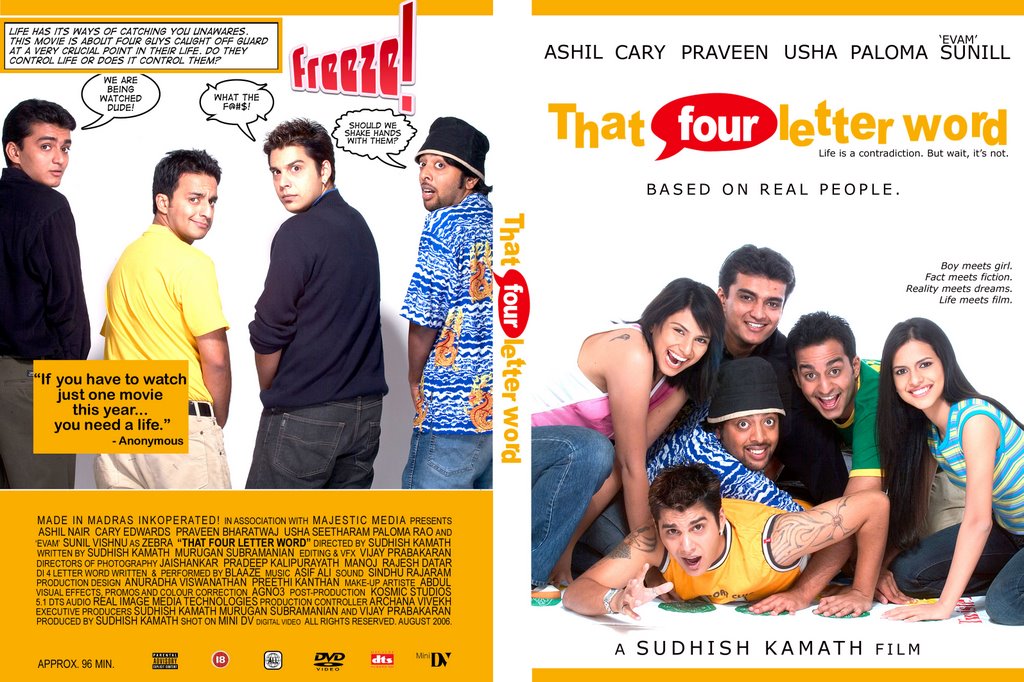
That Four Letter Word: O-V-E-R


Yes, a seven year old dream has finally come true. I’ve finished the movie. Finally!

😀

Thanks to Real Image for doing the 5.1 DTS mix, BlaaZe for doing the title rap (you can listen to the song by hitting the play button below the blog name in the box above), Vijay Prabakaran (and AgNO3) for spending countless hours on colour correction. And my sound engineer Sindhu for the foley effects and overall sound design. Well, I guess I’ll postpone the overall thanksgiving for later.

This post was just to let you all know that my film is finally ready and now, it’s just a matter of finding theatres equipped with digital projection systems.

Click on the title of the post to see original post with comments.

That Four Letter Word: O-V-E-R!


Yes, a seven year old dream has finally come true. I’ve finished the movie. Finally!

😀

Thanks to Real Image for doing the 5.1 DTS mix, BlaaZe for doing the title rap (you can listen to the song by hitting the play button below the blog name in the box above), Vijay Prabakaran (and AgNO3) for spending countless hours on colour correction. And my sound engineer Sindhu for the foley effects and overall sound design. Well, I guess I’ll postpone the overall thanksgiving for later.

This post was just to let you all know that my film is finally ready and now, it’s just a matter of finding theatres equipped with digital projection systems.

AgNO3’s Showreel!

If you’ve been here before, you would have already heard of AgNO3 and my friend Vijay Prabakaran, the guy who made ‘The Lost Window’.

This video was cut by him too and it showcases the works of his company AgNO3, a partnership between him, Swathi Raghuraaman and Rohit Reuben Prabhu.

I love this video.

Update: I’ve been losing sleep and weight over my jinxed project ‘That Four Letter Word’ and hence unable to post. Will be back shortly. The film is long due. Everything else can wait, right?

Toronto calling Pudupettai!

Cameron Bailey is blown over by Pudupettai.

“I was interested in the film because I was told it is a little bit like ‘City of God.’ I could see some of that in it. I could see a little ‘Scarface’ in it. But, it had its own distinct style. Dhanush reminded me of younger Al Pacino of the seventies… small, wiry but intense sort of presence on screen. The look of the film is amazing. It’s more stylish than I expected it to be. I would compare it to City of God, Amores Perros. Very expressionistic colours. Very nicely done visuals.”

That coming from the Film Programmer of the Toronto International Film Festival for South Asia and Africa is enough reason for Selvaraghavan to smile, after most local critics pulled up the film for violence, gore and a sloppy second half.

“Yes, the first half was better than the second but because the film is so stylish and has an unusual visual appeal to it and because Dhanush was quite good, I think the film still has a lot of merit. I wouldn’t say it’s the perfect film but it has a lot of merit,” he defends the film going on to add: “I would consider this film as long as it does not play at other festivals.”

Cameron Bailey saw it at Sathyam on a Monday afternoon and was quite taken in by the audience response. It must be said here that he watched it without subtitles.

“I didn’t have any problems following the story,” he insists. Bailey has been short-listing films for the last ten years. He is also a film critic and been choosing films from India for the last two years.

“Last year I had four films, Buddhdeb Dasgupta’s ‘Kaalpurush,’ ‘Amu’ by Shonali Bose, Ritu Sarin’s ‘Dreaming Lhasa,’ ‘John and Jane,’ a documentary by Ashim Alhuwalia, about call-centre workers. I chose those out of 60 films last year. I will be watching more this year.”

Bailey has already seen about 12 during his trip to India and had watched a few DVDs of Indian films he received in Toronto earlier.

This time too, he’s looking to arrive at four or five films from Mumbai, Chennai, Kolkata and Trivandrum to represent India among 330 films that will be screened at the festival.

“I’ll be done viewing by June 16, done with short-listing in two weeks after that, when I get back to Canada. By last week of this month, I would have seen most of the significant films,” he reveals.

One would think ‘Rang De Basanti’ would rank high on his list.

“Rang De Basanti is a little old for us. But we have programmed it in our Aamir Khan retrospective for Cinematheque Ontario. Our first preference is for brand new films that we can premiere or International premieres of films not released outside India. We have a luxury of being a festival of premieres. So primarily we show North American premieres.”

The film festival premiered ‘Brokeback Mountain’ and ‘Walk the line’ last year and ‘Crash’ in 2004. The Toronto festival does not have a competitive section but does gala premieres with grand red carpets.

What exactly is he looking from India?

“We are looking at more interesting directors. Indian commercial cinema is such a strong force in the world cinema. If we can find a very good example of a mainstream Indian film that works on both the popular and aesthetic levels… If Rajnikant’s ‘Sivaji’ was going to be ready, we would be all over town with it,” he laughs.

Do filmmakers need to pay or get paid when their films premiere at the Toronto festival?

“There is no money exchanging hands either way. If your film premieres in Toronto, you get splashed across newspapers all around the world.”

There are about 800 to 900 from the media and about 4000 industry delegates. “Last year, the deals made at the Toronto Film Festival amounted to 52 million dollars of sales.”

Ask him about the challenges of choosing across different kinds of Indian cinema, the Hindi and the regional and he acknowledges the difficulty.

“They are all very different and not only that, the mainstream films are very different from the art. Some of the most beautiful, sublime nuances I’ve seen are in Bengali and Malayalam films. Fantastic filmmaking. But I wouldn’t expect the same things from a Shah Rukh Khan film or a Rajnikant film. If you are a mainstream film, I want to know if are you entertaining, is it achieving the demands of the
genre. From someone like Buddhadeb, (I look for) very sophisticated artistic expression, some innovation in film and something new about the way human beings live. I ask different things from different films. I’m aware that in different regions, the dominant style of filmmaking varies.”

Will he represent Indian cinema?

“I can’t choose one from each region. I wish I could do that. So I will choose the best. It’s always partly subjective. I’m employed for my taste, honestly. So I have to determine what I think is best. It has to represent, it has to have artistic merit. I’m looking at world cinema and I’m looking at what’s coming out of India. And Indian films have to be as technically accomplished, as creative as anywhere in the
world.”

Bailey is one of 12 programmers around the world choosing films for the Toronto festival. Having been exposed to world cinema, we ask him what he thinks is good and bad about Indian cinema.

“We could talk all night. But I would say Indian commercial cinema has fully captured its audience. It has no problem appealing to a broad audience of movie-goers. The passion with what people watch movies is unparalleled. What is not successful is Indian filmmakers reaching out to an International audiences that does not understand… One of the reasons is that the films are so tuned to the local market that they don’t work outside. The distinct thing is the tone. There is a tone of
intense sincerity in a lot of Indian commercial films. The emotions are big, very heartfelt and sincere. And in the West people are used to irony, people are used to watching films with scepticism, with a distance. Even West European films, they don’t take their films too seriously as much as Indian films do. I think the tone is what
separates the audiences.”

He believes that factors like song and dance and length are superficial and do not really put off global audiences. “Moulin Rouge is a Bollywood film made by an Australian with Hollywood money. So I think people are interested in that.”

Review: MI: 3

Mission Unmissable

Cast: Tom Cruise, Philip Seymour Hoffman, Billy Crudup, Ving Rhames, Michelle Monaghan, Jonathan Rhys Meyers, Kerry Russel, Maggie Q, Laurence Fishburne
Director: J.J.Abrams
Genre: Action/ Thriller
Storyline: Ethan Hunt has to rescue his newly-wedded wife and not let down his mission
Bottomline: The best Hunt

For large parts of the movie, you could almost see Shah Rukh Khan playing Ethan Hunt. But having said that, that is no excuse for Hindi cinema to adopt/steal yet another Hollywood plot just because this one seems straight out of our own milieu.

Even the ‘Wedding Crashers’ plot seemed to be straight out of the Yashraj Films camp. Maybe the differences between sensibilities of Hollywood and Indian cinema are narrowing down after all.

With Mission Impossible-3, however, the similarity with Asian cinema ends with the plot and the sentimentality.

But what really keeps MI-3 ticking is its break-neck speed, explosive gizmo action and mind-blowing visual effects and of course, Tom, who returns as the charismatic suave agent of Impossible Mission Force, Ethan Hunt.

MI opens with a high-tension scene with Hunt tied up to a chair by bad guy Owen Davian (Philip Seymour Hoffman) who has put a gun to Julia’s (Michelle Monaghan plays Hunt’s newly-wedded wife) head right in front of his eyes. The gun goes off and the theme sets in for yet another
doubly impossible mission.

There is not a dull moment during the two-hour duration of the action adventure, full credit to debutant director J.J.Abrams, who, many MI fans would believe has arrived at the right mix of intrigue, drama, action, adventure and gizmo-gadget tricks.

The first instalment, directed by Brian De Palma, though considered the best in the series, had many people going back to the halls because they didn’t get it the first time. The second version, dumbed down by John Woo, redefined the series with his signature slickness as heralded the arrival of Ethan Hunt, the new age Bond.

This one takes that Asian influence a little further, spikes up the cocktail of stunts with a little drama, to arrive at a greater common denominator around the world, especially the Asian markets. Also, there are quite a few Asians in the cast, including Maggie Q, as one of Hunt’s team-mates, in this yarn that takes Hunt to Shanghai, to indicate that MI is looking to make the franchise attractive to markets all around the world.

Director JJ Abrams, creator of the TV series ‘Lost’ and ‘Alias,’ along with his screenwriters Roberto Orci and Alex Kurtzman (also of ‘Alias’) might have created the single most definitive installment that restores the MI franchise to the intellectual respectability and sophisticated glory Brian De Palma brought to the TV series. There’s no way you will miss watching MI-4 after this.

Good old Tom Cruise is first-rate, now quite comfortably settled under the skin of Ethan Hunt, just as Ving Rhames is, as his aide Luther Stickell from the first two parts. Michelle Monaghan makes for an attractive Hunt babe but the film belongs to Philip Seymour Hoffman as the big, bad all-powerful villain who gives Hunt literally a run for his life and his wife. Watch that scene when Hunt interrogates Davian as the Hunt-ed talks like the Hunt-er, something that furthers the tension of the opening scene.

Yes, the performances are timed to perfection just like the taut screenplay is executed to precision with enough ammunition and technical wizardry but at a more basic level, what will take MI-3 to the remotest of villages around the world, irrespective of the dubbing, is the visual story-telling: Exactly what made James Bond the most successful film franchise.

This one’s really Mission Unmissable.
eom

Ikkada choodu!

Moral of the story: Naan enna telunguliya sonnen?
Learn your language. My nanban, captain, filmmaker and editor Vijay Prabakaran made this one minute film for a competition.

Review: Pudupettai

Half-Classic!

You can draw parallels between the growth of Selvaraghavan as a filmmaker in Kodambakkam and the rise of Kokki Kumar as a gangster in Pudupettai.

The rise part of the film is near flawless. It’s almost a classic but for that exceptionally cheesy scene when a skinny, gawky reduced-to-pulp street urchin that resembles a pencil, surrounded by 100 gangsters makes an escape on a tricycle (with a terribly fake visual-effects produced sunrise in the the backdrop) and that too AFTER killing the gangleader’s own brother.

If you forgive that one scene from the first half of the film, the movie’s incredibly compelling that Selvaraghavan, instead of putting “Interval,” should have actually put “The End” and made us await the sequel. And spent that time doing a little more work on Book Two.

And, we could all have gone home believing that Selvaraghavan has risen to the top as among the best filmmakers in Kodambakkam.

The first 90 minutes are among the best we’ve seen in Tamil cinema in recent times, as Selvaraghavan takes us into the dark side of the city, where right and wrong are determined purely on the basis of survival. With a couple of nods to Coppola and maybe a couple to Varma and Mani Ratnam, Selva shows us a world he seems to know extremely well and in a sensibility which is undeniably and authentically crass. Ignore the visual effects department and Yuvan sometimes going a little overboard and what you get is a gangster epic.

Dhanush, a tad animated (but that’s how the mass likes it) gets under the skin of Kokki Kumar, quite comfortably, a Plus 2 drop out who takes refuge in the world of crime and quickly adapts and learns the ropes to stay alive. The things he does are ballsy to say the least, and made appropriately believable for most part of the first half.

It’s almost like how Selva made it to the big bad world of films… First, as a neglected third-rung upstart who did not even get credit for his work (Thulluvatho Illamai), then a hit (Kaadhal Kondain) that got noticed by everybody in town. And another (7 G Rainbow Colony) that signalled his arrival. Undeniably good cinema even if it was wrong.

And with Pudupettai, that boasted of many firsts — shot in Super 35, orchestra from Bangkok, released in 2k digital resolution — saw him reach the top, quite convincingly, even if a little flawed. I’m not sure if cinematographer Arvinda Krishna would have actually liked the inconsistency in colour correction and grading. Seems like a very hurried job by some newbie effects supervisor who wanted to try out all the effects that Lustre provides him with.

The second half is when the nightmare begins. It’s terrible to the extent that it is literally a criminal waste of film.

This is the bit when power gets to his head. What is true for ‘Kokki’ Kumar seems to be true for Selva too. So when Kumar says: “Overa aadna epdi thaan,” you really feel like telling that to Selva too.

Just to show off his directorial skills and to say he’s not influenced by ‘Nayakan’ or ‘Godfather’ or ‘Sathya’ and to leave a stamp of originality in his work, Selva recklessly runs loose with his screenplay, thrusting upon you twist after twist, each worse than the other, just so that he can beat you at the guessing game. Though he beats you at it every single time, you don’t really respect him as a filmmaker because he doesn’t do it well enough. So while there are many moments in the second half that almost show his class, he ruins it with his inherent crass sensibility. Dated ideas like baddies threatening to throw baby from the second floor doesn’t seem to gel in a film that sometimes looks far more sophisticated, especially the bit when Kokki’s rival on getting cornered, quietly reaches for his drink and meal (watch the scene and you’ll know what I mean), intrigues you enough before ruining it all over again with another anti-climax.

The anti-climaxes are many. The final one, though grossly, politically incorrect, is the redeeming factor of the second half.

But then, that’s vintage Selvaraghavan: Good cinema gone wrong.