Lok Paritran needs volunteers.
Praveen is co-ordinating.

Lok Paritran needs volunteers.
Praveen is co-ordinating.
 I had to chop off over 50 per cent of the text from the Take Two between filmmakers Hariharan and Balu Mahendra for the paper due to space constraints. Here is the unedited transcript. Mr.Hariharan, apart from my professor Rakesh, is the one who taught me quite a bit of what I know about filmmaking.
They both started out at the Film and TV Institute of India, Pune. One went to be a legendary filmmaker whose distinct style of filmmaking is today considered to be a school in itself. The other went on to make socially relevant award-winning films, is among the best film theoreticians in the country and also the Director of the L.V.Prasad Film and TV Academy.
When Balu Mahendra met K.Hariharan on Sunday at the Green Park Hotel, they started one of the most insightful conversations Sudhish Kamath ever eavesdropped into.
Hariharan: I recall when I made my first film ‘Yezhavathu Manithan,’ Balu Mahendra was an icon. We were overawed because while we were shooting, we used to listen to songs of ‘Moonram Piram’ on the radio, and say, that is where we should reach. You had reached a certain peak for us all. You don’t know about it but there are a lot of stories floating around about you. We would hear that Balu Mahendran would shoot only from 6 a.m. to 8.30 a.m. He would only take the early hours.
Balu: Oh my God. It was never like that. Being my own cameraman, I had this luxury of deciding what scene to take where, which is not possible for some other director. So I decide when to stop, go to the shade and do the next shot.
Hariharan: So you were not waking up at 8.30?
Balu: No, no… no way.
Hariharan: (laughs) Another myth was that you hated make up. Every morning you would come to the location and say: Take that make up off…
Balu: Even today I don’t use make-up on any artiste. In the sense that no grease-paint to cover the human skin. I had a serious problem with the make-up department and they were up in arms against me. I was basically a cameraman… These people we looked up in awe, people like Ranga Rao, Anjali Devi, Sharadha, Krishnam Raju, all these Telugu artistes, they just couldn’t gel what I was trying to do without make up. It was a serious problem. So I had to say put my foot down and say, “Mr. Ranga Rao, Please go wipe and come back. Have a soap wash.” The old man used to get very annoyed. Another problem was that I used to use very minimum light. That also, they could never understand. That time there was 500 ASA was not available, only 400 ASA… So after I would finish lighting, he used to say: “This is all?” “Yes, Mr. Ranga Rao… This is all.” That was the sort of beginning… But somehow I had the courage and guts to stick to whatever I wanted. Even today, if I need blood or moustache to be pasted… then the make-up man comes in. But even today, they are imposing this make-up man in my unit… whether you use it or not is a different question. So you have to engage a make-up chief and an assistant and a third assistant… So these three guys come in and I pay them for being in the hotel when I go out for shoot.
Hariharan: There’s been a sea change between 1970s and what we are seeing now. I still remember that the director and technician were very important people. To such an extent, that even now when your name comes on the screen, there’s silence. All background music comes to a complete halt…
Balu: It’s not for the anticipated claps from the audience… But wherever I’ve left it silence, it is because the picture would start with a song and if there was music on my name, the music would have no relevance to the song.
Hariharan: Today the stars seem to dominate, how are you handling this situation?
Balu: Till my last film, Athu Oru Kana Kaalam, it was Dhanush who wanted to do a film with me and not the other way. So when a situation like that comes, there’s no question of Dhanush telling me what I should do with his call-sheets. So I have never faced these problems with stars. I have worked with Kamal Hassan, Rajnikant, Amol Palekar, Sridevi and all these people. Even when we were shooting in Ooty for Moonram Pirai with Kamal, 6.30 meant 6.30 in the morning on the spot. We were shooting in December. I was there at 6.25 and they respected my requirements and it went on like that.
Hariharan: How has this changed?
Balu: Nowadays, I hear that the producer and director are both selected by the actor. This is a very sad changeover that has come. The reason for this is that the new directors who came after us, they don’t go tell the story to the producer. They tell it to the actor. The story is so fabricated to suit the actor turning into Superman. When an actor decides to do this, you give the reins to him. If a new director convinces a star, he doesn’t have to bother about finding a producer, which is a major hassle… Finding a producer for the kind of films we want to make was a major hassle in those days…
Hariharan: That’s why I’ve never worked with a film star in all my eight films. I’ve always worked with actors and technicians with whom I could correspondent perfectly. For me, the logic of making a film with a small budget with a lot of creative inputs was primary. So I just ruled out working with a star. The only star person I’ve worked with was Raghuvaran, who I introduced, who later became a star. But I always wanted to do a film with a star but mentally, I was always checking myself and say: Will it all go berserk? Therefore, I turned into other kinds of films… what they call socially purposeful films…I made films like Yezhavathu Manithan or Current, Dubashi, which had strong social themes, rooted in the problems of the nation and the society. That seems to be virtually missing in many films. You’ve attempted some films like that.
Balu: I did two films like that. But to be honest, I did not start off by saying to myself I’m going to make a socially relevant purposeful films. I just wanted to make a film which would also be socially relevant. Two films I can say I made, without any hestitation whatsover, are ‘Veedu’ and ‘Sandhya Raagaam’ … my other films, they had tremendous commercial compromises… If you take ‘Moonram Pirae,’ that Ponmeni Uruguthey song was absolutely unnecessary. I just put it there because Silk Smitha was there and she looked terrific those days. That kind of compromise you make when you make a film for the mass audience.
Hariharan: Right, but the minute you call that a compromise, then mentally you are already accepting it as a lost cause. Supposed you had not taken that as a compromise but taken it as a challenge to make it more creative, what would you have done?
Balu: Even today, I have this problem. Even today, that song in ‘Julie Ganapathy,’ the Ramya Krishnan song… though I am very happy with the way I’ve shot it, a compromise is a compromise… I look at this way. Either do it with this song in or you are not allowed to do it… So between of stale bread and starving, I will have stale bread.
Hariharan: But, for many who look upon you…
Balu: I feel flattered…
Hariharan: Yes, but don’t you feel you are letting them down?
Balu: I know yes. But Hari, in one of my interviews earlier this year, I said: If any film from a younger director who has come after me, is going to be respected and called as a good film, that film is going to have Balu Mahendra’s impact or influence… That is what I’m leaving behind… Not my films. I would love to say I’m leaving behind ‘Veedu’ or a Sandhya Raagam… not the other films I did. These two films had the least number of compromises… Do you think one work in creativity, either be a painting, cinema or a short story can ever be called absolutely original? Because the person concerned, the artiste functioning, is one small portion of one long, long chain that probably started in the caves. I can’t say this came only from me. This came from the caves. I’m only a part of a little bit of the chain which will continue even after me. So if you are going to respect my work as an absolutely original work, I think it’s about that work that ahs the least number of identifiable influences.
Hariharan: You don’t agree with me when I say that cinema is a team effort. Every member is equally and solely responsible for ultimate creation of the work. If everybody starts respecting each other… In your case, you have become a one-man show… But one area I think we lack is the area of script writing. The writer has disappeared from our films…
Balu: In Tamil cinema, we never ever had a writer. Like Malayalam cinema, there’s no equivalent of an M.T.Vasudevan Nair or a Padmarajan here in Tamil Cinema.
Hariharan: Why is it that there with so many great writers, there’s a whole new literature movement…
Balu: All the writers, they look at films and only criticize…
Hariharan: That it’s a cheaper art form…
Balu: It’s a horrible situation… Unless, the writers also come inside. So nowadays, when any respectable writer criticizes the film from outside, I tell them: Why don’t you come in and try writing once and then you ll know what it is function in this chaos?
Hariharan: Both of us have come from the same film Institute … Do you think it’s the serious agenda of the film institute to have develop script writers…
Balu: Definitely.
Hariharan: Rather than technicians… How would you do it, if you were to start all over again?
Balu: In my case, I was a writer. Before coming to films, my short story and poems were respected. So that was an advantage. Then and now. Now I write my scripts because I’m very close to literature. I keep myself updated, at least Tamil. Whatever is going to be acclaimed tomorrow, I would have read it. That’s what I tell my assistants, to make it a point to read at least one short story a day.
Hariharan: This is the right time for people like you to set up a script clinic… Do you think there’s room for that or are you cynical?
Balu: It is possible, when you guys were discussing my ‘Julie Ganapathy’ in class yesterday, I was thinking that: “My God, if I had gone to Hari with this script before making the film, I might have just included one or two suggestions he made…” One or two strong suggestions… So now I m having this idea of inviting writers, people like Prapanchan, Thilakavathy and Sujatha, who himself is a scriptwriter… and conduct a workshop for them on what is required for cinema…
Hariharan: I think it’s crucial…
Balu: We should do it in our Academy…
Hariharan: It’s interesting that we began with the same institute and now, we’re back into another Academy, at L.V.Prasad Film Academy, where you’ve been such an inspiring force and at the same time been humble enough to say that: Ok, I’m willing to learn from you guys…
Balu: I didn’t say that to be humble. I really meant. When I came to class and sat there, the first day. It’s a long process of learning. Anything that stagnates, stink. This is what I told the students yesterday. If you are a film student, you are always a film student. So many things happen around the world… You need to keep on updating yourself. The passion for cinema needs to be sumptuously kept alive. Don’t let that fire go out.
Hariharan: In a situation where its growingly becoming consumerist and globalised, filmmaking seems to becoming very trivial, the consumption..the product is becoming more important… the money is becoming more talked about than the concept…
Balu: When people talk about huge money, I get scared…
Hariharan: I believe cinema exists when it is made with intimacy, small budgets…
B.M: I completely agree… When money starts to talk in the cinema…that too crores
Hariharan: The artiste begins to keep quiet…
Balu: Very rightly said. It’s going to be a hard way ahead. Even in the class, we see people who want to make blockbusters… We have nothing against that kind of expenditure and canvas… We both love Sholay… But at no point…
Hariharan: Should we let the artiste get lost…
Balu: Or disappear into the canvas…
The anatomy of crime and the anti-hero
For many, the short-cut to success is through the dark alleys of crime.
The story of the bad guys are almost a guaranteed winning proposition at the box-office, and for the actors, it’s a chance to make good their careers for they get that rare ability to actually perform and showcase the range between good and evil.
The fascination for the bad guys, however, isn’t a new thing.
Don’t we all remember how ‘Parattai’ made a Superstar?
But the profile of the bad guy has changed many shades since ’16 Vayathinilae.’
Today, he’s the guy around whom the story and the film revolves: the anti-hero. Because, he’s no do-gooder, good-for-nothing, even.
Today, he’s the prototype who made the gawky, scrawny Dhanush a sensation, the character that gave Jeevan a fresh lease of life, a formula that a Parthipan goes back to, when everything else fails, a role the biggest stars love to play to cover the audience in the B and C centers, the mould directors use when they have the task of making a hero out of an unlikely candidate.
After the stalker-glorifying ‘7G Rainbow Colony,’ Selvaraghavan and Dhanush will soon return with their gangster-flick ‘Puthupettai’ as a move to revive the fading star’s career. ‘Thiruttu Payale’ in spite of its two-twists too many is having crowds throng theatres on a weekday.
‘Pacha Kuthirae’ has a usually original Parthipan playing it safe, walking the ‘Pudhia Pathai’ line all over again. ‘Pattiyal’ has created the new generation Surya and Deva (Rajnikant and Mammooty in ‘Thalapathy’) and signaled the arrival of Arya, who shot to fame with
‘Arindhum Ariyamalum’. With ‘Ghajini’ and ‘Aaru,’ Suriya’s found himself home under the skin of the violent guy, because it helps him win over the mass. ‘Chithiram Pesudhadi’ had people flocking to the theatres despite the fact that it had newcomer Narain in the lead.
<!– D([“mb”,”\’Manmathan\’ gave Simbu a career.
So broadly, the anti-hero is of two types: the bad good guy and the
good bad guy.
The bad good guy is the prototype the big stars go in for, because
they continue to do good, inspire good, even if their means are wrong
— he\’s the messiah. He\’s the guy people looked up to. The guys people
wished they were. The alter-ego. They look good or are at least well
built and get to romance the girls.
The good bad guy is the chap who used to be good until time and
circumstances pushed him over to the wrong side of the law, sometimes
just obsessed, a victim of unrequited love — he\’s the victim. The guy
people don\’t want to be but fear to be. And empathise with. They could
look as bad as the people behind the scenes, they are the rejects, the
guys women have a problem falling in love with.
If Vishnuvardhan (director, Pattiyal) found the lives of gangsters
fascinating because of their attitude towards life despite their
random encounters with death, Susi Ganesan says that he found the knot
of the first irreparable mistake and the root of crime the premise for
\’Thiruttu Payale\’.
How and why do people begin rooting for the bad guy when they are used
to seeing the do gooder as the hero?
Because, there is always the legitimisation of the crossover from good
to evil. Usually, a flashback sequence that explains what led to the
transformation from good to bad: an episode of violence and the need
to avenge, unrequited love and a dream that needs to be fulfilled or
sometimes, as simple as bad influences and bad company since childhood
(as in \’Pattiyal\’ and \’Thiruttu Payale\’).
Even at their baddest point in the movie, the anti-hero is
quintessentially the good guy, failing which, he becomes the villain.
A villain dies a villain, his death is relief.
An anti-hero dies a heroic death that further immortalises him.
For, he was a man who tried to cross over to the good side but life
wouldn\’t let him be.
For, it\’s written the scriptures of screenwriting: The man who took
the knife must die by it.
eom
“,0] ); //–>’Manmathan’ gave Simbu a career.
With heroes becoming rowdies, how do you tell between who is a hero and who is an anti-hero.
Let’s start from the beginning.
Broadly, bad guys are of two types: the bad good guy and the good bad guy.
The bad good guy is the prototype the big stars go in for, because they continue to do good, inspire good, even if their means are wrong — he’s the messiah. He’s the guy people looked up to. The guys people wished they were. The alter-ego. They look good or are at least well
built and get to romance the girls.
The good bad guy is the chap who used to be good until time and circumstances pushed him over to the wrong side of the law, sometimes just obsessed, a victim of unrequited love — he’s the victim. The guy people don’t want to be but fear to be. And empathise with. They could
look as bad as the people behind the scenes, they are the rejects, the guys women have a problem falling in love with. He is the anti-hero. Everything a hero isn’t.
A hero is someone you want to be, a manifestation of your dreams and aspirations. An anti-hero is someone you are afraid of becoming, a manifestation of your worst fears and nightmares.
If Vishnuvardhan (director, Pattiyal) found the lives of gangsters fascinating because of their attitude towards life despite their random encounters with death, Susi Ganesan says that he found the knot of the first irreparable mistake and the root of crime the premise for
‘Thiruttu Payale’.
How and why do people begin rooting for the anti-hero when they are used to seeing the do gooder as the hero?
Because, there is always the legitimisation of the crossover from good to evil. Usually, a flashback sequence that explains what led to the transformation from good to bad: an episode of violence and the need to avenge, unrequited love and a dream that needs to be fulfilled or
sometimes, as simple as bad influences and bad company since childhood (as in ‘Pattiyal’ and ‘Thiruttu Payale’).
Even at their baddest point in the movie, the anti-hero is quintessentially the good guy, failing which, he becomes the villain.
A villain dies a villain, his death is relief.
An anti-hero dies a heroic death that further immortalises him.
For, he was a man who tried to cross over to the good side but life wouldn’t let him be.
For, it’s written the scriptures of screenwriting: The man who lives by the sword must die by it.
My ex-colleague Saptarshi Bhattacharya did the story.
 There’s a certain amount of honesty in the characters he creates. Be it Rajiv Samuel (Abbas) not forgiving his arch rival Rajesh Subramanium (Madhavan) for stealing his girl even towards the end, or the sublety of Reena Joseph’s (Reema Sen) reaction when she learns about her fiance-impersonator Rajesh in the refreshing love story ‘Minnale’ or the realism in romance between Anbuselvan (Suriya) and Maya (Jyotika) in gritty cop flick ‘Kaakha Kaakha,’ there is a streak of the real world and real people running through.
It’s that stamp of candour in the frames that makes Gautham one of the most genuine storytellers around.
Even outside the canvas of 35mm, Gautham retains that consistency in signature. He talks straight, speaks from the heart and is matter of fact about satisfaction and uncertainty, confidence and doubt, as he speaks about his latest release ‘Vettaiyaadu Vilaayaadu’ with Kamal Haasan.
It a sequel in spirit to ‘Kaakha Kaakha’?
“I would like to treat it as another episode of a police officer’s life. Something as an extension of Kaakha Kaakha. But then, I thought the genre should be slightly different. As in, make it like a thriller and then shift to the ‘Kaakha Kaakha’ mould in the second half. That’s how it’s come out. Very involuntary also, i think … Like, Ram Gopal Varma makes a trilogy on gangster films. I thought I’ll make a trilogy of cop films. I’m not equating myself to Ram Gopal Varma here, I’m just inspired by the idea. So this would be my second film. After some years, depending on how it goes, maybe the third film.”
The cop-versus-killer cat-and-mouse game, leads to the same problem as in ‘Kaakha Kaakha,’ when the cop’s personal life gets involved and affected in the course of the investigation. The classic serial killer mystery in the mould of ‘Silence of the Lambs’ and ‘Seven’ soon gives away to a full-fledged commercial action film as the cop and the mystery killer go tit-for-tat, says Gautham.
Apparently, the script demanded a place outside India. “It could have been China but I thought New York would be nice. It would have been nicer if we had planned it out a little better. We had problems with the first producer because he ran into a financial crunch. All the planning we made were rendered null and void when climate changed. More money was spent. We had to stay on for another 10 days from what we had planned. So costs went up. But, any place you put your camera, you get a beautiful frame. It’s a beautiful place to shoot. It’s a very film friendly place because a lots of shoots happen there. Once you get permission from the Mayor office, then you can shoot anywhere. You have to tell them what scene you are doing. And there are cops around to help you. We did some good work there. Not extensive as much as I wanted to, because of the budget. Like, I wanted to shoot action sequences on the road and stuff. But it realise its difficult to shoot unless you plan it three months in advance. So I changed it around, changed it around, made it simpler for Kamal and the other actors… But it looks good, the film looks like an English film.”
How difficult was it directing a director?
“I was directing a super actor. But, actually No. Because… lots of stuff happened between me and him because of the production. He was pissed off with change in producer, the film was not taking off, his time was getting delayed all. He was very unhappy and hesitant initially. He was like “Bunch of kids, what they gonna make” and stuff like that. He kept to himself mostly. So I’ll give him the scene, he’ll take a look at it and he’ll act. He’ll make a couple of changes… Simple ones, like “Can I hook this line and this line?” He would tell me when you write, you tend to write a little more. “You can cut this line.” So I take stuff from him. He let me handle it. I can never say he bossed over. He totally understood what I wanted. I wanted a subtle performance from him, the character demanded that and he went for the right variations.”
Did he manage to break ice with the legend subsequently?
“Well, as much as ice could be broken, we broke. It can’t get beyond that ever, I think. When you write something on paper, and when you see somebody peforming that to the hilt… To the T… you realise it’s awesome. And, he gives you much more than that. Certain expressions of his, you can never write. He would do something different for every scene. But we kept him totally subtle throughout. His character demanded him to subtle, quiet and soft, which he understood. As much as co-operation there was, there was from him. No complaints at all. It was a beautiful experience working with him because I learnt a lot in terms a lot on how my writing should be. Like, how an actor’s expression should be written, which we don’t tend to do because we write in the classic screenplay format. Whatever I asked him to do, he did. I asked him to jump in the sea he did that. I asked him to run and shoot on the road, he did that. He was extremely co-operative.”
Did Kamal have to use a double? “No stunt double. Not for Kamal. But there were no major stunts.”
Since, he wrote the film for Kamal, there was no need to modify the script to suit him. “There are moments when he’s not there in the screen and the attention shifts to the villain and to the heroine. Apart from a song in the beginning, there’s nothing we had to incorporate for him.”
Soon, he opens up to tell us more about Kamal’s character. “He’s a deputy commissioner of police. He’s 40-plus in the film, he knows what he wants. He’s instinctive, reacts according to his instincts. He’s a supercop. He walks in where he wants to. The story takes him to another country where he’s investigating a case. He’s not allowed officially. But he goes to check what happened to somebody he knew. And he unravels something.”
Is it real for a cop from Tamil Nadu getting to go on to a foreign country on an investigation?
“It is realistic. First half is very real, bang on… I’ve not compromised at all. He’s not allowed to take a gun. He has to find out what happened from the local cop there. He walks with the other cop and suggests what they could do… So, it’s a sort of an unofficial investigation.”
Who’s playing the villain?
“I can’t reveal that,” he says with a straight face.
What exactly was all the controversy about change in producer?
“Our producer Kajah Mohideen had a lot of financial problems. So the film wasn’t taking off. Kamal and we sat for script discussions and that took him. By which time, the interest rate was escalating. So, he tried commited suicide. Not because of us, but because he had financial hassles. For 10-15 days, Oscar Ravichandran came in, put in Rs. 90 lakh, and suddenly, he said he can’t do anything and backed out. There was a schedule waiting for Bombay. But then, we had to think about Jo’s dates, Kamal’s dates … If we lose those dates, everything goes for a toss.. So I funded that Bombay shoot myself… As usual, I put money in from my partner and we carried on. We did Rs. 80 lakh worth of shoot. Just when we were wondering what to do for the American schedule, Mr.Narayanan came in. But we are doing it on a first-copy basis. Now, Mr.Naryananan is on the helm. But distributors have put a stay on the film saying what Kajah owes them should be given back. The financiers put a stay. My work is going on. But May 5th, it will come out. “
What can people expect from Vettaiyaadu?
“A good film…nothing else. No problem if they call it another ‘Kaakha… Kaakha.’ That is a good film. It made for good viewing, good value for money. This is definitely that. It’s got good songs, it’s got Kamal Hassan. I wanted to go one step beyond that… which im not sure. From your earlier film, you have to go five notches higher. Especially with Kamal, I would have loved to do something like a Nayagan, which is an all-time favourite film, don’t know how “commercial” it was, but it was a complete film. I didn’t do that. I didn’t have that kind of time. So, I thought let me make commercial film.”
And he’s already on to his next film, ‘Silandhi’ working double shift.
How’s personal life been?
“Haywire… because I work 20 hours these days…I’ve gone on to ‘Silandhi’ with Sarath Kumar, Jyotika, Tabu and Milind Soman. I have lost weight. I haven’t spent time with my family. But that’s something I’ve brought upon myself… It’s just that I haven’t done a film in more than one and a half years. And I had a script ready and people were tearing it to bits. I just wanted to do the script and I felt I have a good team to support me on the prost production. Mahendra Jain, financier, is giving us the money, we are doing it on a first copy basis. I wanted to get going on another film. I shoot for Silandhi in the morning and from 6 to 2 in the night, I work on post production for ‘Vettaiyaadu’ and then sleep for 4 hours and work on the other again. We’ve shot for 20 days already. It should release two months after Vettaiyaadu. I’m also starting Suriya’s film in June. That will come out on Diwali.”
Whatever happened to the English and Hindi remakes of ‘Kaakha … Kaakha’?
The English version, I backed out because I wanted to establish myself here in Tamil first. The Telugu version didn’t do well. And I wasn’t ok with Sunny Deol doing it. The whole idea of remaking didn’t appeal to me.
There is quite a bit of money invested and there will be even more you will have to invest. How do you plan to recover your money?
Oh, that wouldn’t be much of a problem. Or at least we hope. We’ve got a decent film with us with a decent cast. Satellite rights alone these days fetch a handsome sum that would recover entire cost of production. Besides, we intend to distribute it ourselves in a small way, one step at a time. It’s our baby, we will make it crawl first before it can walk around the country and do the rounds around the world. We will make it grow from strength to strength. We have a few plans to market the film, taking it personally from one city to another city. We hope to cover ten Indian cities before it’s ready for the world.
When do you plan to release the movie?
Ideally, during Friendship Week, the first week of August. That’s exactly the mood we want people to be in when they watch the film. This movie is about a gang of friends and best watched with your gang of friends.
There’s more to our organization Made in Madras InkOperated! than TFLW. Tell us about it.
Made in Madras was what we wanted to called our film before we came up with That Four Letter Word. But then, it would have been such a cliché with Hyderabad Blues, Bombay Boys and then Made in Madras!! So we chucked the idea but the phrase is so close to our heart because we are simple people made in this simple city and we are proud of our identity. In this globalised world, I think that’s something many of us are forgetting. What was good about us! Who we really are!! Made in Madras hopes to rekindle that spirit of simplicity. It will be a society committed to bringing independent filmmakers together. In a couple of years, we will be ready to produce independent films and make the dream of first time filmmakers come true. We are also putting together a database of professionals and resources available to help you shoot your film free of cost. It will be a not-for-profit organization, run not through money but by ink! Because great ideas just require ink. Either you write them down or print them out. But put it on paper. Paperwork is all it takes to make a film! That’s the idea behind Made in Madras inkOperated! It’s also a fun company, that’s what the pun on Incorporated signifies and the exclamation is the statement we want to make through our work. A form of eccentric expression!
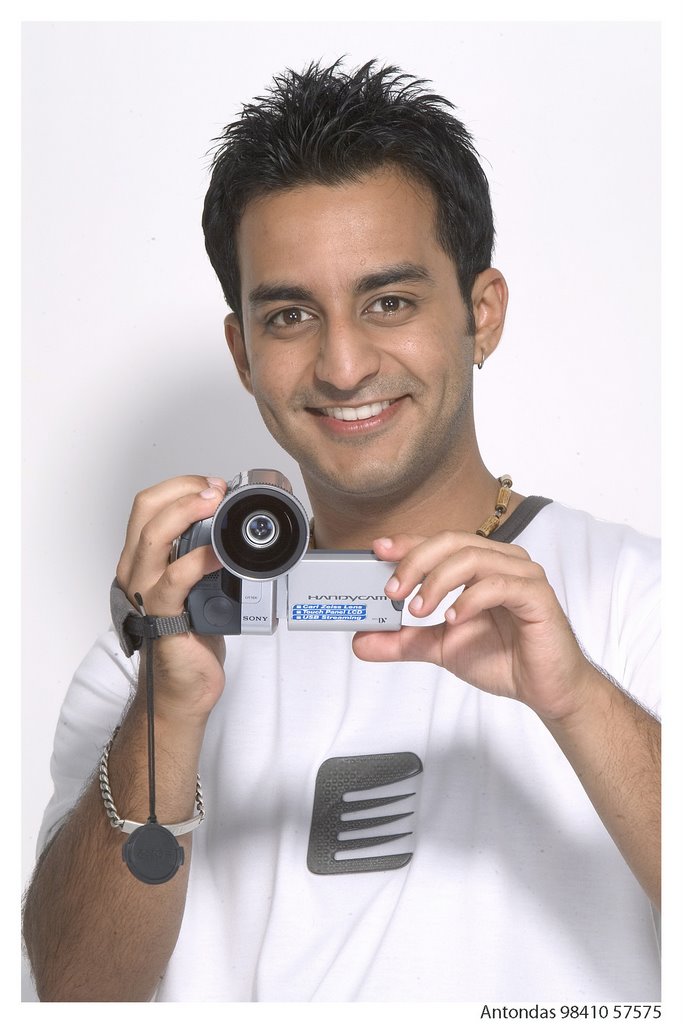 We notice that you use your blog to ask for volunteers for your item dance. How useful have the blogs been? Do you plan to leverage further?
My blog is one part of my life that I’ve made public. So that’s how the film sneaked in and found itself into my regular blog (http://sudhishkamath.blogspot.com). I started my film blog (http://thatfourletterword.blogspot.com) as an attempt to chronicle the making of the film because I realized that the behind the scenes were larger than life, in fact larger than the film itself. But I’ve not found the time to update it as often as I would’ve liked. I just put up a community on Orkut to keep people posted. We have an official site which we will update in the next one month.
It’s been an amazing journey of learning, togetherness and bonding as a family. It has taught us the importance of chasing a dream and the joy of doing it together as a team. Yes, the blogs have been useful in generating moral support. I had at least two volunteers for the item dance but its an idea we dropped. I have people offering me space to shoot. I’m touched. And if this interview is going to add to the help, I will only be overwhelmed! I will be putting down chapters that went into making the film, so that it can be published as a book, for purely selfish reasons. I want to give them away as souvenirs to every person who has been part of this film. A token of thanks. A memento.
What are your future plans?
I want to continue writing because I’ve become addicted to it. I want to finish my first five films before I turn 35. I’m ready with two of the five scripts. My second film Watcha Gonna Do, a multi-genre spoof on American films, will be the first production from Made in Madras inkOperated. And, hopefully it will make enough money to fund my other projects because I know that no producer with a sane mind will agree to fund my third, fourth and fifth films because they will not make money. I know there is a chance that they might not work but these are the kind of films I think are absolutely original. My third film, Checkbox Theory, (I’ve blogged about my Checkbox theory) is about a six-year old boy in love with an eight-year old girl. The film looks at contemporary love stories from the point of view of children. It tells us how clinical we get about love. The older we grow, the more checkboxes we look at ticking, in our choice of partner. The younger we are, the more blissfully we are in love, without any specific reason. To me, that is the pure love, nothing like first love. My fourth film, Slip of Mind, is a psycho-thriller set in the near future where there is no good left in the world. It’s an evil-versus-evil tale and each character has a virtue for a name. The characters are called Hate, Evil, Beauty, Lust, Hope and so on. It is a very dark, philosophical film with a lot of gore. My fifth, Bad News, will be a critique on TV journalism and the entire film unravels through news clippings. Each scene is a news capsule from a different channel. So each TV channel is a character and each tells its own version of the same set of incidents, starting from the abduction of an aging superstar in India, which ultimately snowball to September 11. It’s a fact-meets-fiction tale that requires a year of research. I personally believe I’m not old enough to make my fourth and fifth films yet. I hope to grow up in the next four-five years and develop the right kind of sensitivity and expertise to deal with such complex films. Meanwhile, we at Made in Madras will produce simple films, backed by a panel from the film industry. Just a matter of time before we get Mani Ratnam, Kamal Hassan, Ramgopal Varma, Farhan Akhtar and an A.R.Rahman to see what we see and get them on board as directors who will screen scripts. I personally hope to do one film a year after ensuring that Watcha Gonna Do releases in every corner of the world, no matter how long that takes. High time someone showed the finger to America’s monopoly over English films. English after all is not their language, the Brits created it. And we are/were closer to the Brits than they are/were. So, fuck you Hollywood! Here we come!
Update: I, next, starting next month, want to work on a mainstream Hindi film. I’m calling it ‘Parchayi,’ it’s a tribute film to one of my most favourite films (I’m not saying which one but by the time it comes out, I dunno how many of you will see through it). But yes, a tribute does not mean its not original. It is entirely original because I’ve just taken the soul of a movie I’ve liked and transplanted it in a different world, with different people, with a different conflict and so, it became a very different plot with very little resemblance to the movie I’m paying tribute to. I want to make it now because it is on among the most relevant contemporary issues in Bollywood. There is a huge difference between a tribute and a remake. ‘Parchayi’ is an ode to orginality and fresh thinking, the need to give back something to the movies that have made us and the life around us, instead of rehashing them. To bring movies to life, you need to bring life into the movies. It’s my tribute to movies and people who inspire them.
(concluded)
Want know more? That will take you back to the beginning of the series. 😀
Your movie is seven years in the making. What have been your stumbling blocks.
Money. We always knew it can create, we didn’t know it can also corrupt. We had a producer in Sashi who was willing to invest about 17 lakhs in the film. That was a lot of money for us. Until one day, Levis came and said: “Take ten from me. I want to be part of this film too.” And then, we decided to exploit the potential of in-film promos. We tried more sponsors first through our own company, then gave up and tied up with Ogilvy to get sponsors. That took us a year and a half before deals got finalized. Then we shot a promo. And tried some more to get sponsors. That didn’t work, so we had to make Sashi spend all the money. We spent about 11 lakhs making the film. We shot almost 95 per cent of it. Just another five per cent was left and life began playing games with us. One of our cast members didn’t have dates because she was now an RJ and said she couldn’t spare “even half a day” because her boss was strict. Another guy broke his knee and was advised bed rest for six months. In that period, Sashi’s daughter was diagnosed with tumour and the rest of the cast got busy with their respective careers. Cary and Usha became Southern Spice VJs. Ranvir was away, first in the middle of action, thanks to the Pooja Bhat episode, and then out of action due to an accident and then busy again in life with Lakshya. Getting common dates became a hassle. Mid of last year, one and a half years after we last shot the film, we guys got finally together and decided something had to be done. Sashi said he will give us the last instalment of five lakhs to complete the film. There was no way we couldn’t shoot parts of the film replacing two of our cast members, so we decided that it was easier to shoot the whole film again. Abbas volunteered to be Executive Producer, it was a shot in the arm for the team. In the last months, we did our best to get sponsors, but it is always difficult to get people to part with their money in the last quarter of a year. So all we have now are promises from different corporates, not a penny in hand. How long can we wait? Usha had been postponing her visit to see her sister in America for the last six months, she got a visa some five months ago. She finally had booked her ticket for mid April after we assured her we will finish by March. So two weeks ago, we took the call to go ahead and finish it, no matter what. With or without money. People have been doing it. One of my one-time assistant director Pradeep had got together with his friend Vijay last November for a cup of tea. They wrote a script by November 17, auditioned people and started shooting by November 24 and finished shoot by December 17 and editing by January 7 this year!! With no money at all, sheer will-power!!!
Pradeep and Vijay, today, are my inspiration.
I did this scriptwriting workshop at SRM mid last year and at the end of it, as a part of my motivational exercise told them to write a feature length script in 30 days and if they did, I would personally ensure that the director will provide them with the camera and the editing set-up for the shoot. Early February this year, I got a call from their director. They had a film on them. A completed one. They, today, are my inspiration.
Money corrupts a project. Will-power gives it the boost. Today we don’t have any money. But we have the will, we have people, we have the spirit. What more do we need, huh?
Having said that, thank you Mom!! For letting me steal money from your account to do the movie.
With so many difficulties, many would have given up. But you *REALLY* persevere. Why?
Ah, no way. Why would we even think of giving up on something that means the world to us. That’s like quitting life. Plus, if you’ve spent five and a half years on something, you surely don’t want that much of work to go down the drain, do you? It’s just that that kept us going. This film has changed our lives. We owe it to this film and give it some life now.
Dealing with high profile stars has its own difficulties. Why don’t you use fresh faces? After all, movies like Hyderabad Blues and Kaadhal really didn’t have big stars.
Well, like I said, the film wasn’t written for stars. The film found these stars. Every artiste wants a script he/she can relate to. I guess that worked for our film. Every person involved is in the film, not because he/she is a star but because they believe in the script and they can so relate to it. And hey, it helps to have stars because I know hundreds of filmmakers in the country who have not found distributors because we have such a dim-witted system that believes in names to sell a film. I know many completed films which haven’t found buyers because they didn’t have stars. Even Hyderabad Blues had to wait for four years after it was made before it hit the screen and Kaadhal had Boys Bharat who was a name. With the clutter of so many promos, these days we only decide to watch films if we know some face behind the film. Sudhish is hardly a face, Abbas is, Cary is, Usha today is … it’s these faces you see in the promos that actually help you make up your mind if you want to see the film or not. And no, though we fought like mad dogs on the project, we never had any major problems because we always knew that each of us wanted the film to be good.
Even if Abbas isn’t a part of the film now, he will always remain a part of our family, as one of those responsible for seeing the film through.
 DVD cover of the short film I made with Abbas years ago
Ellipsis was shot in two nights in the middle of a cyclone
You movie is one of the first ventures to be shot fully in digital format. What difficulties do you face with it?
There were very few difficulties as such. Though it would have been easier for us had we not shot using sync sound (location sound). Sync sound is something very few have attempted… something only what a Kamal Hasan has tried before here in the South. Farhan did it too for Dil Chahta Hai. And it’s the toughest thing when you are shooting in real locations. If you shut everyone up on the set, even the most real locations look like a set. If you don’t, it turns too noisy that you can hardly hear the lines. Then there’s the sound of the blast of the AC, other ambience noise … like traffic for example, which require you to go in for more and more retakes. This time, we’d rather go in for dubbing. Other than that, video has its limitations. There is the inherent danger of the film looking like a TV serial, because all said and done, the canvas is smaller when you shoot on video. But the advantages of shooting on video really more than make up for the difficulties. If not for video, most of us wouldn’t have ever made a movie!
Does your movie have music?
Yes, we have this American rap/hiphop/fusion band called Karmacy that has recorded a title track for us. And they are giving us another two songs. Asif Ali, our music director sat with Cary and recorded about 20 scratch songs, we’ve shortlisted quite a few of them. This time around, Asif has done another ten songs, mostly instrumental. It’s about young people. There’s got to be music.
What lessons have you learnt in filmmaking?
Oh plenty. First as a scriptwriter, I learnt how much I should NOT write. As a director, I learnt how much I should NOT take from the script. A director does not just take a script and translate it to film, he adds value and character to the film. He eliminates words and replaces them with visuals. He takes 95 per cent of the text and puts it in context and uses it as subtext. I learnt that there is no limit to how much you can add to a script. A script is basically made up of a page a minute, it probably packs ten ideas a page and is probably made up of, say, a thousand ideas which tell a story. A director needs to take each of these thousand ideas and express each of these using another ten, twenty, thirty, forty, hundred or more ideas depending on the importance and the magnitude of the idea, keeping the desired impact in mind. The lessons are many. The biggest lesson is that there are many more to be learnt. And you won’t learn till you’ve made the mistakes. I’ve made a million mistakes. I’d like to believe I’ve learnt a million lessons.
We hear that you were able to rope in a very decent line up of stars. Film actor Abbas, ex-Channel [V] VJ Ranvir, SS Music VJ Cary Edwards, Usha (VJ & model), Suchitra (Radio Mirchi Rj). How did you meet the actors?
Well, first TFLW was this small film we wanted to make without any money. It wasn’t a script written after we put the cast together. One day on my job, during an interview with VJs Ranvir and Purab, I learnt Ranvir wanted to be an actor. I told him ‘Every VJ wants to be an actor.’ He didn’t take that comment lightly. After we were done with the interview, he told me that it has nothing to do with a VJ. Every body in this world either wants to make a movie/be an actor or cut an album/be a singer or write a book/be a writer. “I don’t know you but I can bet you want to be a writer,” he said. I smiled back and said: “No, I’d be the movie guy.” “Oh, so you want to make a movie,” he asked. “No, I’m making my movie,” I said. He got all curious then, so though I was least interested in telling him what it was all about, I just gave him a polite two line description of what the movie was about and he immediately asked: Can I audition? Man, I couldn’t believe that! He was a VJ, someone I had great respect for. When I studied in Manipal, he had come to our campus for a shoot. He was so funny and not even in my wildest dreams did I think that HE would want to be in MY movie? For icing, there was Purab, who joined Ranvir and said: “Me too. Can I audition too?” Purab, then got busy with ‘Supari,’ so he passed on the script to Cary, who had just about quit Channel [V] after hosting the much acclaimed Virtual [V] for three years. I still remember that we didn’t have money, so the first time I ever spoke to him was through SMS. My message to him was: “Hi Cary, no STD, only SMS. This low budget film. You still interested? Welcome to the film.”
There was Cyrus Sahukar too who was once a part of the film after he expressed interest but he backed out last minute, saying he didn’t have leave. We just had another two weeks to shoot. And I could only think of Abbas, with whom I had shot a short experimental film called ‘Ellipsis’ a few months earlier. I called him, he said: Give me two minutes, I’ll check if I have dates. Two minutes later, he calls back to say we have. “When can we meet,” he asks. “Now?” “Cool,’ he says. Thirty minutes later, at 8.30 p.m., I meet him at his wife’s boutique on North Boag Road. I narrate the script and we end up talking till 2.30 in the morning. I’ve never seen anyone more excited than him. He could so relate to the character he was playing. And then, he told me something that happened four months before that. He had invited me to the premiere of his Hindi film, ‘Ansh,’ and it turned out to be quite bad. Interval break, he asks us to come out and asks us for our honest opinion. “Bad man … it’s very bad,” I say softly. But I wasn’t telling him anything new. He knew it was bad. He almost broke down: “Why does this happen to me? I make the same mistakes in choosing films,” he said with near moist eyes. “Let’s go for a drive,” I suggested because the last thing we wanted to see was him breaking down outside his own movie preview. A friend stayed next street, so we took him there and showed him the trailer we had just shot for the film, just to warm up. At that point of time, Cyrus was still part of our film and I had my whole cast. “I really wanted to ask you if I can be part of your film that day,” Abbas recalled. “I didn’t want to take advantage of our friendship. But I think it’s destiny. God wanted me to be a part of this film.”
To this moment, Abbas has displayed the same amount of unflinching commitment, passion and enthusiasm to the film. Which is why these days I never say ‘my film,’ I always refer to it as ‘our film.’
Oh, and Ranvir almost never made it to the film because he was busy with his play ‘Blue Mug’ and he asked us to postpone shoot by a month. Cary had waited a year waiting for the film to take off by then and so we told him we can’t wait any longer. Ranvir was already upset with us for an earlier goof-up. When we shot in Pune, he drove down all by himself from Bombay and couldn’t find us because he had the wrong phone number with him and we couldn’t reach him. He was left stranded there before we reached him 36 hours later. He was so angry, he swore he wouldn’t be a part of it. By now, he had cooled down but he was still upset that we couldn’t wait for him in spite of him having done so much for the film. “I was a part of the film even before Cary joined,” he reminded us. But Ranvir had a regular job, Cary did not. So we told him we had to shoot no matter what. “Well, no bad feelings then,” he said, wishing us luck.
There was no one else who could have done that role but Ranvir. And the next alternative we could think of was Cyrus Broacha. How do we get Cyrus Broacha, we wondered aloud sitting at Qwikys when a guy walked up to us and said: “I’ve been observing you guys for the past few weeks. I’ve always wanted to help with your film. I have Broacha’s number,” he said. We christened him ‘Angel.’ Ever since that day, Angel was part of our dream. He quit his job, worked with us on the film and went back to Pune to take up a low paying job saying we inspired him to chase his dreams.
Anyway, so we called Cyrus Broacha and said: “For us, sending you the script and asking you to do our film is like asking Amitabh Bachchan if he wants to work with us.” He laughed and said: “I’m not Amitabh Bachchan. Send me the script.” We did just that and he went incommunicado while we made friends with his Mom over a coupla weeks. Initially she was hostile, then seeing that we had no intention of giving up, finally became friends and tipped us on what time we can catch him at home. Cyrus first said he liked the script and wanted to change the lines a bit. We were game. Then he asked: “When are you looking at shooting this film?” Next month, we said. “Oh, I hate to sound like Amitabh Bachchan but I have two foreign tours lined up next month. One is the UNAIDS conference in Barcelona where Bill Clinton will interview me and talk about sex” (he wasn’t exaggerating too much, it was all over the papers that he was interviewing Clinton) and there was the Nickelodeon Chotta VJ hunt in the Middle East.
So he took off, became incommunicado again. We got so desperate we tried calling five star hotels in Spain through the internet phone at Iway to reach him. No luck, people who picked up the phone didn’t even understand English.
So we scheduled his scenes for the last four days and started shoot. Ten days into the shoot, we reach him … this is two nights before we have scheduled his scenes. And he now tells us his boss Natasha didn’t want him to shoot a movie. We then call Natasha who tells us that she didn’t have a problem, in fact, she didn’t even know about the film. “Maybe he doesn’t want to do it,” she said.
So that’s how Broacha pulled a Bakra on us.
And we were all so pissed off that we cancelled shoot that evening and went for ‘Bend it like Beckham.’ In the interval, Cary asked: “Why don’t you ask Ranvir what he’s doing day after tomorrow?” “He will kill me,” I said. “That’s not too bad. But what if he agrees … we have everything to gain,” he said.
Thank you Cary, for suggesting that.
Because the phone conversation, went like this:
“Hi Ranvir, this is an SOS. We need you to bail us out.”
“Why, what happened?”
“Broacha was supposed to do your role and he backed out last minute. We know we are being really selfish but we didn’t know who else to ask.”
“What dates do you need?”
“Four days from day after tomorrow.”
“Okay, I’m free on these days. Because I just quit Channel [V] yesterday. But I’ll come only for four days. And you were going to pay me 5K a day, now make it 10K. Send me the ticket and keep the cheque ready, I’m coming.”
Ranvir, we would have paid you a lakh a day if we had the money! We jumped at his offer. Done!
So Ranvir was in again and we got our Zebra back.
That was the last time around.
This time, it was a rollercoaster because we had to change our cast halfway and resume shoot in 48 hours. And all that we did for years to get our actors, we fit into the most tense 48 hours of my life. That is something I will save for the book I’m writing on the movie.
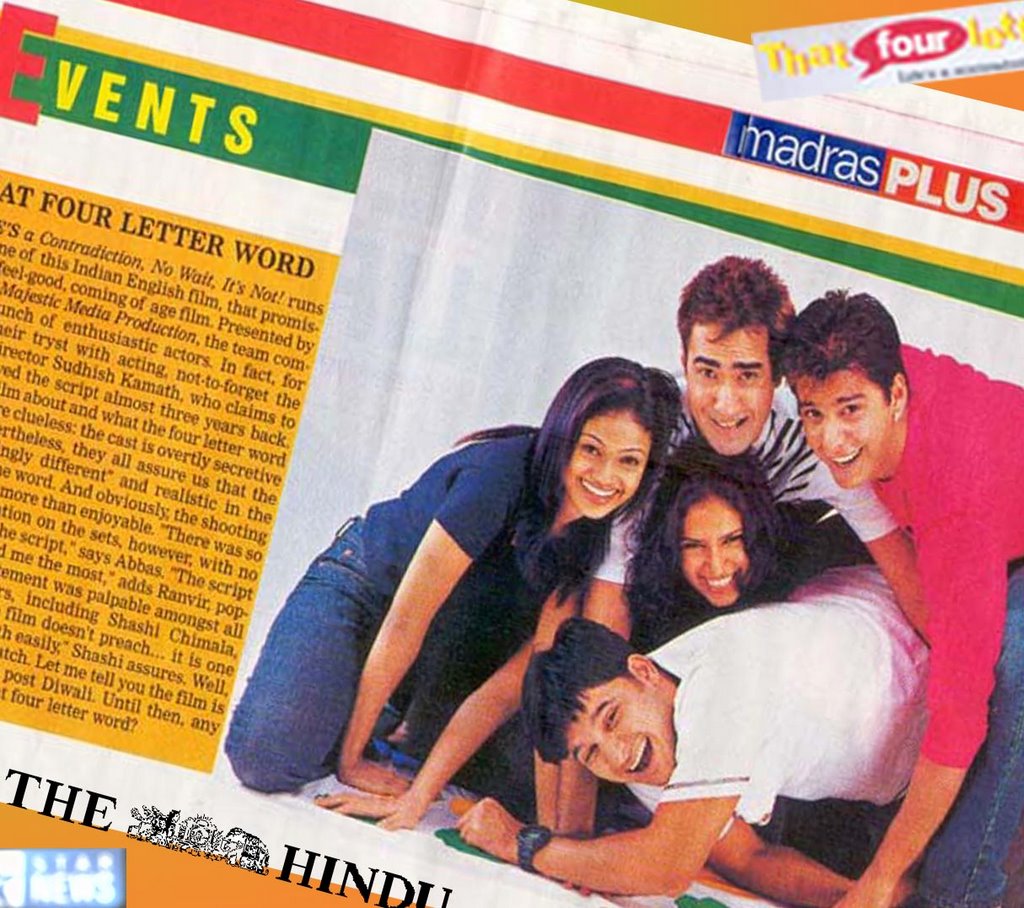
You are a full time reporter in The Hindu. How do you manage to juggle between your full time job and the movie.
Well, the movie has been part of me for these seven years. I go to sleep with it, wake up with it, have breakfast with it, take it with me to office, make it wait while I meet different people and key in my story and then come back home with it. A movie happens in your head. It didn’t really take time away from what my work required of me, except for the 20 days when we had to do the shooting. Or let’s just say that my job isn’t really a job. It’s like life. Everyday, I meet different people, get to know them and write them in my diary using a little journalese and hey, you read it in the papers. Most of my stories are conversational, they talk to people. I didn’t find a style in it, it was what came naturally to me. And I’m glad it worked. I don’t see myself as a journalist or even a writer, nor do I even claim to be.
I dream and films are just about living out that dream … you share it with a few people, shoot it for the camera and share it with more people. It is really that simple, leave the jargon and the work out of it.
Finding the money to shoot that dream is what is 90 per cent of the “work,” the rest of it is what we love to do anyway.
 I got a sneak preview of the theatrical trailer of Gautham’s ‘Vettaiyaadu Vilayaadu’ when I went to interview him at his studio. It blew my mind. Super slick. The movie’s gonna rock.
My interview with Gautham should be out tomorrow. And once that appears, I will publish the uncut version here. He had a lot to say about his relationship with Kamal Haasan. Quite candid. Toned it down quite a bit for the paper because it’s not the paper’s style to sensationalise things.
Watch this space for the Director’s Uncut!
There is quite a bit of money invested and there will be even more you will have to invest. How do you plan to recover your money?
Oh, that wouldn’t be much of a problem. Or at least we hope. We’ve got a decent film with us with a decent cast. Satellite rights alone these days fetch a handsome sum that would recover entire cost of production. Besides, we intend to distribute it ourselves in a small way, one step at a time. It’s our baby, we will make it crawl first before it can walk around the country and do the rounds around the world. We will make it grow from strength to strength. We have a few plans to market the film, taking it personally from one city to another city. We hope to cover ten Indian cities before it’s ready for the world.
When do you plan to release the movie?
Ideally, during Friendship Week, the first week of August. That’s exactly the mood we want people to be in when they watch the film. This movie is about a gang of friends and best watched with your gang of friends.
There’s more to our organization Made in Madras InkOperated! than TFLW. Tell us about it.
Made in Madras was what we wanted to called our film before we came up with That Four Letter Word. But then, it would have been such a cliché with Hyderabad Blues, Bombay Boys and then Made in Madras!! So we chucked the idea but the phrase is so close to our heart because we are simple people made in this simple city and we are proud of our identity. In this globalised world, I think that’s something many of us are forgetting. What was good about us! Who we really are!! Made in Madras hopes to rekindle that spirit of simplicity. It will be a society committed to bringing independent filmmakers together. In a couple of years, we will be ready to produce independent films and make the dream of first time filmmakers come true. We are also putting together a database of professionals and resources available to help you shoot your film free of cost. It will be a not-for-profit organization, run not through money but by ink! Because great ideas just require ink. Either you write them down or print them out. But put it on paper. Paperwork is all it takes to make a film! That’s the idea behind Made in Madras inkOperated! It’s also a fun company, that’s what the pun on Incorporated signifies and the exclamation is the statement we want to make through our work. A form of eccentric expression!
We notice that you use your blog to ask for volunteers for your item dance. How useful have the blogs been? Do you plan to leverage further?
My blog is one part of my life that I’ve made public. So that’s how the film sneaked in and found itself into my regular blog (http://sudhishkamath.blogspot.com). I started my film blog (http://thatfourletterword.blogspot.com) as an attempt to chronicle the making of the film because I realized that the behind the scenes were larger than life, in fact larger than the film itself. But I’ve not found the time to update it as often as I would’ve liked. I just put up a community on Orkut to keep people posted. We have an official site which we will update in the next one month.
It’s been an amazing journey of learning, togetherness and bonding as a family. It has taught us the importance of chasing a dream and the joy of doing it together as a team. Yes, the blogs have been useful in generating moral support. I had at least two volunteers for the item dance but its an idea we dropped. I have people offering me space to shoot. I’m touched. And if this interview is going to add to the help, I will only be overwhelmed! I will be putting down chapters that went into making the film, so that it can be published as a book, for purely selfish reasons. I want to give them away as souvenirs to every person who has been part of this film. A token of thanks. A memento.
What are your future plans?
I want to continue writing because I’ve become addicted to it. I want to finish my first five films before I turn 35. I’m ready with two of the five scripts. My second film Watcha Gonna Do, a multi-genre spoof on American films, will be the first production from Made in Madras inkOperated. And, hopefully it will make enough money to fund my other projects because I know that no producer with a sane mind will agree to fund my third, fourth and fifth films because they will not make money. I know there is a chance that they might not work but these are the kind of films I think are absolutely original. My third film, Checkbox Theory, (I’ve blogged about my Checkbox theory) is about a six-year old boy in love with an eight-year old girl. The film looks at contemporary love stories from the point of view of children. It tells us how clinical we get about love. The older we grow, the more checkboxes we look at ticking, in our choice of partner. The younger we are, the more blissfully we are in love, without any specific reason. To me, that is the pure love, nothing like first love. My fourth film, Slip of Mind, is a psycho-thriller set in the near future where there is no good left in the world. It’s an evil-versus-evil tale and each character has a virtue for a name. The characters are called Hate, Evil, Beauty, Lust, Hope and so on. It is a very dark, philosophical film with a lot of gore. My fifth, Bad News, will be a critique on TV journalism and the entire film unravels through news clippings. Each scene is a news capsule from a different channel. So each TV channel is a character and each tells its own version of the same set of incidents, starting from the abduction of an aging superstar in India, which ultimately snowball to September 11. It’s a fact-meets-fiction tale that requires a year of research. I personally believe I’m not old enough to make my fourth and fifth films yet. I hope to grow up in the next four-five years and develop the right kind of sensitivity and expertise to deal with such complex films. Meanwhile, we at Made in Madras will produce simple films, backed by a panel from the film industry. Just a matter of time before we get Mani Ratnam, Kamal Hassan, Ramgopal Varma, Farhan Akhtar and an A.R.Rahman to see what we see and get them on board as directors who will screen scripts. I personally hope to do one film a year after ensuring that Watcha Gonna Do releases in every corner of the world, no matter how long that takes. High time someone showed the finger to America’s monopoly over English films. English after all is not their language, the Brits created it. And we are/were closer to the Brits than they are/were. So, fuck you Hollywood! Here we come!
Update: I, next, starting next month, want to work on a mainstream Hindi film. I’m calling it ‘Parchayi,’ it’s a tribute film to one of my most favourite films (I’m not saying which one but by the time it comes out, I dunno how many of you will see through it). But yes, a tribute does not mean its not original. It is entirely original because I’ve just taken the soul of a movie I’ve liked and transplanted it in a different world, with different people, with a different conflict and so, it became a very different plot with very little resemblance to the movie I’m paying tribute to. I want to make it now because it is on among the most relevant contemporary issues in Bollywood. There is a huge difference between a tribute and a remake. ‘Parchayi’ is an ode to orginality and fresh thinking, the need to give back something to the movies that have made us and the life around us, instead of rehashing them. To bring movies to life, you need to bring life into the movies. It’s my tribute to movies and people who inspire them.
(concluded)
Want know more? That will take you back to the beginning of the series. 😀
 MADRAS INK.