• SUDA MING’S CHANNEL
  • TALKING FILMS
  • Good Night | Good Morning
  • My Talk Show
  • PROFILE

MADRAS INK.

Menu

  • Archives
  • Columns
  • Diary
  • Interviews
  • My Films
  • Reviews
  • Good Night | Good Morning

  • Word thru the bird

    Tweets by SudhishKamath
  • Connect with GNGM

    Connect with GNGM
  • About GNGM

    Reviews

    “A cerebral joyride”
    Karan Johar, filmmaker on REDIFF

    “Among the most charming and creative Indian independent films”
    J Hurtado, TWITCH

    ★★★★✩
    “You don’t really need a big star cast… you don’t even need a big budget to get the techniques of filmmaking bang on…”
    Allen O Brien, TIMES OF INDIA

    ★★★★✩
    “An outstanding experience that doesn’t come by too often out of Indian cinema!”
    Shakti Salgaokar, DNA

    ★★★
    “This film can reach out the young, urban, upwardly mobile, but lonely, disconnected souls living anywhere in the world, not just India.”
    Namrata Joshi, OUTLOOK

    “I was blown away!”
    Aseem Chhabra, MUMBAI MIRROR

    “Good Night Good Morning is brilliant!”
    Rohit Vats, IBN-LIVE

    ★★★✩✩
    “Watch it because it’s a smart film.”
    Shubha Shetty Saha, MIDDAY

    ★★★✩✩
    “A small gem of a movie.”
    Sonia Chopra, SIFY

    ★★★✩✩
    “A charming flirtation to watch.”
    Shalini Langer, INDIAN EXPRESS

    “Interesting, intelligent & innovative”
    Pragya Tiwari, TEHELKA

    “Beyond good. Original, engrossing and entertaining”
    Roshni Mulchandani, BOLLYSPICE

    * * * * *
    Synopsis

    ‘Good Night Good Morning’ is a black and white, split-screen, conversation film about two strangers sharing an all-night phone call on New Year's night.

    Writer-Director Sudhish Kamath attempts to discover good old-fashioned romance in a technology-driven mobile world as the boy Turiya, driving from New York to Philadelphia with buddies, calls the enigmatic girl staying alone in her hotel room, after a brief encounter at the bar earlier in the night.

    The boy has his baggage of an eight-year-old failed relationship and the girl has her own demons to fight. Scarred by unpleasant memories, she prefers to travel on New Year's Eve.

    Anonymity could be comforting and such a situation could lead to an almost romance as two strangers go through the eight stages of a relationship – The Icebreaker, The Honeymoon, The Reality Check, The Break-up, The Patch-up, The Confiding, The Great Friendship, The Killing Confusion - all over one phone conversation.

    As they get closer to each other over the phone, they find themselves miles apart geographically when the film ends and it is time for her to board her flight. Will they just let it be a night they would cherish for the rest of their lives or do they want more?

    Good Night | Good Morning, starring Manu Narayan (Bombay Dreams, The Love Guru, Quarter Life Crisis) and Seema Rahmani (Loins of Punjab, Sins and Missed Call) also features New York based theatre actor Vasanth Santosham (Bhopal: A Prayer for Rain), screenwriter and film critic Raja Sen and adman Abhishek D Shah.

    Shot in black and white as a tribute to the era of talkies of the fifties, the film set to a jazzy score by musicians from UK (Jazz composer Ray Guntrip and singer Tina May collaborated for the song ‘Out of the Blue), the US (Manu Narayan and his creative partner Radovan scored two songs for the film – All That’s Beautiful Must Die and Fire while Gregory Generet provided his versions of two popular jazz standards – Once You’ve Been In Love and Moon Dance) and India (Sudeep and Jerry came up with a new live version of Strangers in the Night) was met with rave reviews from leading film critics.

    The film was released under the PVR Director’s Rare banner on January 20, 2012.

    Festivals & Screenings

    Mumbai Film Festival (MAMI), Mumbai 2010 World Premiere
    South Asian Intl Film Festival, New York, 2010 Intl Premiere
    Goa Film Alliance-IFFI, Goa, 2010 Spl Screening
    Chennai Intl Film Festival, Chennai, 2010 Official Selection
    Habitat Film Festival, New Delhi, 2011 Official Selection
    Transilvania Intl Film Festival, Cluj, 2011 Official Selection, 3.97/5 Audience Barometer
    International Film Festival, Delhi, 2011 Official Selection
    Noordelijk Film Festival, Netherlands, 2011 Official Selection, 7.11/10 Audience Barometer
    Mumbai Film Mart, Mumbai 2011, Market Screening
    Film Bazaar, IFFI-Goa, 2011, Market Screening
    Saarang Film Festival, IIT-Madras, 2012, Official Selection, 7.7/10 Audience Barometer

    Theatrical Release, January 20, 2012 through PVR

    Mumbai
    Delhi
    Gurgaon
    Ahmedabad
    Bangalore
    Chennai
    Hyderabad (January 27)

    * * * * *

    More information: IMDB | Facebook | Youtube | Wikipedia | Website

  • Browse: Categories

  • December 2025
    M T W T F S S
    1234567
    891011121314
    15161718192021
    22232425262728
    293031  
    « Dec    
  • Recent Posts

    • Simmba: A departure from the formula
    • Zero: The hero who wasn’t
    • Protected: AndhaDhun: What did that end mean?
    • Love and other cliches
    • October: Where is Dan?

Posts By sudhishkamath

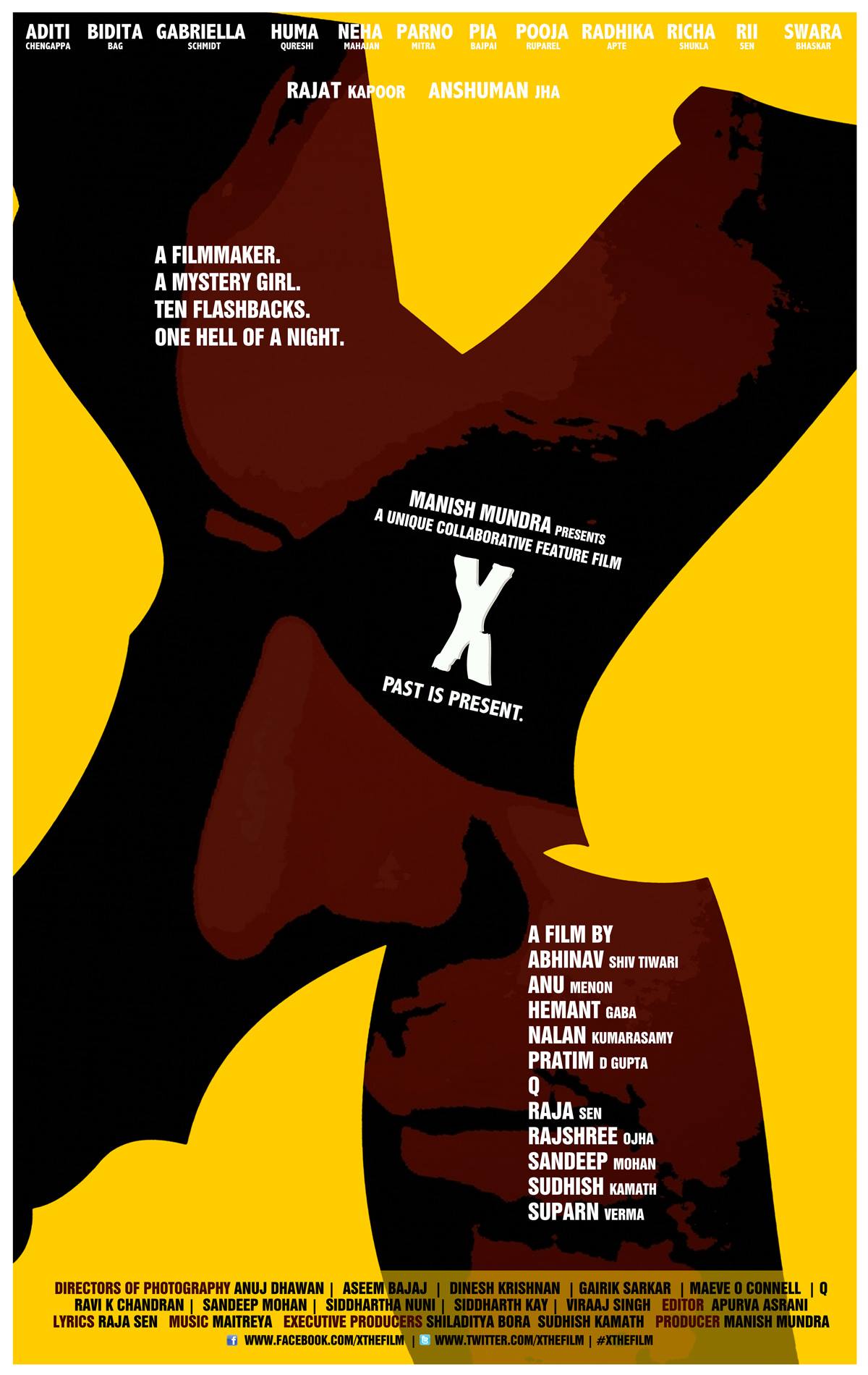
Presenting X

November 18, 2013 · by sudhishkamath

1412697_198310663686540_1958214728_o

Is man meant to stick to one woman?

Is film meant to conform to one genre?

X is a one-of-its-kind film because eleven Indian filmmakers with disparate styles of filmmaking have come together to make different parts of the same film.

NOT an anthology but a single story.

The story of K (Rajat Kapoor) a filmmaker with a mid life crisis, who meets a mysterious young girl (Aditi Chengappa) who reminds him of his first girlfriend at first, and subsequently, of every woman in his life. Who is she? Is she real or imaginary? A stalker or a ghost? His past catching up or a character from the script he is writing? As the night unfolds, the mystery heightens as we cut back and forth between present and past to discover who he really is. Each flashback episode, directed by a different filmmaker (since every woman/story required a different genre) unravels the role of a different ex in his life.

What is it that makes us tick or stop? What is that we truly want or miss in our lives? What is it that keeps us anchored or free falling? What is it that makes us move or let go? Are we products of our past or present? What is that X factor that defines who we are?

Truth has at least as many answers and shades as the lovely ladies in the film: Aditi Chengappa, Bidita Bag, Gabriella Schmidt, Huma Qureshi, Neha Mahajan, Parno Mitra, Pia Bajpai, Pooja Ruparel, Radhika Apte, Richa Shukla, Rii Sen and Swara Bhaskar.

Directors Abhinav Shiv Tiwari Sankhnaad (Oass), Anu Menon (London Paris New York), Hemant Gaba (Shuttlecock Boys), Nalan Kumarasamy (Soodhu Kavvum), Pratim D. Gupta (Paanch Adhyay), Qaushiq Mukherjee (Gandu, Tasher Desh), film critic Raja Sen, Rajshree Ojha (Aisha, Chaurahen), Sandeep Mohan (Love Wrinkle Free), Sudhish Kamath (Good Night Good Morning) and Suparn Verma (Ek Khiladi Ek Hasina, Acid Factory, Aatma) have shot this film produced by Nigeria-based Manish Mundra in California, London, Mumbai, Delhi, Kolkata and Chennai.

In English, Hindi, Bengali and Tamil.

In strikingly different styles as a bridge between the various cinemas of India. Mainstream, Arthouse, Popular, Underground, Regional and Global – all at the same time.

National award winning Editor Apurva Manohar Asrani(Satya, Snip and Shahid) has taken up the responsibility of putting eleven styles onto one canvas in a way that brings out the bigger picture.

Executive Producer of X, Shiladitya Bora is available for meetings at the Film Bazaar, Goa for international distribution and festival enquiries.

Almost all the directors of X will be in Goa as well. Watch out for the signs.

Do say Hi! We might just give you a sneak preview of the film everyone’s waiting to watch.

(The trailer should be out soon. Watch this space.)

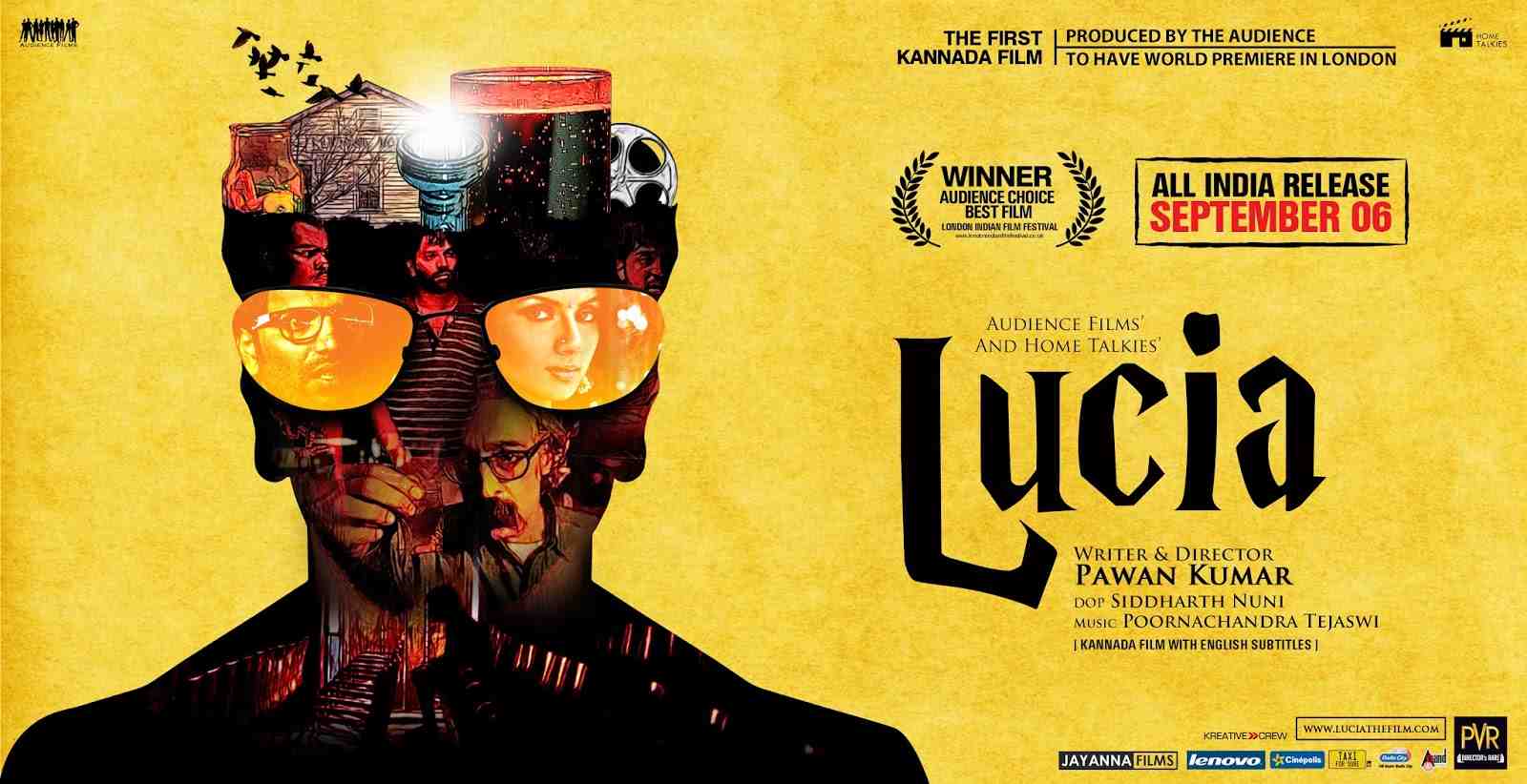
Lucia: The sweet and the sour

September 10, 2013 · by sudhishkamath

Lucia

I was blown away by Lucia. Because it took the core of one of my favourite films ever – Cameron Crowe’s Vanilla Sky (a remake of the Spanish cult hit Abre Los Ojos) and made it so damn accessible. Something even Hollywood’s best couldn’t achieve despite having a super star studded cast: Tom Cruise, Cameron Diaz, Penelope Cruz and Kurt Russell.

Adaptation maybe too strong a word but if you’ve seen Vanilla Sky as many times as I have, you’ll see it’s the same idea that’s at the core of both these films. A virtual reality programme Life Extension (that guarantees you Lucid Dreams that makes you live the life of your choice in your dreams) is substituted by a pill called Lucia (“a corny name for a drug that gives you Lucid Dreams that make you live the life of your choice in your dreams) here.

Both are stories that tell you that the sweet is never as sweet without the sour, as Vanilla Sky puts it. Both are stories about protagonists who fall in love, lose it and try to win it back using the pill/programme.

Both films begin present day with an investigation that’s a result of an attempt to murder and we cut back to see the life of the protagonist before he took the pill/signed up for the programme. While Vanilla Sky takes 70 per cent of the film to tell us about the LE programme, Lucia plays its cards upfront and lets you in on the big secret: right in the first scene. That it’s all about a pill called Lucia!

This minor change in structure helps us to invest on the character and what his dreams mean to him instead of wondering what the hell is going on. Not to say that Lucia does not have its share of WTF moments!

But the true triumph of the filmmaker is that he creates a world and character so real and endearing that you can’t help but root for its underdog hero. Backed with Siddhartha Nuni’s trippy cinematography (it’s unbelievable and also, little ironic that this tribute to cinema has been shot entirely with a Canon 5D), director Pawan Kumar intercuts between three narratives rather seamlessly – the present day investigation, the dream narrative and the reality narrative – and often blurs the lines between the three without ever making this seem muddled up.

Though it does take digs on commercial cinema, it is also smart enough to use the trappings of mainstream cinema to its advantage. There is an item song (but used as a spoof), there is drama, fight scenes, even sentiment (the Shankaranna subplot that packs the poignancy of Cinema Paradiso… the director says he hasn’t seen the classic) and comedy (the song where his girlfriend sends him off with a bunch of foreigners to help him learn English), but all of this is employed with a lot of heart.

When most arthouse cinema is trying to be commercial these days, it is quite commendable that a mainstream film has tried to go this arthouse. The film’s sense of humour is a big plus and barring the songs that add to the length (but then, they are used as a part of the narrative), there is very little you will end up cribbing about. Also, it helps that the actors – Neenasam Sathish, Sruthi Hariharan and Achyuth Kumar – are so bloody good.

The masterstroke of Lucia, however, lies in the twist that subverts the entire story and justifies its structure and colour treatment (the film uses black and white for one narrative and colour for the other to ensure we never get confused). Pawan plants clues all through the film for those paying attention that nothing seems like an afterthought. But yes, if you are familiar with the genre, you might see the twist coming from a distance.

But Lucia is not about the twist or the suspense. It succeeds because it’s about the hero and his dreams. It’s one of those films that is worth watching the second time just to see if knowing the ending changes how you perceive what’s going on.

So don’t wait, go book your tickets. This is one hell of a chill pill if you love your movies. A trip you won’t regret.

He Says, She Says Spl: No more Happily Everafters?

February 13, 2013 · by sudhishkamath

By Sudhish Kamath & Shonali Muthalaly

HE SAYS:

Forever and ever?

Back in the day, before the invention of mobile phones, we used to talk, hang up and spend the rest of our time living a life. We shared it with people we loved because they were around you more than anyone else.

Like the mobile phone that replaced telephones, we are not attached or wired to anything anymore.

If you are young and born in the late Eighties or Nineties, you know the longest relationship most people have had is with their mobile phone.

Back when we had landlines, we rarely changed phones. Today, we change mobiles every year or two.

In many ways, these phones have become a metaphor for our love lives.

When it comes to love, the concept of forever has forever changed. Handwritten long love letters have been replaced by single character emoticons.

Like phones, the lifespan of relationships, is coming down every few years. There’s so much activity in our lives and our batteries are draining quicker than before.

When it stops working and can’t be fixed, you get rid of it and get a new one because you need it. You need it because you are used to it.

Close proximity with computers and mobile phones has only made us adapt and learn from machines. The inbox has become an extension of our mind space. We store information as files and delete what we don’t need.

We live online. Friends are on Facebook, people follow on Twitter and closest buddies on Whatsapp. And Eternal Sunshine of the Spotless Mind is as simple as Unfriend, Unfollow, Block, Ignore and Blacklist.

The nineties said friends are the new family. Today, networks are the new friends. We spend more time on networks than with friends.

The need to belong and find acceptance within the network is superseding the need for relationships. With most urban youth having their first relationship at 16 or 18 and not ready to commit until they are 30 or 40, they don’t want to wait till they are married to get physical. Careers have become more important because it’s become more difficult to find a well-paying job than a relationship.

Once the most intense relationship breaks down, every relationship after that pales in comparison, leading to disillusionment, emptiness and a temporary void.

Like the end of a really good sad movie. Eject. Insert new disc.

Or shutdown. Log in.

I see dead people.

Yet… all it takes is a moment to bring a heart pounding back to life.

Heart. The most resilient thing ever. With a lifespan of over a 50 mobile phones. With an inbox so deep and limitless. With strength that can withstand the greatest of falls. It’s built to love. No matter how hard you try not to use it, you just cannot control it. Want a happily ever after? Surrender to it. It has an endless supply of love. Release it. And it will set you free.

People come, people go. Love stays. Forever. And ever.

SHE SAYS:

Why wait for forever?

Modern love is tough.

Perhaps that’s why Mr Right has been replaced with Mr ‘Right Now’.

Cynical? Not really. Perhaps we’re finally realising the significance of Carpe Diem. Seize the day. Live the moment. Luxuriate in the ‘Now’.

The world has changed. Love used to mean romance: poetry, roses, candle lit dinners. Boys begged common friends for your phone number. Wrote you ten page letters, with cute cartoons drawn in the margins. Composed songs for you, and strummed them on beat-up old guitars.

In the Nineties we fell in love and channelled the likes of Savage Garden: “I’ll be your hope, I’ll be your love be everything that you need/ I love you more with every breath, truly madly deeply do…” Contemporary chartbusters are very different. Think Eminem and Rihanna singing ‘Love the way you lie’: “Just gonna stand there and watch me burn/ But that’s alright, because I like the way it hurts/ Just gonna stand there and hear me cry/ But that’s alright, because I love the way you lie.”

Welcome to the free fall of modern love. Breathless. Relentless. Unapologetic.

So you’re in love. And out. You break a heart. Have your heart broken. Dump. Get dumped. Have a fling. Cheat. Experiment. Maintain ‘friends with benefits.’

It’s fast, it’s ruthless, it’s no holds barred. Speed dating, powered by technology. Relationships on steroids.

Girl meets boy. Girl googles boy. (And vice versa.) A little Facebook stalking, Whatsapp through the night, dates set via SMS. There goes the mystery. But not the drama. By date two, you’re half way through a relationship. Texting, sexting, booty calls. Love and lust, inextricably intertwined. Till it’s over. Till you’re at a party. Again. Exchanging BBM pins. Again. Here we go. Again.

Love at first sight? Please. You have got to be kidding. This isn’t a Jane Austen book. Or ‘Harry Met Sally’. Or a Celine Dion song. They seem so naïve today. Romance instagrammed: Charming – but far from real.

Love today is far more complex. An information overload, incessant connectivity, inescapable uncertainty.

But it’s still love. And it’s still real. And perhaps, it’s more resilient. Because, ironically, in this age of high-tempo relationships, we’re more understanding than ever before. After all, we’ve all ‘been there’. We know what it’s like to hurt. To cheat. To fall in love. Truly, madly, deeply.

So you’ve become more sceptical? It’s called growing up. Another bad relationship? It’ll make you appreciate the good ones. Had your heart broken again? Take pride in your courage to keep believing.

Meanwhile, enjoy the good times. Even if they’re temporary. Maybe Mr Right Now will turn out to be The One. Maybe he won’t.

But in the end you’ll realise that love hasn’t changed. Our generation is as infatuated with finding “the one” as our parents generation was. Only, our odds are better. After all, we’re more willing to take chances. More open to living life on our own terms. And modern love has made us so much braver.

(This originally appeared here).

Vishwaroopam, Polarisation and Duality

February 11, 2013 · by sudhishkamath

A colleague was recently attacked for his positive review of a film simply because he had authored a book on the filmmaker. This, despite the fact, that he had mentioned that in the review itself (This amounts to full disclosure).

Additionally, my colleague had expressly put it on record in the book that he’s a fan of the man. You cannot be more honest than this.

So maybe I should start with this piece with a disclaimer too.

A critic understands duality. It’s possible for a film to be good and bad at the same time, writes Sudhish Kamath.

I am a huge Kamal Haasan fan – to an extent that I believe that the difference between Kamal fans and others is that true Kamal Haasan fans are also smart enough to criticise his films. They are quick to see how The Scientist became Neela Vaanam.

I also know Mr. Haasan personally because I was once involved behind the scenes in organising the Chennai International Screenwriting Workshop. He’s always been an inspiration to me as a filmmaker and my film begins with thanks to him.

So, when his partner Gautami was telling me about their new portal Maiam, I had in fact suggested, that I would like to review ‘Vishwaroopam’. I told her that maybe I could write a very critical piece on the film once I had watched it and that they should carry it to establish the credibility of the website.

She was game. I was excited because I really wanted to find out if they would carry a bad review. Too bad we can’t find out now.

Because the day the film released, I messaged her back saying I cannot do it. I loved the film. It didn’t make any sense for Haasan’s own portal to carry a positive review.

Coming back to my colleague and the controversy of social networks attacking critics, I must admit that it’s quite a difficult task to resist from replying to people. Because the idea of a social network is to socialise with people. And when you are a film critic, everyone has a counter opinion.

This year, we have seen fierce disagreements on pretty much every other film. ‘Matru Ki Bijli Ka Mandola’ (which I thought was pretty OK though inconsistent and a few loved), ‘Akaash Vani’ (which I loved and many hated), ‘David’ (which I loved and many hated), ‘Kadal’ (which I thought was bad by Mani Ratnam standards but a few liked) and ‘Vishwaroopam’ (which I loved and a few hated).

When everyone is a critic, the art of criticism becomes even more significant. At the risk of sounding condescending/patronising, I must say here that the average Joe hasn’t been exposed to the basics of criticism or film studies. He reacts on an instinct, like a child getting his first injection saying: “I don’t like it. It was a bad experience.”

The average Joe probably hasn’t understood why willing suspension of disbelief” is such an integral aspect of storytelling, an artistic licence that allows the filmmaker to tell stories that are larger than life.

Which is why while he has every right to crap over everything he has paid to watch and troll anyone who does not agree with him, these shouldn’t be taken seriously for the same reason that critics shouldn’t be taken too seriously either. What you need to consider is the criticism – the arguments – why is it good or why is it bad.

Since, it’s easier to present further arguments using a modern relevant example, I am going to demonstrate by dissecting ‘Vishwaroopam’ and take you through my thought process of interpreting the film since this is a classic example of a film that’s got polarised reviews from critics, fans and haters.

And also because it’s all about the duality – of being a commercial film with so many metaphors to put most arthouse films made here to shame.

SPOILERS FOLLOW, read further only after watching the film.

Genre: Spy thriller.

What that means: Which means plot involving saving the world/country/city from bomb/some form of nuclear attack/terrorist plot/conspiracy. Simply put, not everyday events. These are things that require action, willing suspension of disbelief.

Director: Kamal Haasan

What that means: This is an atheist filmmaker and activist actor known to make films about humanity, compassion, non violence etc but is considered arrogant, indulgent and narcissistic. The films he has directed so far are usually rich in metaphors and recurring motifs. Mental note: Watch out for them.

The hero: Vishwanath a.k.a Viz who we learn is actually Wizam Ahmad Kashmiri, a secret agent who had infiltrated the Jihadi group.

What that means: First, Viz is an effeminate dancer, who isn’t quite the man of the house, contrasted with his working wife – a Brahmin meat eater – a sharp contrast to the vegetarian Muslim hero. The paradox.

The duality of all their roles. Like the trailer informs us: Everyone has a double role. “I am a hero and a villain” as the hero tells us, a man with “too much emotional baggage” that he has no time to get into since he needs to save New York. His surname Kashmiri is a hint of who the man is: A Muslim abandoned by his father, torn between his love for the State and sympathy for his brothers across the border. Till the end of the film, he refers to the villain of the film as his “brother Omar”.

The villain: One-eyed Omar Qureshi, Jihadi leader who considers Osama his mentor, but also questions his God.

What that means: An eye for an eye? Literally blinded by his beliefs (or possibly a bomb shrapnel/gunshot from American forces as we will probably find out from the sequel), he can only see one aspect of Jihad as presented to him by his mentor – Osama Bin Laden. Omar is educated, speaks English and acknowledges to Wizam that he knows health care is important but cannot afford to have white doctors around with American soldiers held hostage in the next village. He’s as human as anyone, a man who questions his God on the face of adversity. He’s troubled yet does what he believes is right. In one of the most telling shots in the film, he takes the filth from his teeth and feeds it to a pigeon – the metaphor for peace loving Muslims in the film. We see these pigeons in Afghanistan and later in the US. In the US, pigeons are poisoned with pellets that spread radiation and terror around New York. Pigeons and Jihadis who end up dead after being exposed to radiation in the warehouse: #sameguy.

The conflict: The growing terror network of Jihadis around the world caused by American attacks on the Islamic world.

What that means: Haasan decides to intercut between cause and effect – training in Afghanistan and terror in New York – while taking us through Wizam’s days as the villain (when he betrayed his brothers for his duty towards the State) intercut with his days as the hero (when he has to fight his brothers trying to wreck havoc among innocents). In the Afghanistan portions, we see him discover the human side of the Jihadi. Omar loves his son, who wants to be a DOCTOR not a WARRIOR (Later, we also see Omar playing with his son by blind-folding him and quizzing him on the kind of bullets – semi-blind man wanting to blind his son in his game of violence).

Omar’s son refuses to be called a child when Wizam tries to put him on a swing. But another child-like grown up is quick to get on the swing, is more easily swayed. This character ends up becoming a suicide bomber at the NATO base after he’s given a burqa (eerily introduced into the frame as a hand puppet by the senior Jihadi – again, a lovely metaphor to show that the kid has become the hand puppet later when he wears the burqa and blows himself up!). As we cut from the newspaper shot of his death, Wizam remembers the now dead kid swaying on the swing, as he walks across another swing with a younger child on it.

It’s a shot of the swing in the background that lasts all of two seconds. A little later, he sees the dead doctor lying near a dying horse, frees the animal from misery by shooting it dead (again, duality and the irony – that death is sometimes the kindest act you could do), takes her stethoscope and gives it to the kid who wanted to be a doctor.

The father walks in and points his finger like a gun and mock-fires at the kid’s defiance. The hero helps the kid point his finger as a gun at this father and mock-fires. The villain’s sidekick laughs, villain mock-fires at the sidekick. Kid runs out of his home and starts mock-shooting other kids. It has become a game. Kids shooting kids. Violence begets violence. This is a harbinger of things to come. American troops bomb the village, killing innocents. Cause. Intercut with Effect – Jihadis come to America, bomb New York. Not just Jihadis from Afghanistan, from all around, including Nigeria.

Treatment: Intercutting present with past, effect with cause, in a rather REALISTIC tone for a spy thriller!

What that means: This is a spy thriller. There’s absolutely no need for restraint. We have seen Bond, Bourne and even Agent Vinod do the craziest badass things. Yet, Haasan wants to play it real because he wants us to invest in the people and care for them. The only thrills are through rash driving cars in traffic. And gunshots. Not hand to hand combat. The spy knows he cannot barge into an FBI operation, he can only politely request: “Can I come with you?”

His wife, being an expert on the nature of the radioactive material, is asked to help the bomb squad. When she first mentions the Faraday Shield that was needed to stop the bomb from being triggered by a mobile phone, the bomb expert knows what she’s talking about. Later when she is allowed to the room by the FBI officer who thinks it’s over, she repeats the need to get a Faraday Shield. The bomb geek says the Faraday Shield “should be there in five minutes” (so he clearly has arranged for one already).

Realising that might be too late, she looks around and sees that a microwave could do the same. She saves the day. Why should she? Because education saves life. Not violence. A doctor saves life. DOCTOR not a WARRIOR (Deja vu? Omar’s son wanted to be a doctor) Woman preserves. Man destroys. Not the hero… who gets to put the last bullet into the Jihadi after he’s shot multiple times by the SWAT team. Compared to other heroes in movie situations like this, our hero doesn’t get to do much at all, except maybe blow through the bottom of the door to make a cockroach get away from the Spycam. Earlier when the FBI officer Tom apologises to him for kicking him, before he could say anything, his boss, the Colonel (Shekhar Kapur) butts in saying: “No need. These things happen.”

Haasan is happy to take the backseat and let other characters deal with most of the action. It’s quite unusual for a hero considered narcissistic to give the villain a far more complex role than his own.

Moral: A Muslim agent has to fight a Jihadi group that he once infiltrated and betrayed.

What that means: It’s not everyday do we see a spy thriller made out of India that looks so credible and plausible, while maintaining the equipoise and the duality of truth – of both camps. American and the rebel camp…The Jihadis.

The villain, Omar is fighting for a cause he strongly believes in. Even if it’s caused by blind beliefs, to avenge the death of his family. What US calls collateral damage. The duality of truth is that while there are fundamental Muslims like Omar, Vishwaroopam also tells us that are many liberal Muslims like Wizam, who marry Hindu girls, who stay vegetarian, are patriotic to the country, are peace-loving, have sympathy for their misled brothers… and yet are willing to fight for what they believe is right. To save innocents from collateral damage.

You can replace Wizam in Afghanistan here with Jack Sully in Pandora (Avatar). A man sent to infiltrate the natives for unobtanium/oil that the imperial capitalists want. While Jake wasn’t a native himself, here Kashmiri is a Muslim himself fighting his misled brothers. He maybe misled himself, given that his act of betrayal leads to death of innocents in Afghanistan. He knows he did a lot of wrong, which is why I strongly suspect that we will learn in the sequel that he did in fact, save Omar’s son, who is probably now studying to be a doctor.

It’s very rare to see a Muslim hero, a patriotic one at that, in our films. Or even American films for that matter. Haasan takes a genre template and infests it with so many metaphors, recurring motifs and meaning for those who like depth in their cinema. And I haven’t even got started on the science versus religion subtext (a theme that he explored in Dasavatharam as well).

But I have to concede it’s mostly lost on the audience. But I wouldn’t blame the filmmaker at all. Because that would be like blaming a writer for the illiteracy of his reader.

The average Joe isn’t cinema literate. Which is why criticism, NOT critics, is all the more important today. Criticism means arguments, not just judgments in 140 characters (though we do that too as a teaser to the full review later). We present our case, let you watch the film and make up your mind.

But at the end of the day, it’s still just one person’s opinion. I don’t expect you to agree with me. Similarly, it’s not fair for you to expect a critic to agree with you. If you will only read reviews you will agree with, you must write your own and read them.

A true critic understands duality. That it is possible for the film to be good and bad at the same time, depending on who’s watching it.

Which is why, it’s all the more important, to present your arguments and leave.

Let people be the judge.

Because people also are smart enough to see the difference between argument and judgment. Between reason and emotion. Between critic and troll!

(This was written as a guest post for IBN-LIVE)

David: Three for the price of one!

February 2, 2013 · by sudhishkamath


One’s a super stylish, black and white, moody gangster film that punctuates the narrative with sudden bursts of bullets in the tradition of the best noir films. And David (Neil Nitin Mukesh is really good) is the good guy-protecting-the-bad facing a moral crisis.

Another is a grungy, high-energy, coming-of-age tale of a young musician who sets out to avenge his father’s honour. David (an earnest Vinay Virmani) here, is the good guy wanting to embrace bad for revenge.

The third is a slow, lazy, breezy, drunk… almost stoner, unusual ‘romance’ between a happy go lucky drunk and a deaf and dumb girl. David (Vikram is endearing) here is a bad guy (drunk, juvenile, vandal who goes around punching women) wanting to be good and romantic.

Yes, the fact that these three stories/genres are set across different decades –  in 1975, 1999 and 2010 – is a bit of a stretch and even more when the filmmaker insists that the climax of all three stories happened on March 3rd!

To be honest, I was dreading the fact of watching a film connected only by a name that might end up having a contrived climax that tries to tie up everything. But luckily for me, David was all about the journey and not the destination.

David is an exploration of morality – between right and wrong – and it does so with so much more restraint and style than the blatant in-your-face good versus evil face-off in Mani Ratnam’s Kadal. While I knew from the promos that the film was going to pack a lot of style, what I didn’t anticipate was the surprising amount of soul and substance and a filmmaker in supreme control, so damn confident of his craft.

Here, you are not just rushing through the motions for the sake of pace but exploring it slowly, letting your audience soak in the rich textures of character, their environments and inner turmoil. David is the journey into that part of the mind that is at a two-way fork on the road and how their demons, their Daddy issues, their meeting with their Goddesses shape their destiny.

There is so much glorious detail in David that sets it apart from most Bollywood films. Every frame is so exquisitely composed and choreographed to capture character and mood, a perfect marriage of form and content. The first is dead serious, the second bitter-sweet realistic and the third completely zany and creative. While each character study is faithful to the genre the story is set in, the journeys of the three Davids have one thing in common – they all want answers. David is about the unravelling of those answers while cashing in on its artistic licence and constantly reminding you of its fictional nature through its storytelling devices – music video-like montage sequences, stylised action (the shootout sequence is simply fantastic), surreal supernatural twists, larger than life atmospherics and lavish shot compositions that will put Sanjay Leela Bhansali to shame.

Remember that classy, slo-mo shootout picturisation of the jazzy version of Khoya Khoya Chand in Shaitan that the filmmaker indulged in simply because it looked so cool? There’s a similar boxing sequence here set to Damadam Mast Kalander. Only that this time, Bejoy connects it to what’s going on in the film and uses it to underline the David-Golaith theme running through the film. This is not style for the sake of it. This is style that underlines the film’s central conflict. As a physical manifestation of the battle with the demons.

The relationships are so tenderly etched out in all three stories – be it the classic love story in the first, the unusual bond between an elderly widow and a musician or the beautiful friendship between a drunk and the lady running a massage parlour. It’s these touches that give David its heart and their meditation on the choices they need to make, gives the film its soul. The all encompassing style with which the narrative unfolds is just a huge bonus.

David has to be among the best looking films to have ever come out of India. I’m happy to report that it’s also among the bravest. It’s never afraid to be politically incorrect, whether the Davids are doing right or wrong. Bejoy gets it right.

It’s easy to make a fast film. To make a slow one requires balls.

It’s easy to make a film as a moral science lesson. But to make an amoral film requires guts.

David packs in the spirit of the indie in the big bad world of Bollywood Golaiths.

Mr. Orange approves, Mr. Nambiar.

(I saw a bit of the Tamil version as well, Jiiva is fantastic in it. Will surely now go watch the semi-dubbed Tamil version just for him!)

Kadal: Mani Ratnam at sea as gospel meets masala

February 1, 2013 · by sudhishkamath

Kadal

Kadal is a difficult film to write about especially because a lot of why it doesn’t work lies in spoiler territory.

So do come back to read this only once you’ve seen the film. And yes, that means you must watch it. Even knowing that it is bad. Simply because even a bad Mani Ratnam film is better than most films made.

To begin with, the faulty Prologue should have been done away with at the editing table. It gives away too much information that makes a significant plot twist before interval predictable. We were better off not knowing how exactly Arvind Swamy and Arjun know each other. Because once we know their equation, it’s easy to see a twist coming the minute Arjun returns to the scene. This weakens quite a bit of the first half of Kadal.

The prologue is a weak first scene because Arvind Swamy’s priest comes across as a little too uptight for us to see him as good. He’s like that pest in class who gets you caught for copying. Which is a pity because the character actually blooms into a real person a little later when he enters the village the film is set in. He smiles a lot, he likes people and as tolerant as he is with mischievous urchins, he doesn’t hesitate to slap the kid when needed. And just like that, an uptight stereotype became a real person. Wish we saw more of this human side with his nemesis, who takes character exposition to new heights by taking the name of the Devil in almost every scene he appears. Saataan this, saataan that! Yes, we get it. You don’t have to come in black-and-black to talk about Saataan post interval, we understood who you represent from the very first scene.

It’s not just the simple black and white, good and bad stereotyping that fails Kadal, it’s also the lack of character motivation… What are the these people doing in the film?

An orphan boy who wants his “father” and the whole village at his feet, signs up with the Devil halfway into the film… So far, good. But ten minutes after interval, his “father” is dead and there’s nothing left for the boy to do but wait for the climax to redeem himself. So he bides his time romancing the heroine.  A couple of songs with almost similar visuals – and at least one same reused shot of the couple in a bicycle on the shore in both songs – put the film into a time warp.

Nothing happens. One principal character is away and the other free to do what he wants to.

The priest who has to prove his innocence and win back the trust of the villagers… does it instantly on return! And the Devil of the villain has absolutely nothing challenging him till the climax.

To re-emphasise, as the film does again and again all through the second half, the villain’s graph coasts along gloriously smooth, the boy’s is stuck in a time warp and the other is in exile finds himself suspended from the film and the story.

We have the boy turn all out killer without the slightest hesitation and turn soft again almost instantly every time a romantic song sets in. This is as uni-dimensional as any Tamil masala film, not what you would expect from Mani Ratnam. But it also wants us to learn lessons of forgiveness from the church! Only Mani Ratnam would have thought of making masala meet gospel!

There are some great moments where you can see the class of the master – like the scene during the opening credits when we see the child for the first time, as he discovers that his mother is dead. It’s such a powerful sequence all the way to the burial and you wonder why he didn’t just open the film with this compared to the weak opening at the seminary.

The first half has many such moments – especially the first half hour when the village warms up to the priest who employs a tape recorder to break the ice, the priest’s relationship with the orphan, his attempts to tame the runt all the way to the arrival of his wounded friend from the past! The subplot involving Lakshmi Manchu is quickly forgotten in the second half and the boy’s transformation from bad to good happens with the weakest of Mani Ratnam’s heroines… a girl who behaves like a child (like Priyanka in Barfi, not as over the top). Mani Sir, this is not a new type. Almost, all Tamil film heroines behave like they are 14 year olds with a crush on the hero!

Rahman’s songs are picturised great and the film looks fantastic no doubt but the overdose of the simplistic Biblical good versus evil discourse turns the film predictable. But for the unbelievable unprecedented technical excellence in the picturisation of the climax (Rajiv Menon’s cinematography brings the storm alive), there’s very little the second half offers in terms of good cinema.

The actors are mostly good. Gautham Karthik reminds us of his father and gets a dream debut, the girl is bad but that’s probably because of the ill-etched character she’s been assigned while Arvind Swami gets to make a superb comeback and Arjun gets to be all out bad, even if uni-dimensional. But they have all worked hard on getting the diction right. The technical team gets the milieu somewhat right. Rahman has given us a rather eclectic unusual soundtrack and if the film is let down, it’s only by the weakest material Mani Ratnam has ever been associated with (the screenplay and dialogues are credited to Mani Ratnam and writer Jeyamohan).

For a more superior and authentic film set in this milieu, go watch Neer Paravai (incidentally Jeyamohan wrotes dialogues for this too) which had a lot more to do with the sea than Kadal, where the sea, barring the spectacular climax, is just pretty wallpaper for the rest of the moral science lesson set inside a church!

END is here: Complete Script & OST

December 21, 2012 · by sudhishkamath

EK NAYI DUNIYA / APOTHEOSIS

END is here.

In an ideal world, I would have had enough money to have shot and released my new film called Ek Nayi Duniya / Apotheosis today. But for now, I would like to share the script and the instrumental theme composed by Sudeep Swaroop with supporters of independent cinema in the hope that some of you like it and spread the word.

Click here for Script | Score

By the time the film is ready for release next year, you will know if you want to watch it or save your money.

After Good Night | Good Morning, I wanted to do a film at the opposite end of the spectrum.

If GNGM was new age romance in an old-world setting, I wanted to deal with an old-world arrangement in a futuristic setting.

If GNGM was conversational, I wanted to make a film that was largely atmospheric.

If GNGM was claustrophobic, I wanted to make one on a huge canvas and a lot of space.

If GNGM was shot indoors in an air-conditioned studio, END will be shot in the middle of the Indian Ocean during the monsoon mid 2013.

Why am I then putting the script out?

Could someone steal it?

Sure. They are most welcome to. Only that I am 100 per cent certain that they wouldn’t dare.

Besides, I have taken care of the legalities to protect myself in the unlikely event that someone figures a way out to monetise this script without really making the film. But if you want to go ahead and make the film, please go ahead. I promise I won’t sue… as long as you credit and pay me, of course.

But I am certain that wouldn’t happen. Because nobody wants to invest money on anything without a precedent.

I am pretty sure that nobody would have made Good Night Good Morning even if I had put the script out before making it. Nobody would have thought it was possible to make a feature with two people on the phone for its entire duration. But it worked. I couldn’t have asked for a better launch as a filmmaker.

EK NAYI DUNIYA (Apotheosis is the English working title) is a modern day Adam and Eve relationship drama that plays out like a science fiction psychological thriller.

Like Good Night | Good Morning, I have tried to keep things simple: a two-character film once again. Something I can shoot in three weeks even in the most difficult of conditions. As an independent filmmaker who really likes his day job (I’m a film critic), I don’t want to make films that take too much time to shoot. But I compensate by spending months writing the film.

We have been writing this since mid-March. I would like to acknowledge the contribution of my script assistants Nikhil Venkatesa who worked with me for six months, Shrikar Marur who interned for six weeks and Sandhya Ramachandran who contributed for a few weeks before being swamped with her college project.

END didn’t start out as a science fiction film. But today, it’s just impossible to even imagine it as any other genre.

I started writing this as a simple film about a couple on honeymoon dealing with the pangs of arranged marriage – as an antithesis to Woh Saat Din or Hum Dil De Chuke Sanam.

We did a lot of research, got over a 100 respondents for a sex survey to figure out what happens during the honeymoon in an arranged marriage set-up. It seemed like India’s best-kept secret.

But after the first draft, I felt I was exploring a few relationship issues that I had already covered in GNGM. Besides, I felt claustrophobic… every morning, the couple would wake up on the same bed during their honeymoon!

One of the exercises I used to make students do when I was teaching screenwriting was to make them rewrite the logline as different genres, just to check if they had indeed chosen the best genre to tell the story. It helps to practice what you preach. We hit a goldmine when we transported the idea of an incompatible odd couple into science fiction.

To cut a long prologue short, take a look at what the film/script tries to do and a brief synopsis below.

If you like it, maybe you want to give the script a read. It’s an early draft and the script is likely to change a lot more in the next six months. So if you have any ideas, criticism or any words of appreciation… or better still, MONEY to collaborate and co-produce this film, mail me at madeinmadras@gmail.com

It would be refreshing to see someone put money on the table reading the script and not looking at the star cast.

I don’t want to announce our actors at the moment so that you can visualise the characters just the way you want them to be.

Thanks for your time and interest in my work.

EK NAYI DUNIYA: WHAT IT SEEKS TO DO

The Indian Arranged Marriage presents a fascinating dynamic and a unique equation between the sexes. It’s an arrangement, a match that’s put together by a system that expects the marriage to work simply because it is tried and tested. Over centuries. It has worked. And continues to work. The divorce rates in India are among the lowest in the world.

Yet, it isn’t exactly ‘And They Lived Happily Everafter’ situation that we have seen in most Indian films about the arranged marriage. In the conventional Hindi film narrative, a couple bound in matrimony inevitably falls in love. This cannot be further from reality today as couples in metros are falling apart, unable to reconcile their differences, especially when the woman is strong-minded, truly liberated and fiercely independent.

This isn’t because culture, tradition or society is to be blamed. This is because men and women are built so differently that even if they were the last people left on the planet, they would still have issues living with each other IF they were equals.

After the first draft of this idea, I realised that no matter how I played it, it would seem like I am criticising the Hindu arranged marriage system simply because the film chooses to highlight conflict and the tension that’s bound to rise.

To ensure that the conflict takes centre-stage and does not get hijacked or distracted by the cultural and socio-political subtext that isn’t intended, I decided to explore this dynamic of the arrangement through the lens of science fiction.

What if this was a story of the modern day Adam and Eve? Two people who are products of the world that was. Two people who are the only survivors of an apocalypse triggered by man’s disregard for nature. What if they got a chance to start afresh? Would they go nature’s way or want to stick to what years of nurture taught them?

Man, a soldier of the system, is a survivor who would do anything to feel safe, inexplicably attached to the concept of a home. Or the nurturing of the mother. (Though the character will never be referred to by name in the film, I call him RUDY, short for RUDRA KAILASH SINGH – a name borrowed from God of destruction – Shiva.)

Woman, an explorer always questioning the world, is a preserver who would do anything to protect, and is too wild to be tamed by any boundary, man-made or otherwise. She’s nature herself. (Though she will never be referred to by name in the film either, I call her BHAIRAVI, short for BHAIRAVI KUMAR – a name borrowed from the fierce Goddess, the other half of SHIVA/RUDRA.)

Can these opposites really fall in love? What is this home and the world they want to start together? A unit of the system that will lay down rules on how things must play out for the future? Or an unending quest? Is it a physical place? An emotional state? Or a mental space?

To understand who they are, we need to understand what made them – the system. Is there someone who’s controlling what’s happening to them? Or can they beat this system?

There are no easy answers. Hence, this is a film that hopes to provoke you into thinking about what we really want, how we want to live and where? This is a puzzle of a film that can be interpreted according to your own faith and belief system. But it also assures you that there may be other possibilities too. Equally real. The only truth, after all, is that there is no one truth.

The film tells you the story of the modern day Adam and Eve and their post-apocalyptic world that may or may not exist physically but we see the pattern. It’s almost cyclical – The Wild, The Cradle of Invention, Civilization & Escape – and through these four chapters of history, we see it repeat itself. The film then becomes the story of our world itself and its life cycle.

SYNOPSIS

Fourteen years after a global catastrophe, a spaceship on a mission returns home to an accident.

RUDY and BHAIRAVI fall out of the sky and are probably the only ones to survive. They manage to land on a pristine island in the Southern Hemisphere.

This modern day Adam and Eve need to create a new world together. It was a match made in heaven. Just not right for earth.

As the male and female energies clash and the opposites repel, the couple thrown into this unlikely marriage must survive the odds.

And each other.

Read the full script here:

View this document on Scribd

Guest Post: Yash Chopra – On the fringes of art

November 16, 2012 · by sudhishkamath

– Rakesh Katarey     

What art is and how a work qualifies its creator to be an artist, have long been central to any discourse on art. Any serious retrospective on the body of work left behind by Yash Chopra will have to consider this sublime puzzle.
It is expected of artists – intrepid and avant garde as they are – to use the canvas to represent and reflect ideologically on life and experience and confront our inconvenient truths. Was Yash Chopra an artist enough whose works did so? Was he able to achieve through his modern idiom half of what the peerless K. Asif achieved in his historicals?
It is not easy to conclude if Yash Chopra will ever make the list of India’s best filmmakers, given the parameters being laid out here. But progressive he was, and yet, breathed his last on the fringes of art, hesitant as he always was to tar his canvas in black. Something his brother B.R.Chopra did with far greater conviction and honesty.
While younger directors like Imtiaz Ali and Zoya Akhtar have brought to bear their convictions upon their films in dealing with the complexities of relationships in a matter-of-fact manner, Yash Chopra spent years sorting triangles, battling the one conflict that seems to dog almost his entire body of work.
Filmmakers play out the dialectics of mind and experience, the contrasts of the utopias and the dystopias to draw cinema out of life. They subvert the status quo through their events and characters. But Yash Chopra could only watch convention destroy the lives of his characters in being a passive spectator as if his job were to only point out how unfair it all was, but do nothing about it. Perhaps he was too gentle to become an artist confronting ugly truths. His advice to Mahesh Bhatt to refrain from projecting harsher aspects of life and spare his films the dosage is therefore instructive.
He possibly modelled his characters on the lives of his near and dear ones and, of course, on his own. But in trying to be fair to his characters and therefore to himself, he curbed and compromised their natural propensities. Since he had chosen one of its roles to play himself – or many – he failed to be objective and built excuses to explain the helplessness of his characters in dealing with the inconvenient truths of their relationships. He defended their vacillations in the name of fate and chance. And life in all his films would invariably degenerate in the second half into a sum of divine accidents, not a result of interconnected ideological conflicts beginning in the first half.
In Kabhi Kabhie, an ageing Amitabh smoulders on the virtues of silence and sacrifice to please their elders than assert his love, a regressive sentiment celebrated for decades thereafter. In fact, Yash Chopra spawned an entire generation of film makers who felt life was ‘all about loving your parents’(KKKG) or taking their permission and suffer their irrationalities than elope (DDLJ). It allowed parent pleasers to don the masks of sacrifice – as inTrishul -to hide their betrayal of their true love and gutless surrender to tradition.
In that sense, his characters – although rebellious enough to fall in love – are fettered by him and have had to suffer rather than stand and fight. They’ll have to settle for happiness only when allowed to.
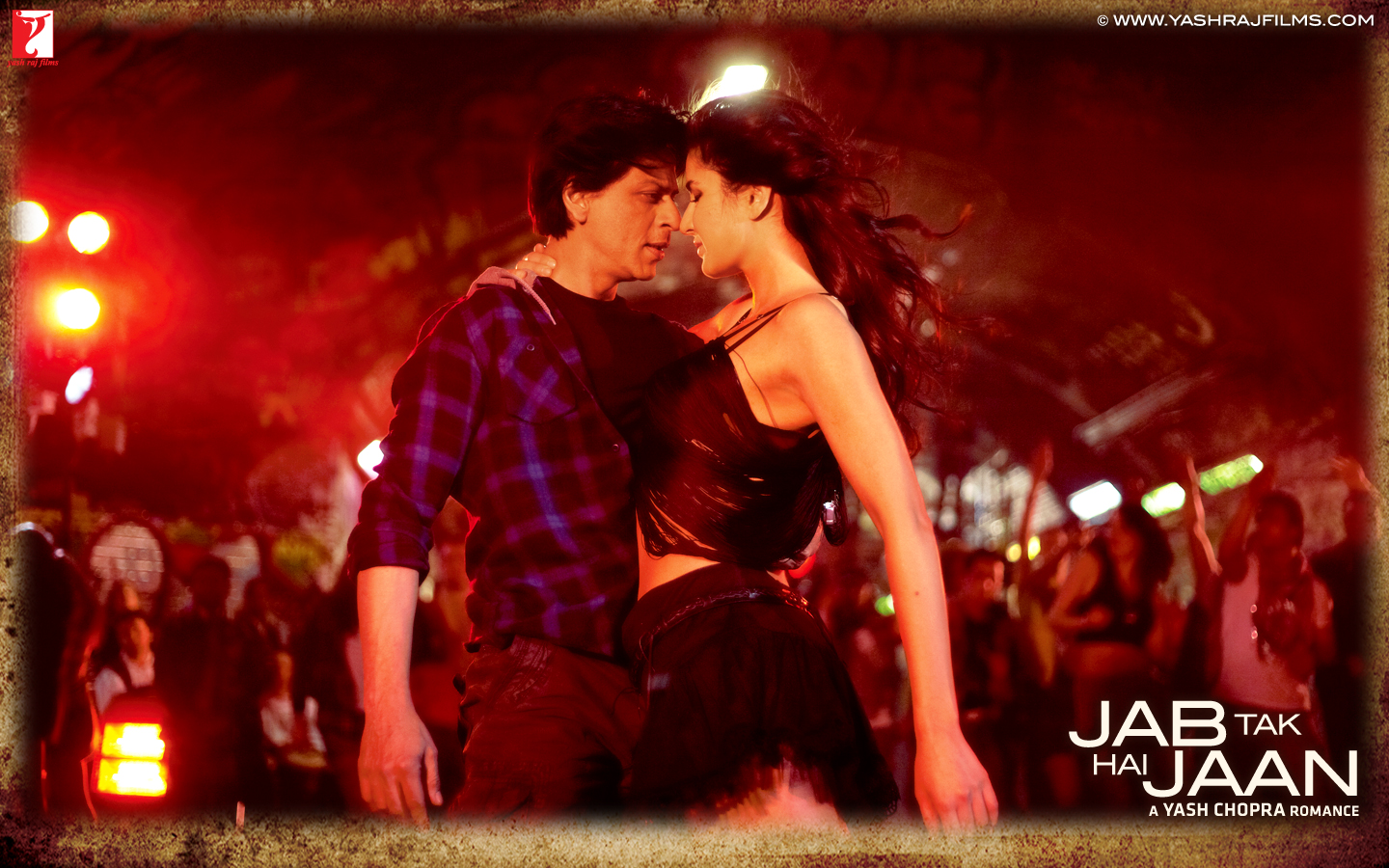
In JTHJ, the director has done worse. He has fiddled out a story that has no conflict! Only his inconsequential triangles stay. The first half is a breeze as Katrina transforms from a dainty of the castles into a galli ki goondi. As they set the screen on fire together, Shah Rukh is the agent of change holding a mirror to Katrina’s inner self and tutoring her on the virtues of modernism over her deal-making devotion.  For a while, she seems truly transformed. Yet when the push comes to the shove she regresses into the morals of faith and kills the only possible seed of conflict. And the director doesn’t seem to mind! He seems more interested in setting up events that can somehow bring the two together! The promise of a grand rebellion over nothing is soon exposed and the film goes into an eternal yawn after the intermission. So of what consequence was her transformation to the narrative? As usual, the thespian’s characters are quite simply out of depth with the times. All he takes are Ray Ban’s, Guccis and a few sundry accidents to get the film to cross the tape.
From Kabhi Kabhi to Trishul to JTHJ, Yash Chopra seem to only drawn the scars of lakshman rekhas rather than become the saboteur of convention he is made out to be. Yes, his cinema was progressive enough to have crossed the borderlines of lies we live out. But his celluloid shrinks at the very sight of standing by the truths that subvert the status quo.  And that diminishes his claims over being an artist.
(Rakesh Katarey heads NITTE Institute of Communication, Mangalore)

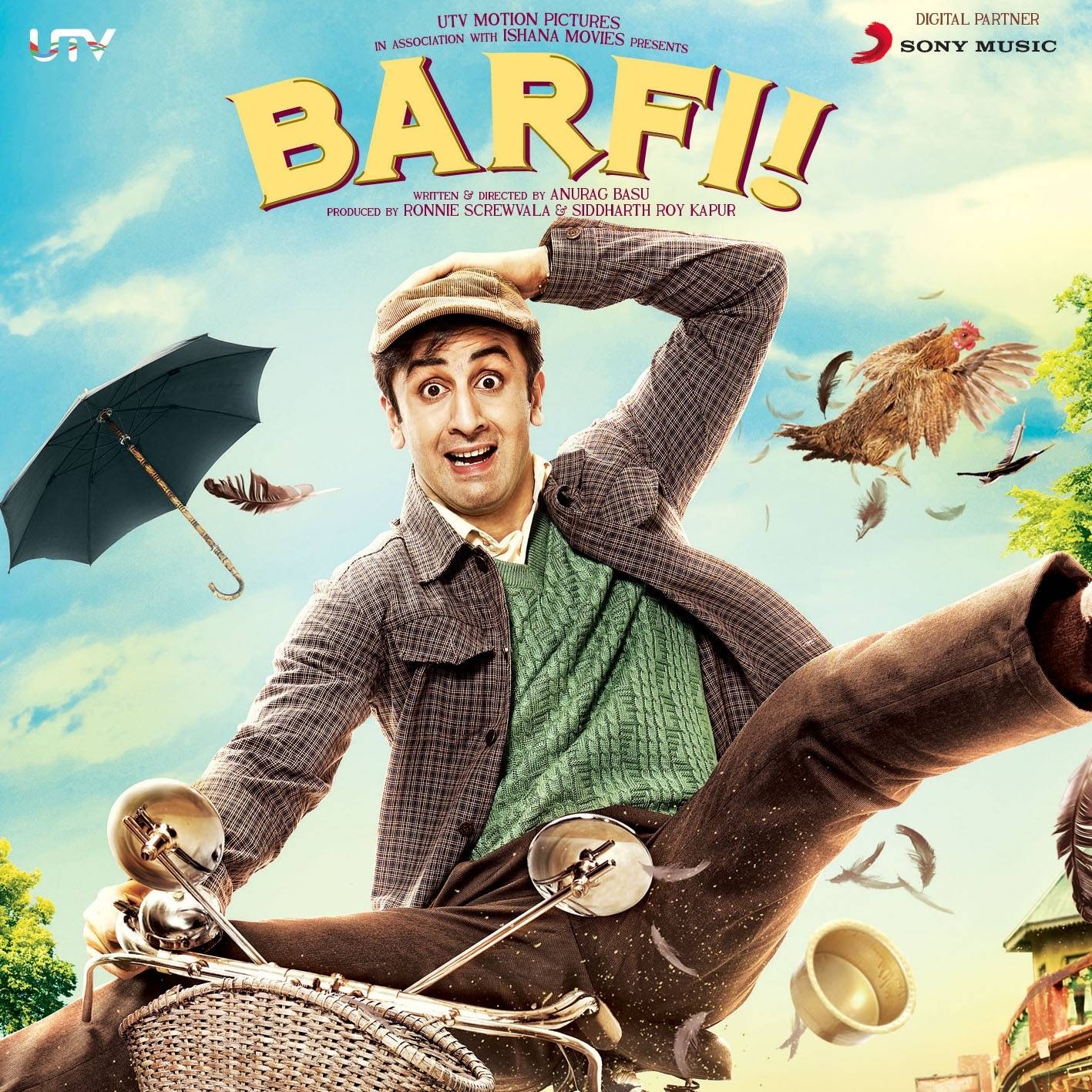
Barfi! Let there be light

September 15, 2012 · by sudhishkamath

Genre: Dramedy
Director: Anurag Basu
Cast: Ranbir Kapoor, Priyanka Chopra, Ileana D’Cruz, Saurabh Shukla
Storyline: A carefree, spirited young man with a hearing and speech disability has to kidnap his childhood friend, an autistic girl, for an emergency.
Bottomline: The sunny, summery anti-thesis to the wintry, bleak ‘Black’

It’s tough not to draw parallels between Black and Barfi! with so many striking resemblances, overlapping of themes and equally emotional popular response.

Yet, they are at the opposite ends of the spectrum, despite their distinctively different European treatment.

If Bhansali and Ravi K Chandran chose to paint their canvas in shades of gothic black, Basu and Ravivarman bathe their film with beatific light.

If Black tried to make you cry, this one tries to make you laugh.

If Black chose to focus on characters trying to overcome their disability, Barfi! chooses to focus on the characters ability to see the world differently.

If Black was about a character battling old-age and schizophrenia and another coming of age, Barfi! is about the return to innocence as the lead characters celebrate their ‘disabilities’.

While Barfi (Ranbir) has the ability to put a smile on your face though he can’t talk or hear himself, autistic Jhilmil (Priyanka Chopra) sees the world through the wide-eyed innocence of a child.

They are not trying to compete in this world or trying hard to prove a point like characters in Black. They are happy living a life together, far away from the madness of materialism of today. Remember the seventies when songs about life used to be about how life was a song? Barfi! totally milks music for old-world charm.

It’s the Ranbir Kapoor show all the way as Barfi makes you smile and applaud with his antics without needing a single line of dialogue. It’s a fitting tribute to Charlie Chaplin and his own grandfather Raj Kapoor, the original Indian tramp and he proves once again that he’s the best actor of his generation.

Priyanka too is just wonderfully restrained for most parts. However, the best portions of the film do not belong to their story. Their scenes together look blatantly cutesy and manufactured.

Almost like Basu wants to say: “Look how much spirit these two happily disabled characters have. Please smile for them, they don’t need your tears.”

Though a far cry away from Bhansali’s “Look how much spirit these two characters have to fight their disability. Shed a tear for their struggle and triumph,” Barfi! gets problematic by reminding us of their disability all the time – even if it’s for laughs.

Why do filmmakers need to treat disability like a show-pony irrespective of whether they want to make you laugh or cry? Barfi is the other side of Black. Equally manipulative. Which is why Iqbal despite its budgetary constraints seems like a more honest film – it makes you completely forget that Iqbal cannot talk or hear.

Even if you are to overlook the plot contrivances here (don’t you just hate it when characters are bumped off conveniently to get the story moving forward?) and the desperate efforts to manufacture conflict of an epic scale, there’s that leisurely pace that might discourage repeat viewings.

The first hour of the film is picture perfect, especially, the scenes with Ranbir charming Ileana and their relationship. This is Anurag Basu’s finest hour with the visual medium. He shines with his craft, using non-verbal communication, flawless physical comedy, superbly employed metaphors and leitmotifs to a fetchingly French background score by Pritam that is really the soul of the film.

And then, one of the biggest cliches of Indian cinema (the hero needs money for the kidney operation of a loved one) kicks in a convoluted plot of kidnapping and needless suspense to make up for conflict.

Still, there’s a lot to love in this “Adventures of the Happily Disabled” once you buy into the platonic Barfi-Jhilmil relationship. It just doesn’t seem right when it turns into a love triangle because clearly one of them is still a kid at heart.

Which brings us to the film’s biggest strength at the box office – it’s family friendly. Pretty much every member of your family is probably going to love this film and many will swear it’s the best film of the year.

Strange that many looked down upon Basu’s last film ‘Kites’ though it was just an adult version of the same story: Love knows no language and it happens when two people are on the run. If Barfi channels Chaplin and French cinema, Kites paid homage to Tarantino and Rodriguez.

Barfi is a safe bet. Populist, instantly likeable, charming and unfortunately, a tad too light.

Interview: Adhi – Namma Ooru Hip Hopper

August 29, 2012 · by sudhishkamath

For a 9 a.m. audio launch at Sathyam Cinemas, Hip Hop Tamizhan draws an almost full house.

The crowd sings along, the girls too… never mind that the song contains lyrics that some may find sexist (See Box below)

After the concert, he gets endless requests to pose with fans for pictures. He entertains some, tells the rest he’ll be back soon and sits down for an interview.

Adhi is all of 23 years old.

“I’ve been rapping for the last thirteen years,” he says. “Ever since I heard Michael Jackson’s Jam. That’s how I came to know about rap and I have been rapping gibberish since. I came across hip-hop artistes like KRS One and Jay Z who changed my views on hip hop and I realised that hip hop is not about guns, drugs and violence.”

He made it a point to himself updated through the internet. In 2006, he met Yogi B, Tamil hip hop artiste from Malaysia. “That was when we decided to start our band, Hip Hop Tamizha. Yogi B became our advisor. I had been doing Tamil hip hop since 2002.”

The band stayed underground, happy with their small, niche, cult following.

“Until we were called by the Election Commission to come up with an election anthem… I don’t know how they found us. That song worked magic because we were asked to perform that song for Anna Hazare when he came to the Pachaiyappa’s College grounds. And within 2-3 months, Club Le Mubbule went viral.”

ClubLe MubbuLe Official Music Video

The song has got over four and a half lakh views on Youtube since. “The song was video was put up a day before Kolaveri. It was just a radio performance, an amateur video but it trended for nearly two weeks on Youtube.”

Remy Martin Hip Hop that signs up with hip hop artistes around the world tied up with the band for Hip Hop Tamizhan, launched by Purplenote. And band is all set to launch its own clothing line. Adhi attributes the band’s growth to ‘Club Le Mubbule’.

Adhi just did his first song with Vijay Antony for Naan. “But I am not keen on films. I want to create a parallel space for non-film music.”

That might sound ambitious but not if you consider how far he’s come at such a young age without compromising on his education.

“This is 2012. You have to do everything. My Dad’s a professor. So I know education is very important. If I have my education, if I don’t make it as a rapper, I can always go get a job and come back to rapping later,” says Adhi.

He’s even found a way to make money from his career.

“Yes, I am making money and putting it back into my music. I don’t get money from my Dad. I was born with a silver spoon but I spit it out,” says the boy from Coimbatore, who used to come to Chennai every weekend when he was studying engineering in the Bannari Amman Institute of Technology.

“But after I moved to Chennai to live on my own, I didn’t even have money to go back and visit them. Because I was taking a one-year break from college (between his engineering and MBA), I told my Dad I would do it myself. The first year was difficult,” he admits.

But he kept himself busy building the band.

“My band is always my family. It’s always been the five of us: Me, Triple B, Jeeva, Neal, Siraj. We have been together from the start. And we collaborate with many artistes from around the world. Adhi is just part of Hip Hop Tamizha. The band is bigger than just me.”

The response at concerts was encouraging. Despite the morning launch, students had bunked college to cheer the band. “We did a concert in Coimbatore months ago. Some 3000 people turned up. We did a concert at MIT, 1200 tickets were sold. That’s when we realised we were becoming big and no longer underground.”

Today, as his first album Hip Hop Tamizhan hits the stands, he’s standing tall. On his own feet.

High on a song

“Clubbula Mabbula thiriyara pombala enna di nadakudhu senthamizh naatula? / ladies elaarukum vanakamunga!! Ladies maanam parakudhungA!”

(“Drunk women in nightclubs, what is going on in the land of Senthamizh? / Hello, all you ladies… Ladies, your reputation’s gone”)

“It was first done six years ago when I was 17 or 18, I was in the first year of college. Nobody knew me then. But when we started taking it seriously and doing this as a project about a year ago, we approached radio stations, they helped us and the song went viral.

Today, I realise that I am nobody to tell you can’t drink or you can’t do that. But when I wrote it, I was a kid. I had a different mindset.

 It was just a fun pop song. Yes, there’s a bit of my personal ideology there but it’s limited to: Don’t be wannabe. Be proud of who you are. Who cares about the boys. Save the girls. At 17, what do you expect? I am not a bad guy. I love girls. Who does not love girls? But I am not only about that song. I have done songs about alcoholism, education, elections, etc.

There are some girls who have told me they like the song and there are some guys who have told me they don’t agree with the song. To those who like it, Thank you and to those who didn’t, I am sorry if I hurt your feelings.”

P.S: Here’s the reply song to ClubLe Mubbule: The Reply Song

Page 6 of 90 « Previous 1 … 4 5 6 7 8 … 90 Next »
  • Create a free website or blog at WordPress.com.
Privacy & Cookies: This site uses cookies. By continuing to use this website, you agree to their use.
To find out more, including how to control cookies, see here: Cookie Policy
  • Subscribe Subscribed
    • MADRAS INK.
    • Join 480 other subscribers
    • Already have a WordPress.com account? Log in now.
    • MADRAS INK.
    • Subscribe Subscribed
    • Sign up
    • Log in
    • Report this content
    • View site in Reader
    • Manage subscriptions
    • Collapse this bar
 

Loading Comments...